Editor’s Note: This is the second in a three-part series. See part 1 here.
I delayed writing Part 2 of this series a while, as when pouring over recent quarterly financials for residential and commercial smart products maker and distributor Resideo, it was apparent that a lot was changing for its ADI Global Distribution subsidiary.
It actually started back in April 2024 when Resideo announced it would buy fellow electrical products supplier Snap One in a $1.4 billion deal, which closed two months later. That, plus information and messaging in subsequent Resideo presentations gave us the hunch something bigger was afoot, prompting us to wait and see what might be coming.
ADI Global Sales & Margin Jump on Acquisition & Organic Strength (Aug. 5)
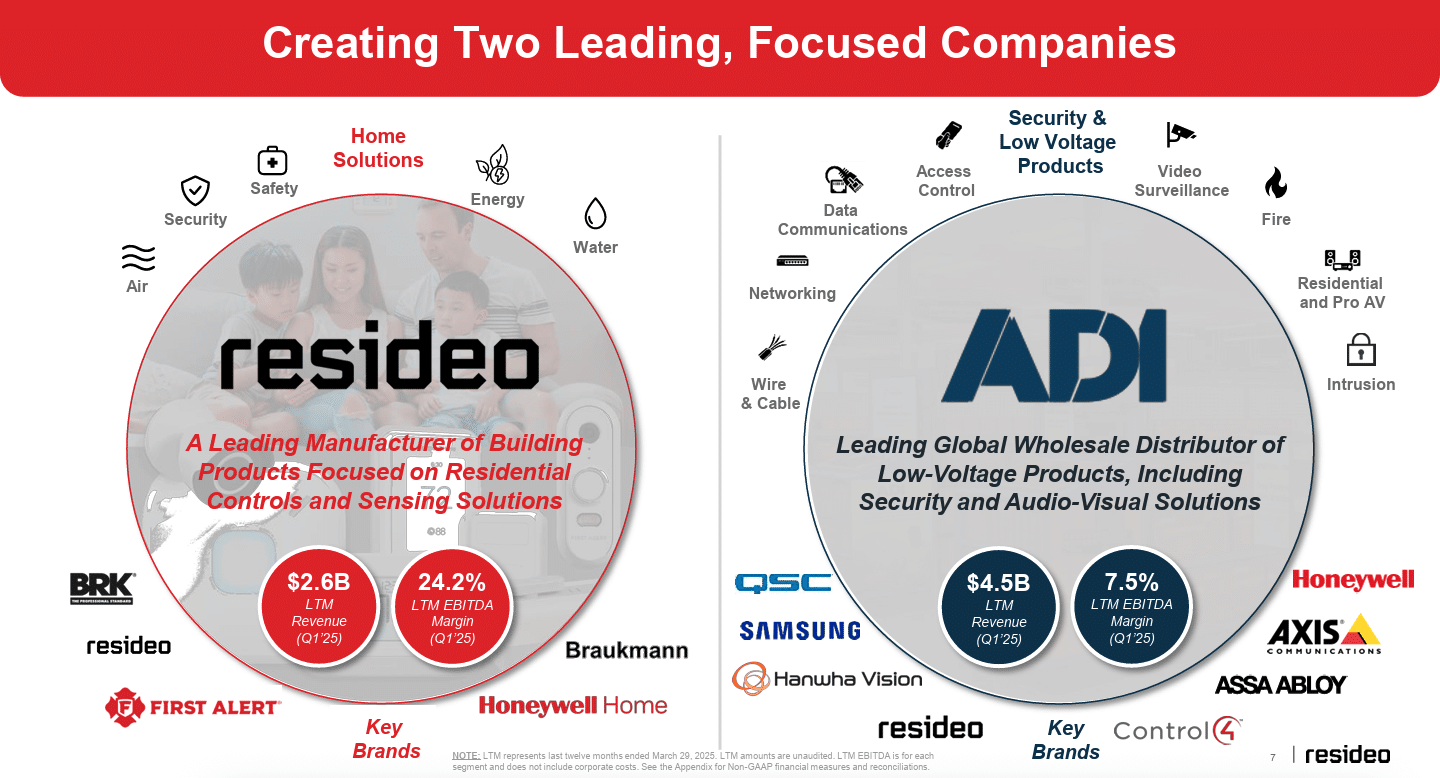
Our intuition was proven right at the end of July, when Resideo announced its plan to spin off ADI in the second half of 2026, resulting in two independent public companies.
I won’t cover all the details of that divestment, as MDM has detailed all the essential info and context surrounding the transaction. Instead, this article will discuss how ADI’s digital initiatives well-positioned that business unit for this next chapter as an independent organization.
Ready for Independent Life
From my outside perspective, when other distributors have gone through a spin-off process, it usually delivers strong returns over the first 18 to 24 months after they begin operating independently. Note, this is not a financial endorsement, as there are plenty of trusted financial institutions to provide that. This is merely my observation and my experience, having been “spun off” once or twice in my distribution career.
Above all else, this gives the ADI team focus and energy on one goal.
Resideo is one heck of a company, but what does the team working with The Home Depot on BRK Electronics, First Alert and Honeywell-branded residential product sales have in common with the team selling security and low voltage products to contractors? The realistic answer is not much. As a consultant (or novelist and poet Gertrude Stein, to be precise) might say, “There is not a lot of there, there,” which means those are very distinct and separate business models without much commonality. An analyst might struggle to find synergies.
I am excited as an observer to watch what the distribution arm of Resideo does with the unit that will become a new publicly-traded entity as ADI Global Distribution.
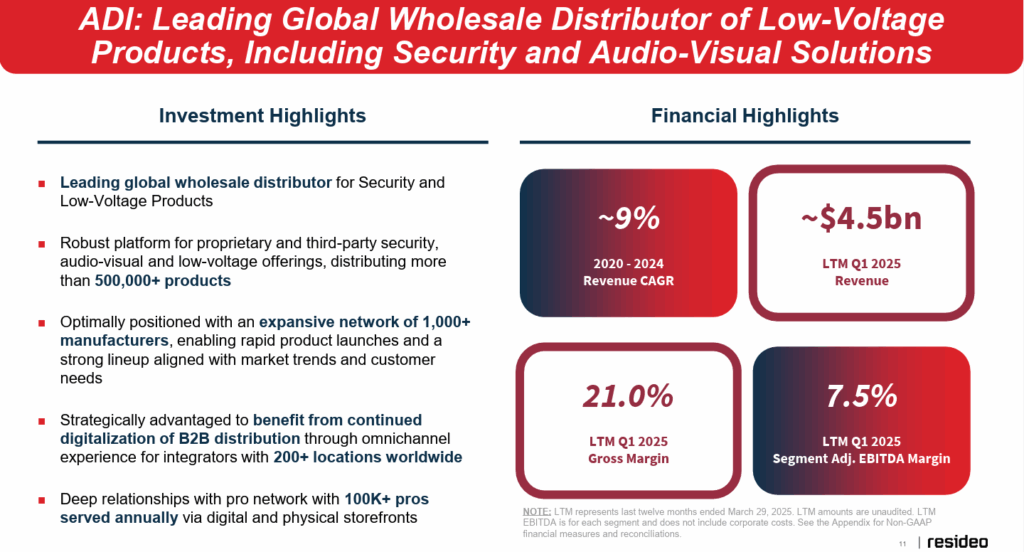 Credit: Resideo July 30 investor presentation
During the July 30 Resideo presentation announcing ADI’s spinoff, one investment highlight jumped out to me (see presentation slide above) and was exactly what I had originally set out to write about in this second part of our MDM Premium series: “Strategically advantaged to benefit from continued digitalization of B2B distribution through omnichannel experience for integrators with 200+ locations worldwide.”
That statement ties directly into the public statements that Stu Tisdale, ADI’s Senior Vice President and Chief Experience Officer shared about the organization’s “continued digitization” efforts. He shared great insight on this in a March 2025 interview with DigitalCommerce360.
The Challenges of “Continued Digitization”

“Serving contractors both online and offline presents several challenges,” Tisdale shared in that interview. “In B2B, especially with distributors, your website often functions as a window into your ERP system.”
An ERP system is typically the heartbeat of any distribution business, but they were built for manual order entry. Much of the industry still operates ERP systems that are well over a decade old, which aren’t modern enough for the new end customer-focused world of communicating and ordering.
Modern commerce demands have lit a fire under distributors to upgrade or overhaul their ERP system — or change providers entirely — and it’s often a long, painful, expensive and resource-intensive project. My condolences to any reader in the middle of such an endeavor. Most ERP systems aren’t flexible unless they undergo customization — also not easy or cheap. This lack of flexibility limits how quickly you can resolve poor customer experiences that stem from ERP-related issues. If the root of the problem lies within an inflexible ERP, improving customer experience can be slow and difficult.
“Another major challenge is maintaining consistent pricing across all channels,” Tisdale stressed. “B2B companies that serve contractors typically allow sales teams to adjust contract pricing-based on factors like purchase volume, product mix and project size.”
In short, to meet today’s B2B buyer expectations of consistency, your website must have a pricing solution that shows the same price in your ERP and website. That sounds elementary, of course, but ADI sells to more than 100,000 customers (see bullet No. 5 in the aforementioned slide) and sells millions of distinct SKUs. That represents millions upon millions of pricing decisions that have to have near-perfect consistency and accuracy. It is one of the toughest things to get right in B2B distribution.
This summer, ADI directly addressed laying its long-aged but always reliable AS400 Adonis ERP to rest. That ancient system was the heart of ADI’s commerce in the Americas for 40 years and is now running on a much more modern commerce mainframe ERP.
ADI’s leaders have consistently stated during recent earnings calls that the company is addressing challenges in pricing and ERP flexibility.
What is ADI Doing to Serve its Customers?
I liked what ADI shared about its three essential eCommerce capabilities.
The shopping experience must be fast and highly optimized. The construction cycle for every project is organized chaos in the best of times. Has the electrical contractor hooked up the power? Has the HVACR contractor finished their job? Has the material arrived on time? And so on.
It is the ultimate “get me what I need NOW, and I often find out what I actually need when I get there” business. Speed is everything and one of the biggest difference makers between taking or losing market share.
A powerful on-site search function is critical. As Tisdale shared, “Contractors expect to find exactly what they need quickly, even if their search terms are complex or partially incomplete.”
I’ll share an example: I went to ADI’s website and started typing in the search window for CAT 6 Riser and Plenum cable (trust me, ADI customers buy this often by the pallet load). I typed in all sorts of variables in the search bar… Cat ^, CT6, Cat Riser, Cat Plenum, CAT6 r, etc. I tried for fun to see how fast the search was and how it might autocorrect me if I was doing it on mobile. The speed and autocorrect was impressive. I would give that test search my personal two thumbs up.
Accurate product availability and delivery times are more important than just fast shipping.
Tell a contractor exactly how many units are available at each location and then tell them when they will be receiving it accurately — That’s underlined on page one of my personal playbook on how to take share from the competition.
Seeing what is actually in stock and then knowing when it will show up is crucial and it is apparent from Tisdale’s comments that ADI gets it.
One quote from him that that I wanted to share verbatim was: “Success in B2B eCommerce is often measured by shopping cart revenue, but this metric tends to understate the actual influence of the website. Many contractors use the website to gather information about products, inventory levels and pricing before completing the purchase through other channels.”
Omnichannel can often be an overused term in distribution. Having all the tools to allow your customers to order the way they want to at that moment is everything. No matter what method they use to place the order — via your website, your app, via text or good-old stopping by a local branch — you should follow with the same methodical process:
Find a way to take that order seamlessly, accurately and with speed. Then confirm you got the order with details they can review, along with shipping and delivery timeframes.
That’s the process that modern B2B distribution commerce demands, regardless of whether:
- The contractor is at the jobsite. They voice text your inside team to find him/her items X, Y and Z.
- The contractor calls your team directly on the phone or through email
- The contractor finds that the item is on stock and orders it 100% self-service online
Almost nothing in distribution is a one-size-fits-all response to any situation. There’s always nuance, but convenience, speed, accuracy and consistency are what every customer is looking for.
If a customer wants to order by sending you a picture of their product list written on a napkin, find a way to take that order seamlessly.
There are so many foundational elements to make the omnichannel experience the best you can for customers. This includes some foundational elements such as:
- World-class data management — If you send them the wrong product because of poor data, you then must credit, fix and rebill to process. If that happens repeatedly, eventually that customer is no longer yours.
- Technology integrations — ERP, digital platform, search, pricing and more are crucial. As Tisdale stressed, it has to be seamless. Your customers want results. Don’t make your problems their problems.
- Integrating digital self-service functions with your full-service human team (or as HR would say, change management). Your people have that next-level problem solving and product and engineering expertise your customers count on. Make sure you get them on board and in the loop. Tech is only part of the equation. People complete it.
There are so many additional tactical and workflow elements to build and manage for all the above foundational elements that there is no way to list all of them in one article.
So, What can you learn from ADI?
This is pure conjecture on my part, but my guess is that ADI has ongoing customer research (surveys, feedback, etc.) or has leaders and sales teams so close to the end customer who understand the buying journey. Other leading distributors have shared how they emphasize this, and I would be surprised if it isn’t essential to ADI’s feedback loop.
It sounds simple, but it is complex. The ADI business model is unique to it, like I believe every distribution business is different. If you understand your customer, your people, your culture and your capabilities, then you can forge a path to close the gaps.
The equation is simple, but more difficult in practice: Make it easy to buy from you + deliver when expected = happy customers who stick around + market share growth.
The execution requires a digital plan that is in sync with your associates who serve the customers every day. The execution is always difficult, but that is what makes this channel fun.
Up next
In Part 3 of our series, we’ll examine more details on what ADI has shared about its technology integration efforts and current go-to-market strategies. We’ll identify key takeaways that might work for your unique distribution business.