Editor’s Note: This is the second article in a three-part Premium series that analyzes MSC Industrial Supply and its company evolution. Find Part 1 here and stay tuned for Part 3, as well as a comprehensive MDM Case Study report that packages this series with additional insights.
In Part 1 of the series, we focused on MSC Industrial Supply’s recent pricing pivots and changes to their list pricing online. This is a significant change, as the distributor is updating its pricing on 2.4 million SKUs in its fiscal 2025 (September 2024-August 2025) and MSC continues to evolve its overall business model.
As we covered in Part 1, MSC and its printed “Big Book” catalog made the company one of the top B2B distribution catalogers in North America.
In the Store: MDM’s U.S. MRO Market Trends Report
MSC’s journey from a catalog, spot-buy distributor to what the company calls a “mission critical partner” has been fascinating to observe in recent years.
As I was writing this analysis, I started with one simple premise: Why is MSC evolving and where is it going with it?
At the Stephens Annual Investment Conference on Nov. 20, 2024, MSC officials shared this:
“It’s one thing when your customers are ordering out of a one-foot-high Big Book — they are likely to keep picking your product over and over again. Now, when you are going online, you can see our products and you can price it versus competitive products. It really changes the whole dynamic.”
That quote, in my opinion, answers the why part of MSC’s recent evolution.
One of the key differences between MSC and other comparable distributors is that MSC is not historically a branch-based distributor with thousands of local branches to serve end customers like Grainger and Fastenal. That distinction is important as we move through this MSC series. MSC has just over 40 locations nationwide, including five Central Distributions Centers.
So, what are the core foundational elements for MSC as it continues to move from a spot buy distributor to a mission critical distributor for its end customers?
MSC shared some key statistics that are important to understand as it continues to evolve its model:
- About 70% of its business is in light and heavy manufacturing
- 45% of MSC’s business is categorized as metalworking products and solutions
- It acknowledged that the company used to primarily rely on a “spot buy” business model, but now most of its business is from planned spend
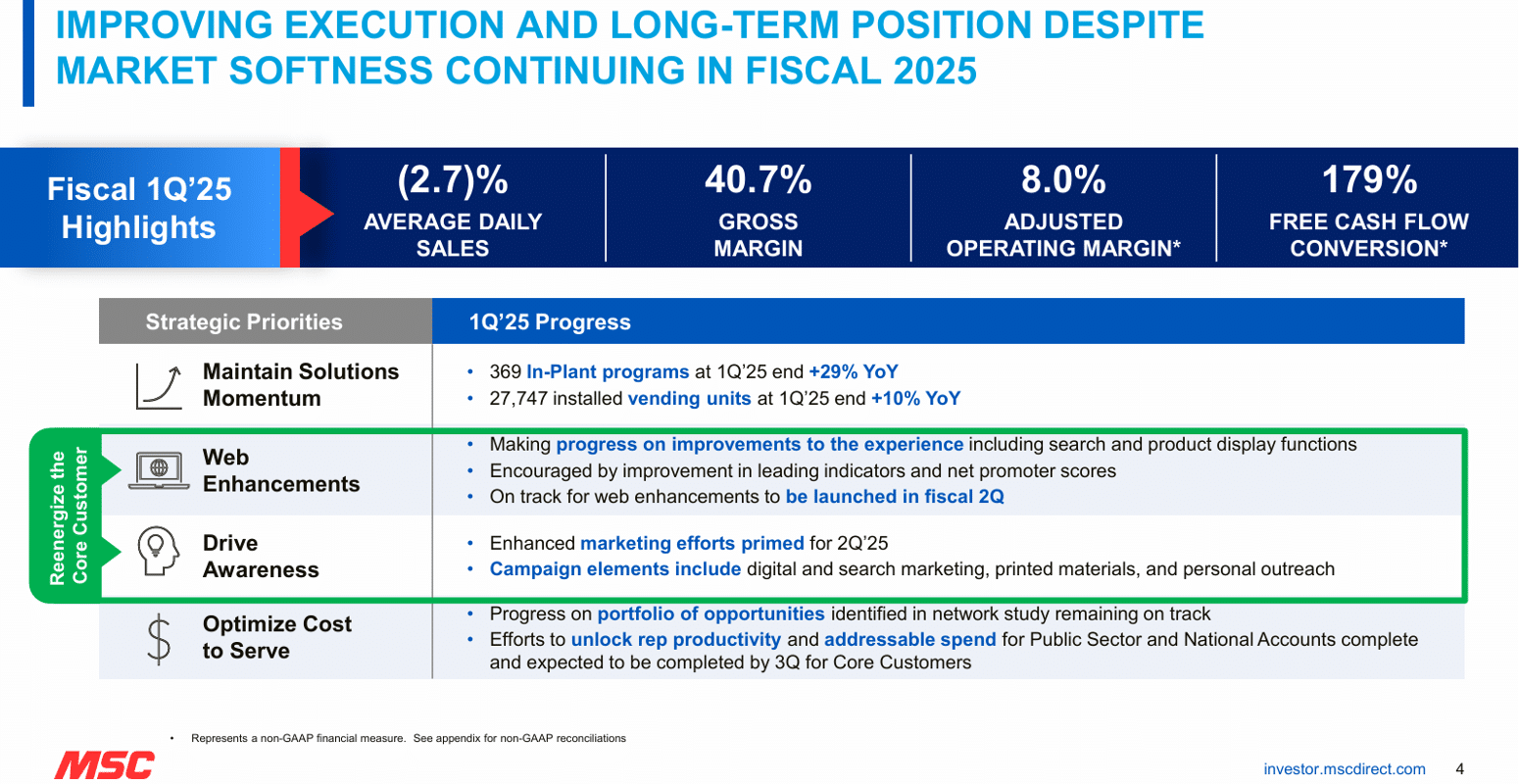
- Through the end of MSC’s fiscal 1Q25 — ended Nov. 30, 2024 — the company’s eCommerce business represented 63.7% of total business (Q1 results shared Jan. 8, 2025).
MSC’s Competitive Advantage
MSC’s metalworking technical expertise is a barrier to exit for its customers and a barrier to entry for the competition. Let me explain.
MSC has a strong metalworking heritage and foundation that has accelerated this strategic evolution. The metalworking expertise is a foundation for expansion. When you visit mscdirect.com and examine the resources the company has devoted to metalworking from training, testing and education, the dedication to metalworking is obvious.
As MSC officials shared at the Stephens conference, “leading with metalworking puts us on the production line with the customer.”
That position of being on the factory floor and at the spindle with the end customer is a “mission critical” partnership. The key foundational element for MSC is the strong expertise its associates provide to end customers in metalworking and manufacturing.
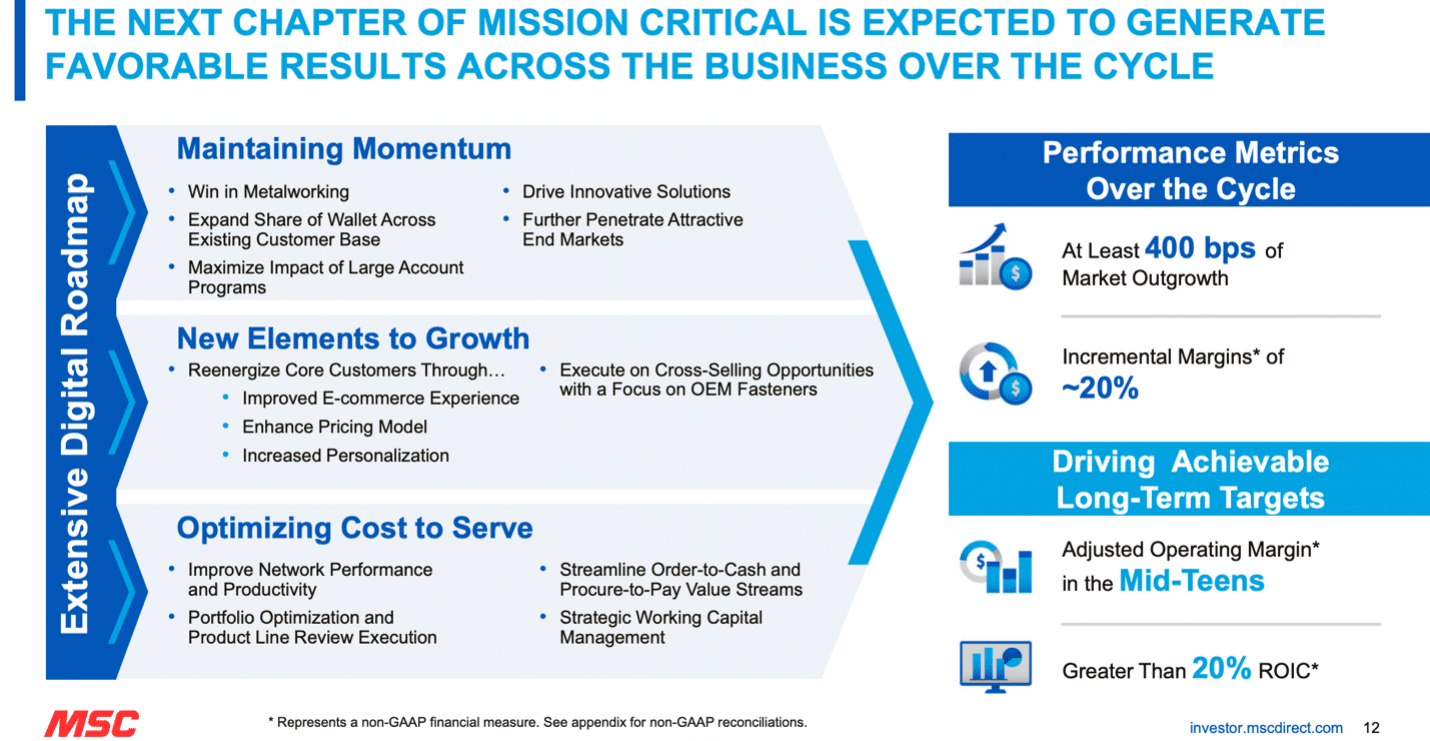
MSC Industrial has been providing top human technical support to the business done at the spindle, and it continues to invest in this core foundational element. In my opinion, that allows MSC to move at an accelerated pace into the next chapter of this yearslong “Mission Critical” initiative that was first unveiled in the fall of 2020.
So, how do you expand that metalworking foundation? You are ingrained with your core customers working with them at the spindle and on the production line — creating the industry’s highly-desired “customer moat” and stickiness with your organization and as a barrier for customers to leave. That same technical strength position makes it harder for competitors as a barrier to entry. So, how is MSC expanding that metalworking position to increase its share of wallet and overall business?
MDM’s 4Q24 MarketPulse Report (store link)
MSC Associates In-Plant Growth Strategy
As of late January 2025, MSC has 329 “In-Plant” programs. The rough definition of an In-Plant is an MSC associate who goes to a customer’s production facility and has a badge to enter it. The associate may have their own desk area there. It’s the closest thing to being on that customer’s payroll. MSC’s recent news releases, presentations and annual reports have emphasized this program as an ongoing investment area and strategic direction.
On-Site Vending
Likewise, MSC continues to invest in on-site vending services at customer facilities. The company began 2025 with more than 27,000 vending units installed on-site in customer locations. These programs are very effective for distributors to help them grow share at the customer level — typically for high consumables like safety and MRO supplies, but are very customizable — and having tens of thousands of them installed occupies a large square footprint at the customer.
Grow Larger Accounts
MSC is investing in growing with national and larger accounts. It is leveraging the at-the-spindle relationship to expand the number of product categories offered to the customer that currently spans safety, JanSan, MRO, Class 3 Maintenance supplies and OEM fasteners as product categories MSC has publicly highlighted.
MSC has recently shared that it wants to: maximize the impact of large account programs for growth; and grow large contract “stand up” contracts.
This Transition is Working
The move from MSC’s “spot buy” heritage to “mission critical” is delivering results.
MSC recently shared some interesting sound bites, one being at the Raymond James Institutional Investment Conference in March 2024, when Executive Vice President and Chief Financial Officer Kristen Actis-Grande said that MSC’s business “used to be primarily spot-buy, but now 60% of our business is planned spend.”
Actis-Grande further emphasized this focus on large accounts driving business with this: “Our In-Plant Program has grown from basically 5% to 14% of our revenue in three years.”
It is apparent that MSC is smartly moving towards its Mission Critical Objective and understands why the company needs to evolve.
More from Actis-Grande: “MSC historically was a spot-buy catalog provider: Place an order late in the day and get it delivered the next day. It was a competitive advantage but that is not that unique anymore.”
I agree it is not that unique anymore, but the modern foundation that MSC’s Mission Critical plan is built on is.
This short company video posted Jan. 22 also visualizes MSC’s mission critical positioning well:
The Big Takeaway
So, what can you take away as a channel leader from MSC’s strategic objective to continue its journey to becoming a mission critical partner?
As a distributor, what is the key foundational program your business is built upon? What are the crucial technical expertise and support elements you provide to customers today that you can double down and create even stronger barriers to exit and entry?
What value-adds are you providing? Vending, inventory management, engineering support, project management services, digital solutions, training, technical support… this list continues to grow in the industry.
As a manufacturer, are you giving more support to a distributor that is providing mission-critical support versus one that is not? In the long run, mission critical distributors will outperform the distributors that are not adding long-term value to customers.
As a manufacturer rep, understanding how you can support mission critical distribution to create barriers to entry and exit is a key growth driver for your agency.
When you add value to the end customer and become critical to their business, that partnership tends to last for all parties in the channel.
Up Next
In part 3 of our series, we will dive into MSC’s very effective digital programs. Over 60% of the company’s sales are classified as eCommerce-based, making MSC one of the leading web-driven distributors in North America. It makes for plenty to explore on that front.
MDM’s Case Study Series
-
- Watsco (in Premium Dashboard here, in MDM Store here)
- Ferguson (in Premium Dashboard here, in MDM Store here)
- Wesco International (in Premium Dashboard here, in MDM Store here)
- Fastenal (in Premium Dashboard here, in MDM Store here)