
The Institute for Supply Management released its monthly manufacturing Purchasing Managers Index (PMI) on Sept. 2, reflecting August U.S. industrial activity, which showed an acceleration after a July slowdown.
The PMI — regarded as a key of U.S. industrial health — improved 0.7 percentage points to a reading of 48.7% following a one-point slide in July. Even so, it marked the sixth straight month that the PMI was in contraction territory (anything below 50.0%) after a brief expansion in January-February preceded by 26 straight months of contraction.
In the Store: MDM’s 2025 Economic Outlook Report (Premium access)
The August figure was slightly below expectations of 49.0% forecasted by economists polled by major news outlets.
ISM PMI – the Last 12 Months
source: tradingeconomics.com
More granularly, the latest report showed that output revealed mixed results in August, with the PMI’s subindex for new orders up 4.3 points to 51.4%, more than offsetting a 3.6-point slide for production to 47.8%. Employment, supplier deliveries, inventories and new export orders each increased month-to-month, while customer inventories, prices, backlog of orders and imports each declined.
MDM’s 2Q25 MarketPulse Report (Premium access)
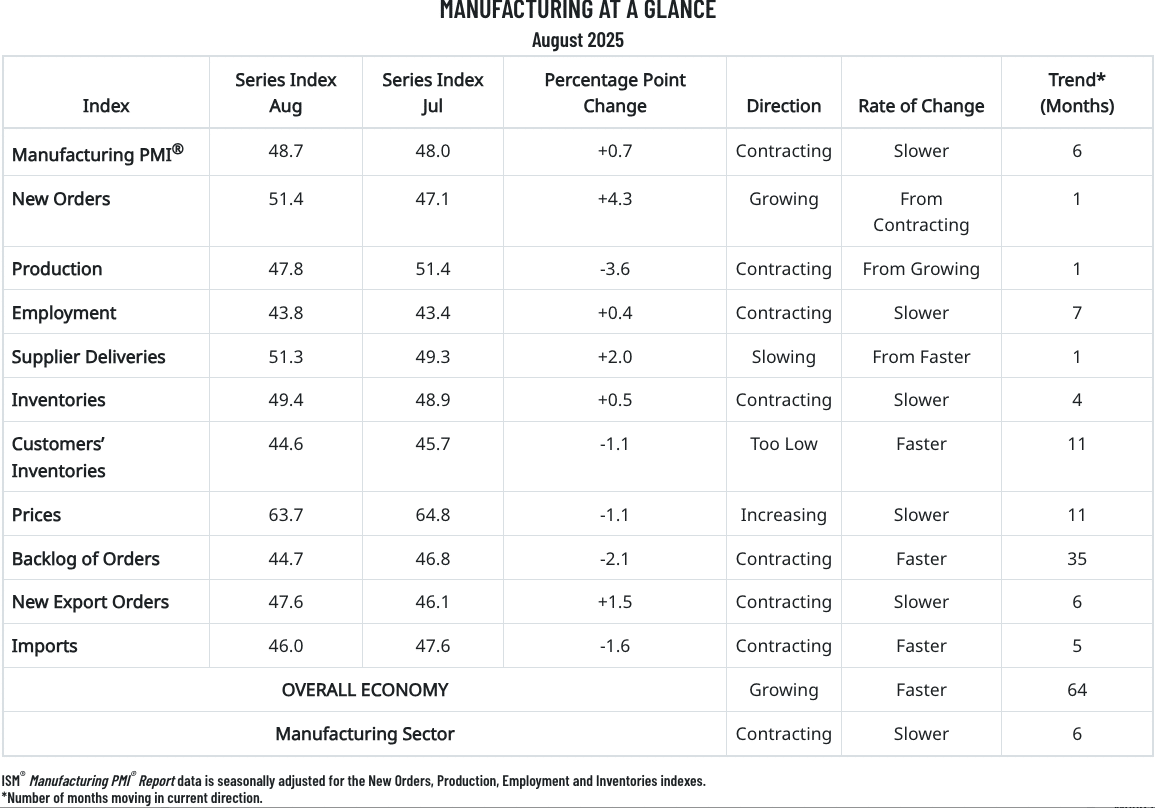
Two of the six largest manufacturing industries (food, beverage & tobacco products; petroleum & coal) expanded in August, compared to none in July.
Of the 17 manufacturing industries the PMI reflects, seven reported growth (same as July), led in the by the order of textile mills; apparel, leather & allied products; nonmetallic minerals; food, beverage & tobacco; petroleum & coal; miscellaneous manufacturing; and primary metals. The 10 industries reporting contraction were led by paper products and wood products with the biggest declines.
In the Store: MDM’s U.S. MRO Market Trends Report
PMI August Respondent Commentary
- “A 50% tariff on imports from Brazil, combined with the U.S. Department of Agriculture’s elimination of the specialty sugar quota, means certified organic cane sugar — and everything made with it — is about to get significantly more expensive.” (Food, Beverage & Tobacco Products)
- “Orders across most product lines have decreased. Financial expectations for the rest of 2025 have been reduced. Too much uncertainty for us and our customers regarding tariffs and the U.S./global economy.” (Chemical Products)
- “Tariffs continue to be unstable, with suppliers adding surcharges ranging between 2.6% to 50%.” (Petroleum & Coal Products)
- “Tariffs continue to wreak havoc on planning/scheduling activities. New product development costs continue to increase as unexpected tariff increases are announced — for example, 50% duties on imports from India, and increases to all countries up from original 10%. Our materials/supplies are now rising in price, so our sell pricing is again being reviewed to ensure we keep a sustainable margin. Plans to bring production back into U.S. are impacted by higher material costs, making it more difficult to justify the return.” (Computer & Electronic Products)
- “The construction industry, especially home building, is still at a lower level. With new construction at a low level, our new sales are impacted. We are mainly now relying on replacement business. Cost of goods sold is higher due to tariff-impacted goods.” (Machinery)
- “Domestic sales remain flat but are down four percent from plan by unit volume [tariff pricing]. Export demand is falling as customers do not accept tariff impacts, which likely will require some production transfers out of the U.S. Supplier deliveries remain consistent with ocean shipping costs dropping significantly. Tariff costs have biggest financial impact but also costs of copper and of steel products.” (Fabricated Metal Products)
- “The trucking industry continues to contract. Our backlog continues to shrink as customers continue to hold off on buying new equipment. This current environment is much worse than the Great Recession of 2008-09. There is absolutely no activity in the transportation equipment industry. This is 100% attributable to current tariff policy and the uncertainty it has created. We are also in stagflation: Prices are up due to material tariffs, but volume is way off.” (Transportation Equipment)
- “Very tentative domestic market, with home building and remodeling not very active at all. Inflation, among other factors, is starting to impact consumer buying power, leading to negative signs for our order files. International markets are upended due to the unpredictability of on-again, off-again tariff activity.” (Wood Products)
- “We’ve implemented our second price increase. ‘Made in the USA’ has become even more difficult due to tariffs on many components. Total price increases so far: 24%; that will only offset tariffs. No influence on margin percentage, which will actually drop. In two rounds of layoffs, we have let go of about 15% of our U.S. workforce. These are high-paying and high-skilled roles: engineers, marketing, design teams, finance, IT and operations. The administration wants manufacturing jobs in the U.S., but we are losing higher-skilled and higher-paying roles. With no stability in trade and economics, capital expenditures spending and hiring are frozen. It’s survival.” (Electrical Equipment, Appliances & Components)
- “There is still uncertainty in the construction market. Large expansions or investment are hampered by the unknown of costing and the economy. The markets we operate in can be strong short term, but there is an underlying feeling that has you questioning for how long.” (Nonmetallic Mineral Products)
Related Posts
-

A new chair will succeed Timothy Fiore in June 2025 to lead ISM’s Manufacturing Business…
-

U.S. industrial production fell in July as mining and utilities declined, while factory output missed…
-

Following two consecutive months in expansion territory, March fell back into contraction and below economists'…