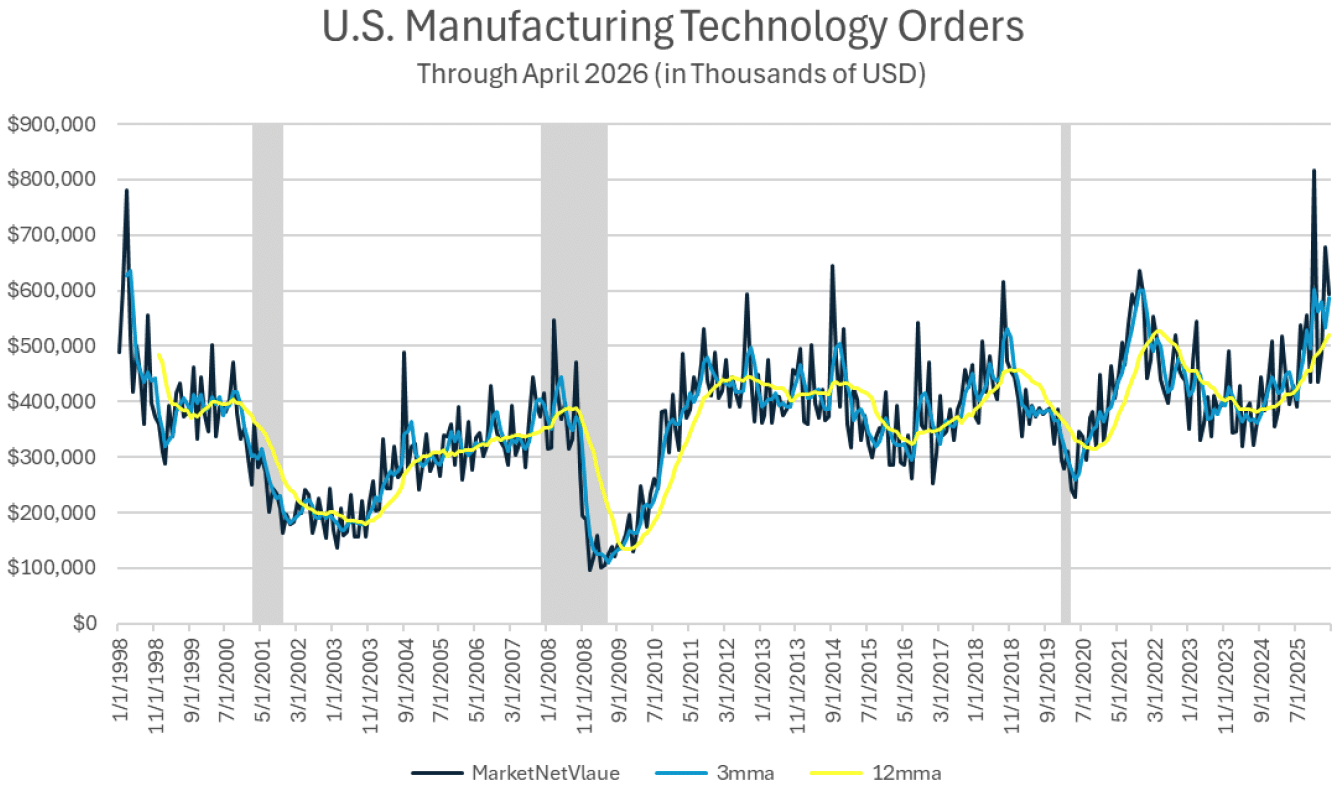
New U.S. orders for metal cutting, forming and fabrication machinery (manufacturing technology) totaled $594 million in April — a 12.5% decline from March’s surprising 40% surge, but a 33.2% increase year-over-year. That’s according to the Association for Manufacturing Technology’s (AMT) latest Manufacturing Technology Orders Report (USMTO).
Through April, year-to-date orders of $2.19 billion were up 28.9% vs. 2025.
“While the value of machinery is showing strong growth, the number of units sold continues to grow at a slower pace. Average order values increased faster than inflation since the end of the 2020 pandemic recession,” the report stated. “The gap between average order value growth and machine tool inflation has widened in the first few months of 2026, indicating that, although some pricing pressures persist across the industry, a significant portion of the order value growth is due to additional automation being added to orders of increasingly sophisticated machinery.”
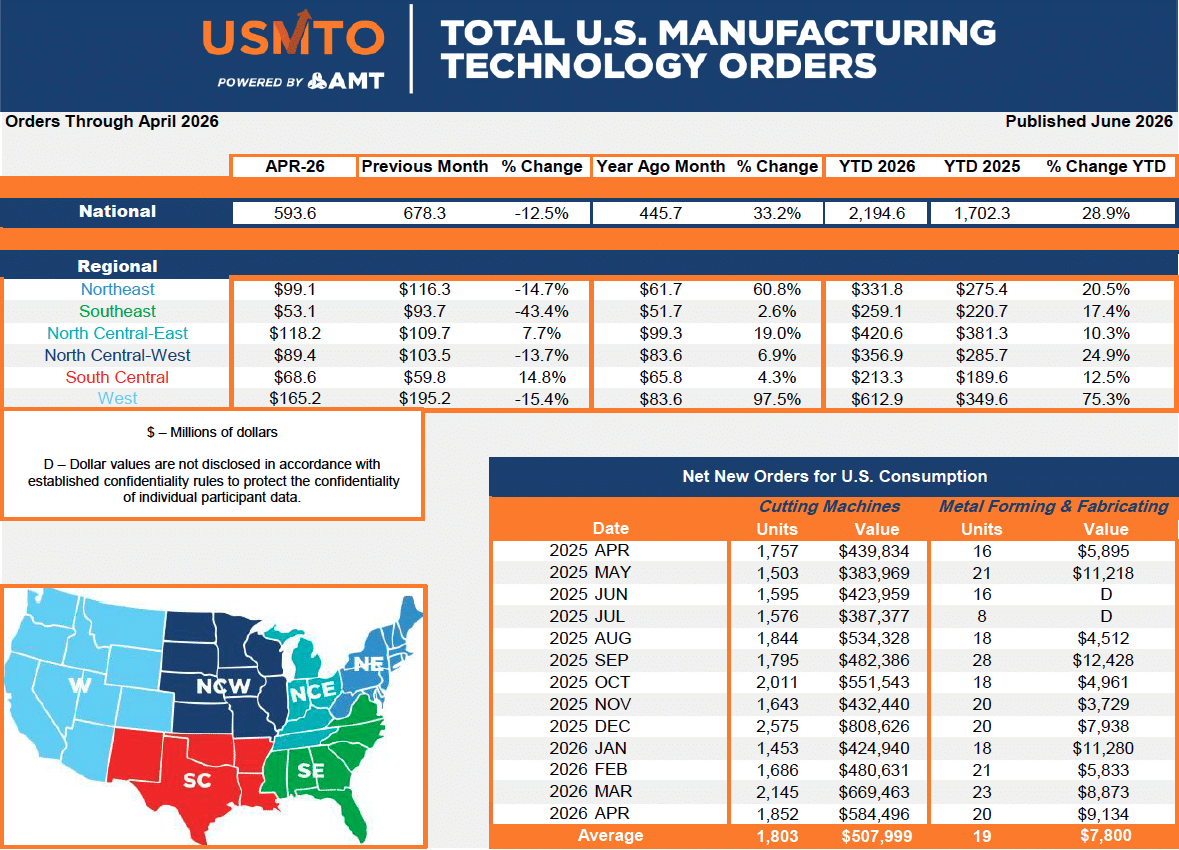
The April USMTO report emphasized the following points:
- Contract machine shops — the largest customer of manufacturing technology — have progressed from slower-than-market growth in recent years to accelerate to match broader market browth in recent months
- Orders from aerospace manufacturers increased modestly in April, but for the second time already in 2026, the value of orders increased more slowly than the number of units, which could indicate that aerospace manufacturers are beginning to buy less sophisticated machinery to quickly boost capacity
“The current upswing in demand for manufacturing technology began in September 2024, when interest rates began to decline, heightened political uncertainty began to subside and IMTS 2024 opened in Chicago,” the report continued. Since then, capacity utilization for machinery manufacturers has steadily trended upward. With order activity already elevated and customer preferences turning toward more sophisticated machinery, the manufacturing technology industry needs to closely monitor capacity constraints to avoid a similar expansion in delivery times to that seen during the order frenzy following the recovery from the COVID-19 recession through IMTS 2022.”