U.S. manufacturing activity accelerated in May to its fastest pace in just over three years, according to the latest Purchasing Managers Index from the Institute for Supply Management, published June 1,
Seen as a reliable barometer for the industrial sector, the PMI registered 54.0% in May, up 1.3 percentage points from March and April.
The PMI had held in the high-40s for two years before surging 470 basis points in January, and it’s improved since.
Of the five core subindexes that comprise the PMI, the ones for new orders, production, employment and inventories all indicated faster growth compared to the previous month, while supplier deliveries were flat. Of the additional five subindexes, the measures for Customers’ Inventories, Backlog of Orders, New Export Orders and Imports each accelerated, while prices saw a 2.5-point slowdown after jumps of 6.3, 7.8 and 11.5 points in April, March and February.
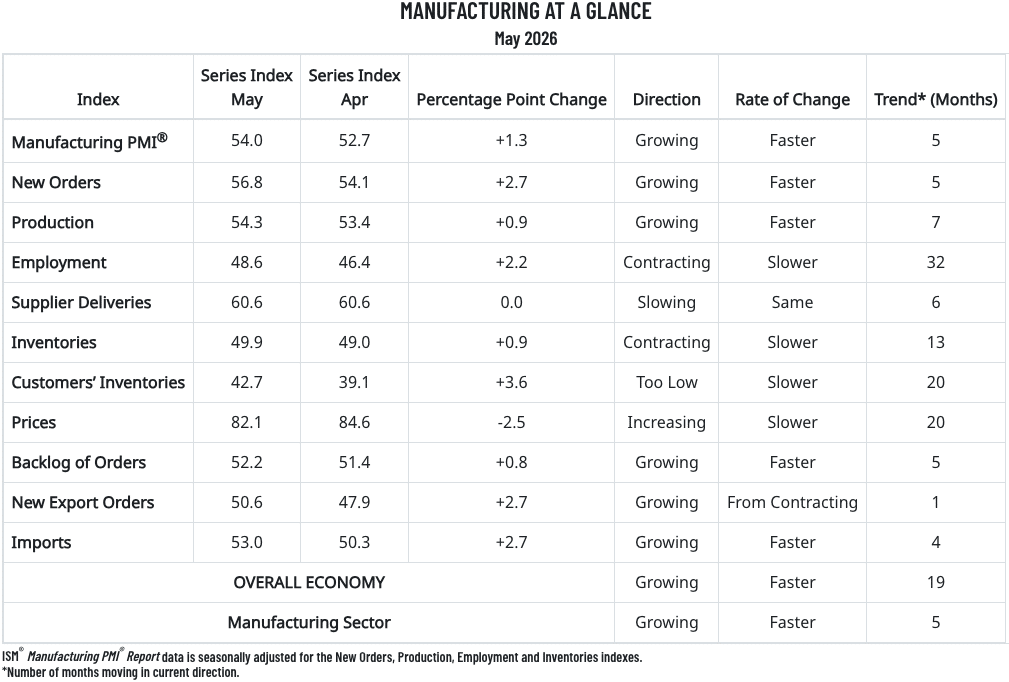
ISM shared that only 2% of the manufacturing sector’s GDP contracted in April, compared to 19% in April and 16% in March, and the percentage of GDP in strong contraction (composite PMI of 45% or lower) was also 2% — the same as April.
All of the six largest manufacturing industries expanded in May, in the order of computer & electronic products; machinery; transportation equipment; petroleum & coal products; chemical products; and food, beverage & tobacco products.
ISM PMI May Survey Respondent Commentary
In the May survey commentary collected by the ISM, 25% of the comments were positive and 69% were negative (31%/69% in April). Among comments, the Iran war was mentioned in 42% and tariffs in 18%. 57% of panelists mentioned pricing volatility as an issue for their company.
Here is the sampling of commentary provided by ISM in its May manufacturing PMI report:
- “Impact of Iran conflict starting to directly and negatively impact cost of supply chain. Oil and related commodities are escalating in price.” [Transportation Equipment]
- “The Middle East conflict is triggering shipment delays and uncertainties. Elevated gas prices and inflation will surely impact our purchases. However, over the last quarter, we’ve seen increased demand that was unexpected.” [Machinery]
- “As with all companies, we have felt the effects of fuel-related inflation and general market uncertainty due to overall economic variability and geopolitical events that have impacted such markets as construction, automotive and agriculture, as well as the general industrial sector.” [Chemical Products]
- “Continuing trends of 15-percent sales increase in April, cost increases on a majority of raw materials, and fuel charges on many inbound and outbound deliveries. We remain cautiously optimistic that if global economic factors stabilize and the Iran conflict ends, we can continue with increased sales and maintain acceptable margins.” [Chemical Products]
- “Cost of diesel is having huge impacts on our profitability. Confusion abounds around tariff refunds. We purchase many imported goods but in most cases are not the importer of record, so it is currently unclear to what we may be entitled.” [Food, Beverage & Tobacco Products]
- “Prices continue to rise for many products — some due to increase in data center creation for electronic components, others as a result of the Iran war and reductions in availability of oil/petroleum.” [Computer & Electronic Products]
- “Supply constraints continue to propagate and are a key headwind to supporting increased aerospace and defense demand. Semiconductors, critical minerals and certain types of raw materials are illustrative examples of sales plans at risk. Corporate risk mitigation actions are underway to secure supply in the midst of constraints.” [Transportation Equipment]
- “The current atmosphere is one of extreme uncertainty and concern for the future in terms of both price stability and longer-term supply continuity related to the Iran conflict and Strait of Hormuz closure. We have a lot of negotiations in process related to requested price increases, some related to oil prices and some still fallout from the 2025 tariff/geopolitical climate.” [Miscellaneous Manufacturing]
- “Continued dynamic random-access memory (DRAM) volatility, increased gas prices and tariffs are causing long lead constraints and price hikes that customers are not willing to bear. Panic is starting within our industry.” [Electrical Equipment, Appliances & Components]
- “Business appears to be weakening — uncertainty surrounding the Iran war, rising energy prices and customers unwilling to commit to expenditures beyond a very short term.” [Fabricated Metal Products]