Bob DeStefano, president of SVM E-Business Solutions, is the author of the B-to-B Online Marketing Toolkit, a step-by step manual to help distributors and manufacturers leverage online marketing to produce bottom-line results. Order it now in the MDM Store.
According to research, over 80 percent of customers begin at a search engine like Google when researching products and services online. So, if your company is not ranked on the first page of search results for your products and services, your website is virtually invisible.
|
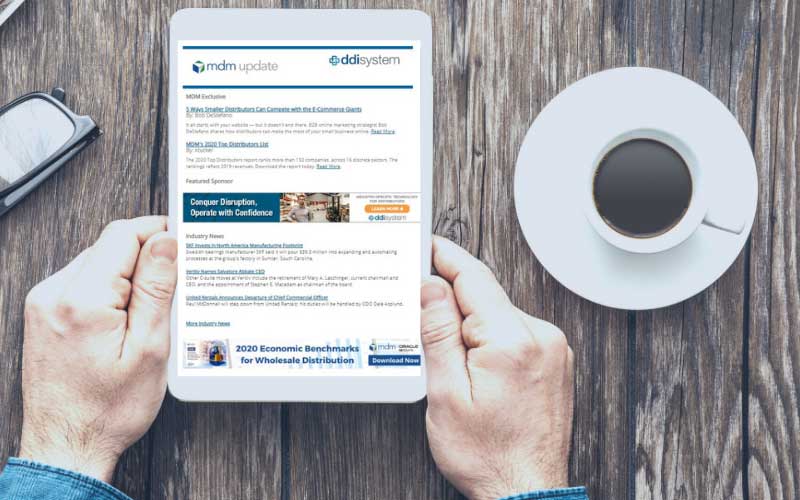
We Deliver Distribution News to Your Inbox Sign up below to receive MDM Update, your free weekly distribution news update by email. |
Often business leaders miss out on the search engine marketing opportunity because they don’t know the right questions to ask. The following questions will help you ramp up your search engine marketing efforts.
Do you have defined goals for search engine marketing?
Tip: Search engine marketing will help drive targeted traffic to your Website. So why are you trying to attract more traffic?
Think about the goals and objectives for your Website and online marketing efforts. Your search engine marketing program should
be designed to support these goals. Your goals may include selling products online, generating leads, building a marketing
database or improving brand awareness.
Do you know who you are trying to attract with search engine marketing?
Tip: Once you know why you want to attract more traffic, spend some time defining who you are trying to attract. Take a moment
to brainstorm about your target audiences. Who are they? What industry or business are they in? What is their role within
their company? What are they searching for? By defining your specific audience groups, you will be able to understand and
address their unique needs and motivations.
Do you know who your top competitors are on the search engines?
Tip: Your search engine marketing program must also focus on your competition. You want to make sure you clearly identify
your top competitors, so you can continually evaluate how your company’s search engine presence ranks relative to the
competition. And remember, your online competitors are not just the companies you typically compete against for new business.
Anyone on the first page of Google for your offerings is a competitor.
Do you know what terms or phrases your customers use when they search for your products and services on Google?
Tip: Proper keyword research is the most important step in search engine marketing. When choosing the best keywords, it is
important to choose phrases that are not only relevant to your business, but also ones that are searched most often by your
target customers. Begin by getting inside the heads of your customers and brainstorm about potential terms they use when thinking
about your products and capabilities. Then, turn to keyword research tools like Wordtracker or Google Adwords to create a
list of highly searched terms that will drive targeted traffic to your website.
Have you assigned each keyword phrase to the most appropriate page on your website?
Tip: Begin by creating a keyword plan for your search engine optimization campaign. Your keyword plan will map each of your
keyword phrases to the most appropriate pages on your Website. Review all of the pages on your Website and determine the best
page for each of your keyword phrases. If an ideal page does not exist, it needs to be created.
On each page you are optimizing for search engines, is the copy sufficiently long and keyword-rich?
Tip: Keyword-rich copy is critical to search engine optimization success. Your keyword phrases need to be used throughout
the entire page. Ideally, every page should have about 200 to 300 words of copy and your keyword phrase should be used approximately
5% of the time – or 5 times for every 100 words of copy. However, make sure you resist the urge to overuse the phrase
on the page. Google will penalize you if you go overboard with keyword stuffing.
Do your page <title> tags lead with your targeted keywords?
Tip: Search engines consider page titles very important when evaluating page content. In addition, the page title is used
for the blue clickable link people will see in the search results. Title tags must be written to include the most important
phrases for the page, while appearing compelling to the searcher so they will want to click them. Keep them below 60 characters,
including spaces or else it will be cut off in the search results. In addition, each page of your Website should have a unique
title tag.
Does your site employ <h1> heading tags for content titles?
Tip: Search engines consider heading tags, <h1>, more important than normal text. You should make use of heading tags
on every page to highlight the most important keywords and the heading for the page. In addition, use the <h2> and <h3>
tags for subheadings using other relevant variations of your keyword phrase.
Do you have keyword-rich <alt> tags for all navigation graphics and all product images?
Tip: Search engines cannot read text included in images. However, every image can have an <alt> tag that includes a
brief description that can be read and indexed by search engines. So, make sure all of your product photos include relevant
keyword phrases in the <alt> tags. Make sure to only include relevant keywords that are important for the page and relevant
for the image.
Do your pages have keyword-rich <meta> tags?
Tip: The ‘description’ <meta> tag is very important, since Google uses this information below the clickable
link in the search results. Craft your ‘meta’ descriptions for each page like a compelling call to action, include
your most important keywords for the page, and keep them below 150 characters, including spaces. The ‘keywords’
meta tag has been exploited over the years, so it is largely ignored by Google and other search engines. Still, it may have
some impact, so use it to list your most important keywords for each page.
Do your filenames and directory names include targeted keywords?
Tip: Think strategically about how you construct and organize your Website. Search engines will also look at directory names
and file names when reviewing the content of a Web page. Where it makes sense, try to use your most important keyword phrases
in these names.
Are you using Google Webmaster Tools and an XML Sitemap to assist with the indexing of your Web pages?
Tip: To search engines, an XML sitemap is like a roadmap for your entire website. With Google Webmaster Tools, you will be
able to share your Sitemap.XML file, as well as tell Google how you would like the URLs it indexes to appear. In addition,
it provides detailed reports about your site’s search engine visibility on its search engines. You will be able to see
how Google crawls your site and learn about specific problems it may be having accessing it.
Do you have a proactive link building program in place?
Tip: Link building involves gaining links to your Website from other popular Websites in your industry or space. The more
quality inbound links you have, the more popular your Website is in the eyes of Google. Good content attracts links, so fill
your Website with interesting and informative content. Next, get your Website listed in online directories and portals. Finally,
you should leverage online public relations and distribute press releases and articles online.
Are you running a results-focused paid search campaign?
Tip: Paid search is an immediate way of attracting targeted search traffic. Unlike traditional advertising, where you ‘pay
for exposure’ regardless of the results, with paid search you only pay if someone clicks on your ad and visits your
Website, providing a compelling ‘pay for performance’ mode of advertising. To manage an ROI-driven paid search
campaign, make sure you setup ‘conversion tracking’ so you can tie your bidding strategy to business results (e.g.,
sales, leads, etc.).
Are you measuring the success of your search engine marketing campaign?
Tip: Since search engine marketing is all about attracting targeted traffic, begin by leveraging Web analytics to monitor
traffic increases from search, as well as what search engines and phrases people are using to visit your website. To make
sure the volume of targeted visitors continues to increase, you should also monitor your position or ranking in the search
results. Finally, to measure the success of your paid search advertising efforts, harness the measurable nature of the Web
to track the cost-per-visit, cost-per-lead, and cost-per-sale for all of your paid search ads.
If you answered no to any of these questions, it’s time to take action! If you don’t, you are only getting a fraction of the value out of your website. So, what are you going to start with?
Bob DeStefano is an online marketing strategist and professional marketing speaker with more than 16 years experience helping industrial companies leverage online marketing to produce bottom-line results. Connect with Bob on the Web at www.bobdestefano.comand www.svmsolutions.com or by calling 1-877-786-3249 x3.
![]() |
Download
the Top 40 Industrial List -FREE |
| View the Top Distributors in 12 Sectors: | |
| 2011 Distribution Landscape Report: Access Now | |
Join MDM's Independent Distributor
Network
Follow MDM on Twitter
Critical Profit Driversin Distribution Al Bates, Profit Planning Group, speaks frankly about the most important factors to driving profit. Watch now. iPad users: click here to view. |
Economic Update:Behind the Moderation MAPI Economist Cliff Waldman discusses some of the factors behind the slowing economic recovery. Watch now. |
7 Minutes With ...Bell Electrical Supply CEO Burt Schraga discusses the importance of building a strong culture in his organization. Watch now. |
More Audio and Video Features from MDM: |
Think About It: |
|
Training Resources
| Title | Company | Location |
|---|---|---|
| Digital Strategy Manager | Border States Electric | Fargo North Dakota |
| Risk Manager | Border States Electric | Fargo ND |
| Purchasing Manager | PCA SKIN | Scottsdale, AZ |
| BUSINESS DEVELOPMENT MANAGER | Graybar Electric Company | Denver, CO |
| INDUSTRIAL OUTSIDE SALES REPRESENTATIVE | Graybar Electric Company | Phoenix, AZ |
| General Manager | Applied Industrial Technologies | Norfolk, VA |
| Rubber Specialist | Applied Industrial Technologies | Baltimore, MD |
| View ALL Wholesale Distribution Job Listings |
|
|
Comments
Leave a Comment