Lead photo by MDM
Distributors continue to share details of how they have been impacted by the Trump administration’s fluid tariffs policy — and a pair of new reports shed more light on the extent of these impacts across the broader wholesale trade industry.
On July 2, JPMorganChase — the retail and commercial banking unit of financial services firm J.P. Morgan — shared a new report on the cost of tariffs on U.S. midsize businesses, centering on the finding that such firms are overexposed to potential high-tariff countries.
A secondary key finding was that wholesale trade was identified as the industry having the highest tariffs exposure to the tune of $48.7 billion in import duties following April-June negotiations, representing more than half of the U.S. economy’s total exposure. That’s more than halved from the $111.7 billion exposure during the policy that went into effect April 2, but dwarfs the $18.7 billion exposure that was before April 2 when sweeping U.S. tariffs were announced on imports from nearly every U.S. international trading partner.
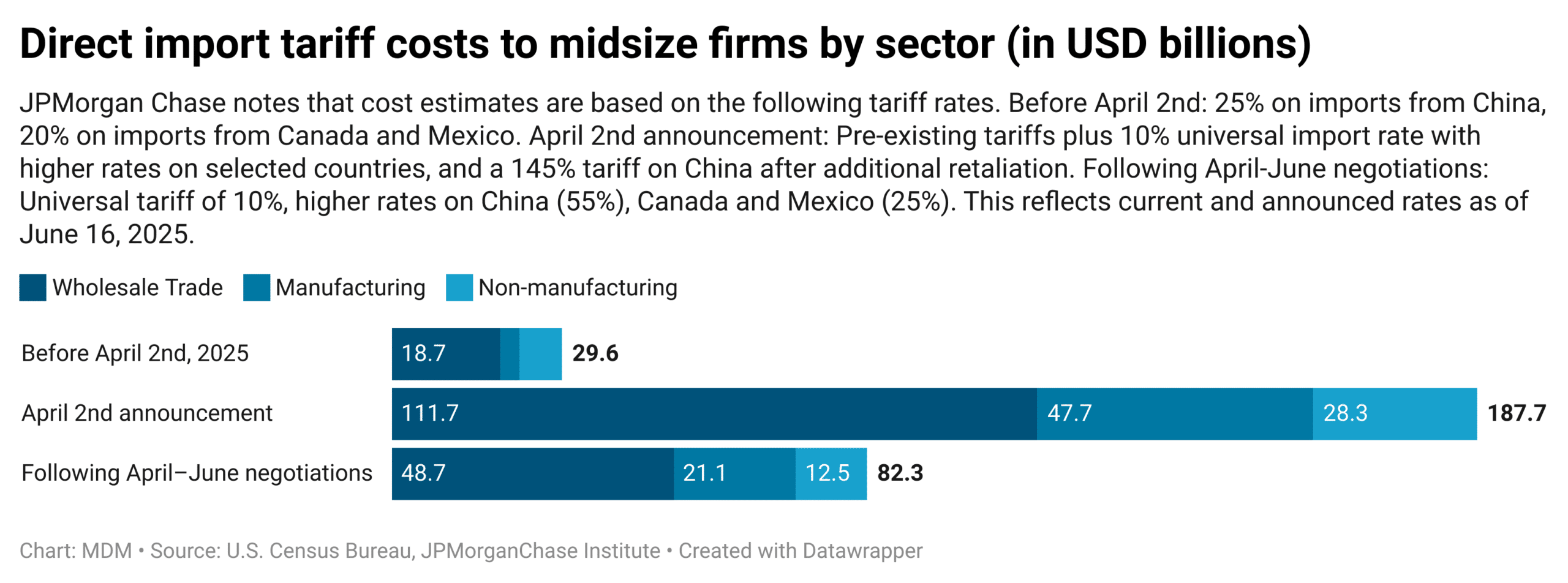
The report — led by JPMorganChase researchers Chris Wheat, Chi Mac, Ole Agersnap and Nick Niers — acknowledged that wholesale trade is the largest importing sector and bears the largest tariff costs vs. manufacturing and nonmanufacturing as the other two comparable industries. It adds that because wholesales often operate on thin margins, they often pass on those higher import costs to their customers.
“The large exposure of midsize wholesalers to import tariffs is also important in and of itself. If they raise prices, they may offset some of the tariffs, but doing so could cost them sales,” the report details. “Wholesalers that specialize in importing are especially at risk if their customers switch to domestic inputs. On the other hand, their expertise could also be valuable to clients navigating a volatile tariff environment — particularly midsize clients, who may lack internal resources.”
Find an executive summary of the JPMorganChase report here.
—————-
On June 30, small business networking firm Alignable shared the results of its new research report on how tariffs are affecting North American businesses, and the findings included the nugget that wholesale trade was identified as the industry most impacted U.S. tariffs.
The research, which included collecting responses from over 4,000 small business owners between June 14-June 26 — found that 72% of small wholesalers reported lower revenues due to tariffs, just ahead of restaurants (71%), followed by retail (57%) and manufacturing (56%).
Other findings from the Alignable report include:
1 in 5 small business owners fear their business won’t make it to 2026 if tariff policies don’t become more favorable
- 44% of polled small business owners reported a tariff-related sales decline in June, a major jump from the 26% and 25% seen in the survey during May and April, respectively.
- The average reported revenue decline was 13% across all industries, and 20% of small business owners reported losses of more than 25%
- Massachusetts led all U.S. states with the highest share of reported tariff-related sales decline at 54% in June, followed by New York (49%), Illinois (45% and Ohio (43%)
- As for expected impacts, Massachusetts also leads the way for the highest share of tariff-related sales decline at 59%, followed by California and North Carolina (53%), Pennsylvania (50%) and New York and Illinois (49%)
Find an executive summary of the Alignable report here.
—————-
Tariff Impacts Research from MDM and NAW
The JPMorganChase and Alignable reports follow MDM’s own extensive spring 2025 research into tariff impacts on distributors of all demographics.
At the end of April, NAW released the findings of a survey done in collaboration with MDM based on responses from 200+ distributors, covering their to-date response, pricing and expectations for the months ahead.
During mid-April, MDM released the findings of our research on tariff impacts and distributors’ response to them — along with a wealth of distributor commentary — collected in the 1Q25 Baird-MDM Industrial Distribution Survey during early April. We segmented these results by distributor size for a better apples-to-apples comparison.
- How Are Distributors Combatting Higher Costs from Tariffs? Here’s What They Told Us (Premium)
- Distributors Forecast Shaky 1-10% COGS Increase with Tariffs Influence (Premium)
- Research: Distributors & Manufacturers Split on Signs of Pullback, CapEx Plans (Premium)
NAW and MDM continue to closely monitor tariff impacts on distributors and will plan to share further research as we collect it. This includes the 2Q25 Baird-MDM Survey, which we’ll share the results from later in July.
Related Posts
-

Slips, overexertion and first-year worker injuries dominate wholesale industry claims, according to Travelers’ 2025 Injury…
-

This category can only be viewed by members. To view this category, sign up by…
-
U.S. wholesale inventories were flat in April, missing expectations, while the trade deficit narrowed sharply…