Editor’s Note: This is the first in a four-part article series. Parts 2-4 will be Premium articles.
SERIES INTRODUCTION: LEAN SIX SIGMA & AI in WHOLESALE DISTRIBUTION
What if we’ve been thinking about AI all wrong?
—————————————————————————————————————————
For the better part of two decades, I have carried two seemingly unrelated experiences with me.

The first was becoming a Lean Six Sigma Black Belt during my years with DHL. Like many practitioners, I learned the disciplines of process improvement, root-cause analysis, variation reduction and the importance of sustainable control. Those lessons shaped how I think about business to this day.
The second is what I see now as Chief Innovation Officer at the National Association of Wholesaler-Distributors (NAW): organizations across wholesale distribution racing to understand, adopt and capitalize on artificial intelligence.
At first glance, these two worlds could not be more different. One emerged from industrial engineering, process discipline and continuous improvement. The other is powered by machine learning, large language models, autonomous agents and technologies that seem to evolve weekly.
Yet the deeper I explored AI adoption in distribution, the more I found myself returning to the same question: What if Lean Six Sigma wasn’t wrong? What if it was simply early?
That question became the catalyst for this series.
“The future won’t belong to organizations that use AI. It will belong to organizations that learn faster than volatility.” — Bart Tessel, NAW Chief Innovation Officer
Today, executives are inundated with AI advice. Most of it focuses on tools, models, vendors and use cases. Far less attention is being paid to the operating model required to successfully deploy AI at scale while maintaining trust, accountability and business results.
At the same time, AI is forcing us to reconsider some of our most fundamental assumptions about work itself. If AI can automate tasks, redesign workflows and in some cases eliminate entire process steps, what happens to traditional continuous improvement methodologies?
Do Lean and Six Sigma become obsolete? Or do they become more important than ever?
Over the next four articles in this series, we’ll explore a provocative possibility: The future isn’t AI versus Lean Six Sigma. The future is AI powered by disciplined thinking.
We’ll examine:
- Why Lean Six Sigma may have been ahead of its time
- How AI changes processes without eliminating the need for control and governance
- Why pricing may become the next great frontier of operational excellence in distribution
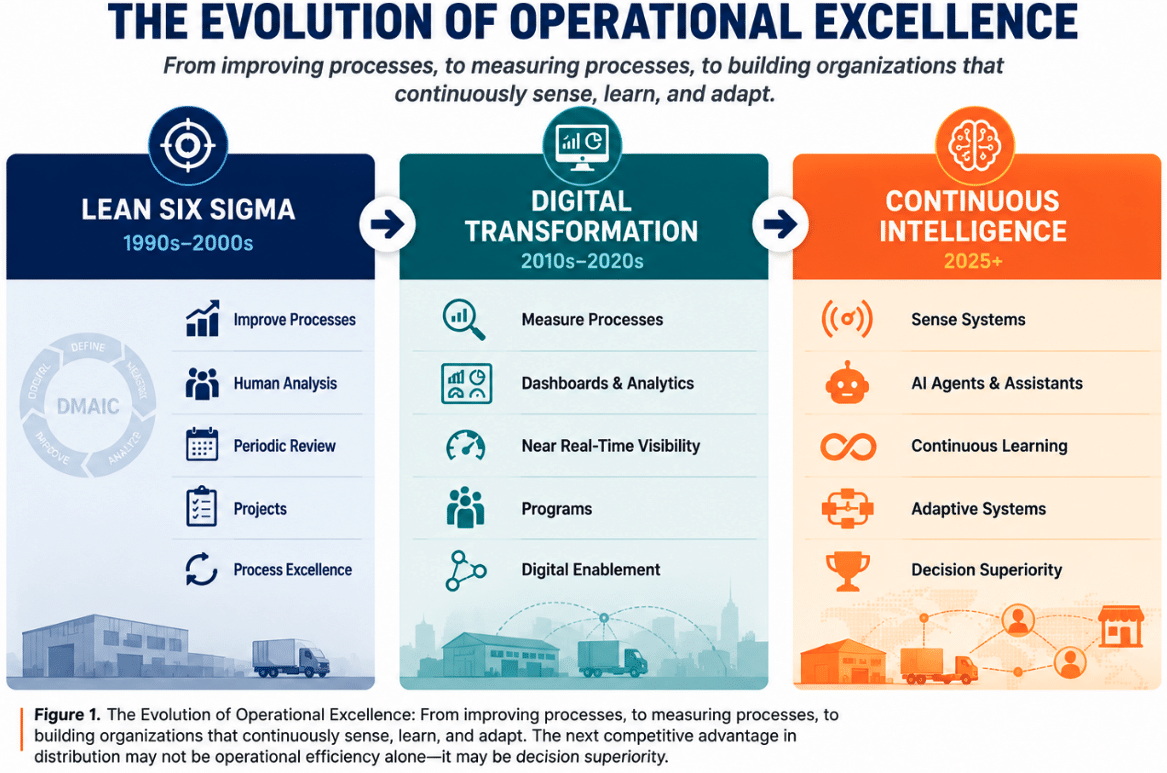
- How organizations can move from continuous improvement to what I call Continuous Intelligence
- Why domain experts, not AI, must remain accountable for business outcomes
- And why competitive advantage may increasingly belong to companies that learn faster than volatility
This is not a series about technology. It is a series about leadership. It is about decision-making. It is about building organizations that can continuously sense, learn, adapt, and improve in an increasingly complex world.
Whether you’re a CEO, functional executive, operator, technologist, or student of business transformation, my hope is that these articles challenge some assumptions, spark new ideas, and start a broader conversation across our industry.
The future of distribution won’t be determined by who adopts AI first.
It will be determined by who learns to operate differently because of it.
Let’s begin.
—————————————————————————————————————————
Part 1
Lean Six Sigma Was Early. AI Makes It Real.
Introducing an operating model for distributors who want results, not hype.
—————————————————
Executives in wholesale distribution are being bombarded with AI messages that all sound the same: adopt, experiment, don’t get left behind. And yet when I sit down with distributor leaders, the ones running complex networks on thin margins, I hear a different truth: “We want to move, but we’re not sure where to start. And we can’t afford to chase the wrong thing.”
That last phrase matters. Because the single biggest risk I see in the current wave of enterprise AI is not the technology. It’s the human habit we’ve always had, and in many organizations, it’s getting worse:
- jumping to conclusions
- building consensus around the wrong diagnosis
- “fixing” symptoms instead of root causes
- automating processes that were never stable in the first place
If this sounds familiar, it’s because it’s the same failure mode Lean Six Sigma (LSS) set out to correct decades ago.
Here’s the provocative thought that has been on my mind for a while and I suspect many of you will recognize it: Lean Six Sigma wasn’t wrong. It was early.
Lean Six Sigma promised disciplined problem solving, control, and repeatable improvement. What it lacked in most companies was the ability to run those cycles fast enough and keep them alive long enough. Great projects happened… and then reality returned.
AI changes that. Not because AI is magic. But because AI collapses the constraints that made continuous improvement hard to sustain at scale: data latency, measurement friction, analysis bandwidth, and slow feedback loops.
And that leads to a new operating model: one that distributors can use to turn AI from “innovation theater” into measurable advantage: From Continuous Improvement to Continuous Intelligence.
Why Distribution Needs a New Operating Model
Distribution is already an efficiency machine. That’s why it exists. But today, efficiency alone isn’t enough. Volatility punishes slow learning systems.
In 2026, a single wrong decision, a pricing move, a buy position, a demand-planning assumption, a sales concession, can take a meaningful bite out of margin fast.
The executives who win the next decade won’t just run efficient operations. They will run fast-learning operations: a management system designed for high-velocity decision environments.
The Basic Idea: AI + LSS = A Closed Loop That Actually Closes
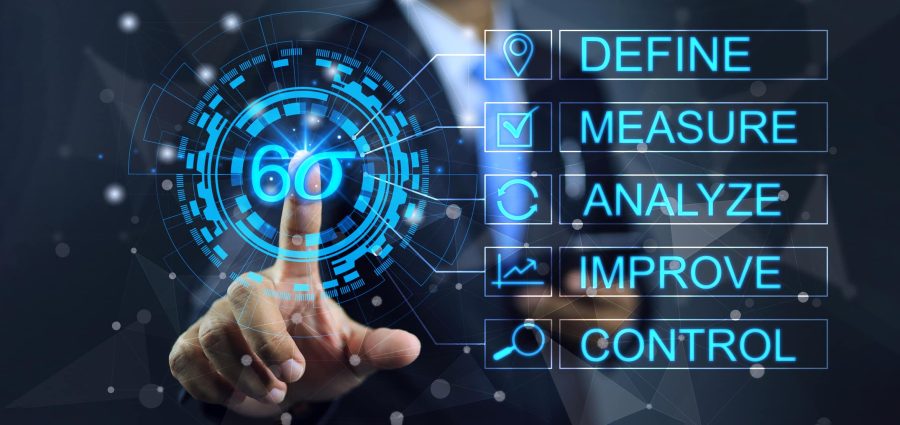
Lean and Six Sigma are at their best when they do four things consistently:
- Define the problem correctly
- Measure reality without bias
- Analyze root cause, not surface noise
- Improve and Control in a way that sticks
In the real world, we get stuck, especially in distribution, because the “Measure” and “Control” parts decay. Dashboards become wallpaper. Control plans fade. Teams move on.
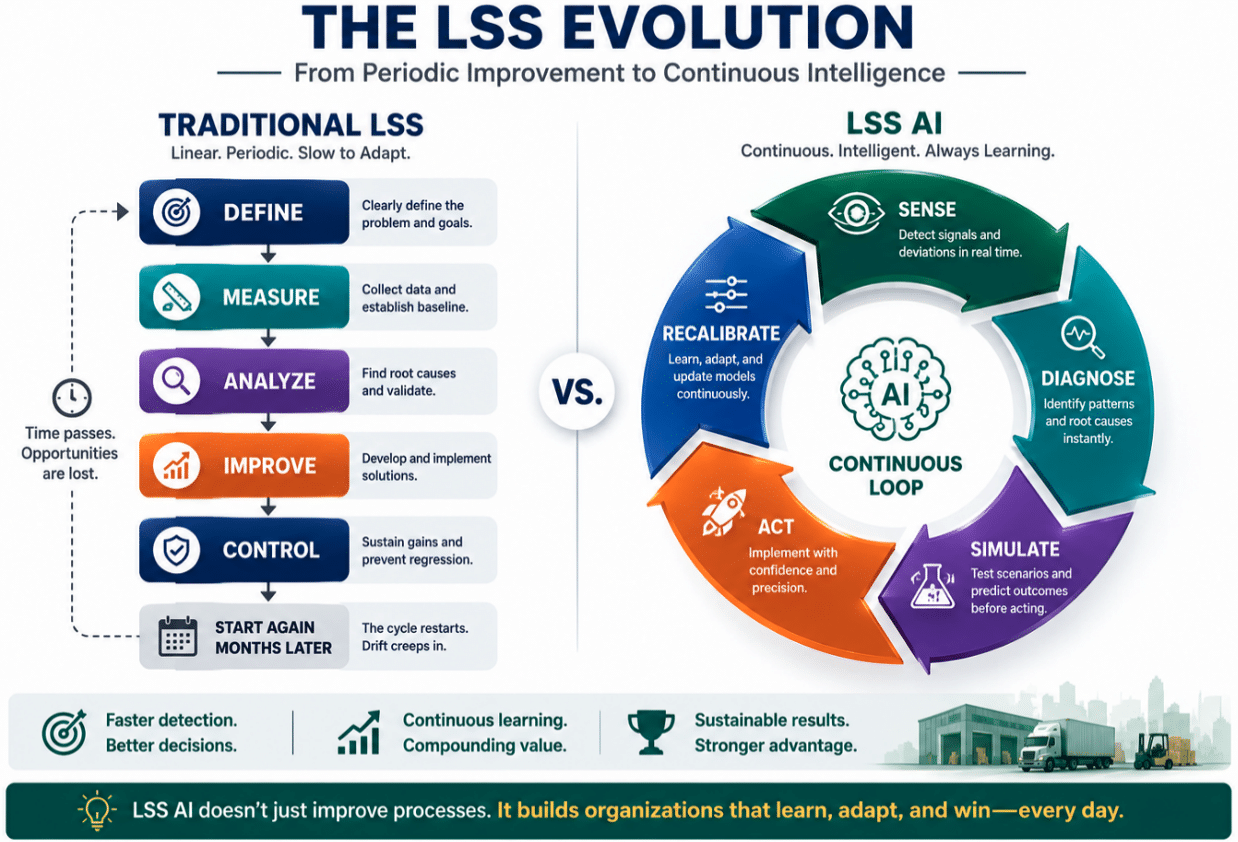
Let’s flip the script: AI makes measure and control continuous, not periodic. If you’ve ever said, “We improved it, but it didn’t last,” you’re describing a control problem and not an effort problem.
A Simple Model: The LSS AI Loop
Think of LSS AI as a loop that runs every day, not every quarter:
- Sense: detect deviations early (process drift, pricing variance, forecast bias, service failures)
- Diagnose: identify likely root causes and patterns (not just exceptions)
- Simulate: test countermeasures before changing the business (what-if pricing, buy position, labor, routing)
- Act: implement with guardrails and escalation paths
- Recalibrate: update thresholds and capability measures continuously
This isn’t science fiction. Other industries are already moving this direction; manufacturing, logistics, financial services. Because their tolerance for variation is low and their decision density is high. Sound familiar?
The Most Important Warning in This Whole Series
If you take nothing else from this first episode, take this: AI does not fix unclear processes. It accelerates them.
Lean taught us the sequence: stabilize → standardize → improve → automate.
AI tempts organizations to reverse it: automate → hope → scramble → blame.
LSS AI is a corrective to that temptation.
Why This Matters More Than “AI Strategy”
Most AI conversations start with tools, while we should start with outcomes:
- Where are we leaking margin through variation?
- Where are decisions inconsistent: by person, by branch, by customer segment?
- Where is the business relying on “tribal knowledge” instead of a controlled system?
Distribution is full of these “hidden variation factories,” especially in:
- pricing (discount drift, margin leakage, inconsistent guardrails)
- demand planning and purchasing (forecast bias, overreaction, underreaction)
- sales (inconsistent qualification, ad hoc concessions, CRM entropy)
- overlooked functions like accounting, HR and IT (exception handling, approvals, repetitive admin work)
Up Next
In Part 2, we’ll explore the core strengths of Lean Six Sigma, as well as AI, how they deliver value individually, and even more importantly, how LSS can accelerate AI adoption.
Related Posts
-

It results in a combined industrial packaging, JanSan and foodservice distributor with $28 billion in…
-

Hills Distribution now includes Plimpton & Hills, Coastal Supply Group, RJ Murray Company and Bender…
-

The facility features an expanded footprint and improved layout to enable greater throughput.