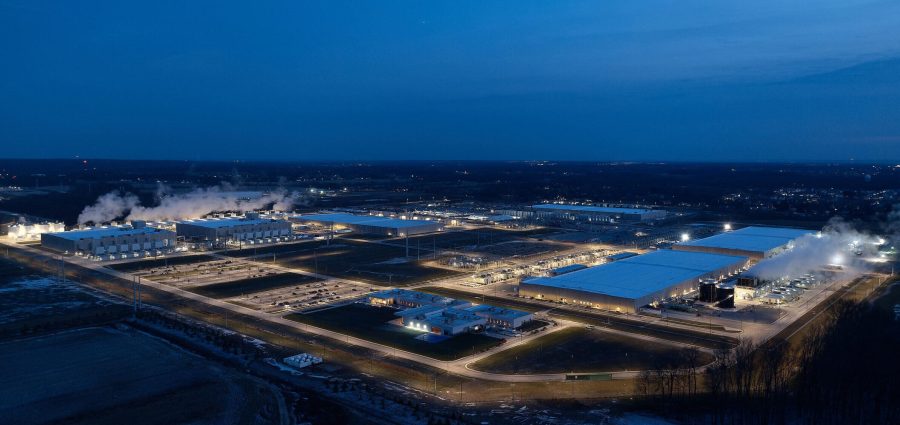
Lead image: This image in Central Ohio captures Google’s entire New Albany data center campus at dusk. The three buildings at left are all operational data centers. Source: Google
As demand for data centers surges, pushing long-term growth projections higher and fueling an accelerated wave of construction and retrofitting across the U.S., distributors are lining up to win their share of the business.
With most industries, including distribution, eyeing AI as an (inevitable) tool toward growth, the demands of digital services have only grown. With it, naturally, comes a surge in the construction of data centers that fuel those efforts. Continued strength on this front led some distributors (at least those equipped to serve large, complex and time-sensitive projects) to make focused investments to continue to serve this market that is poised for long-term growth.
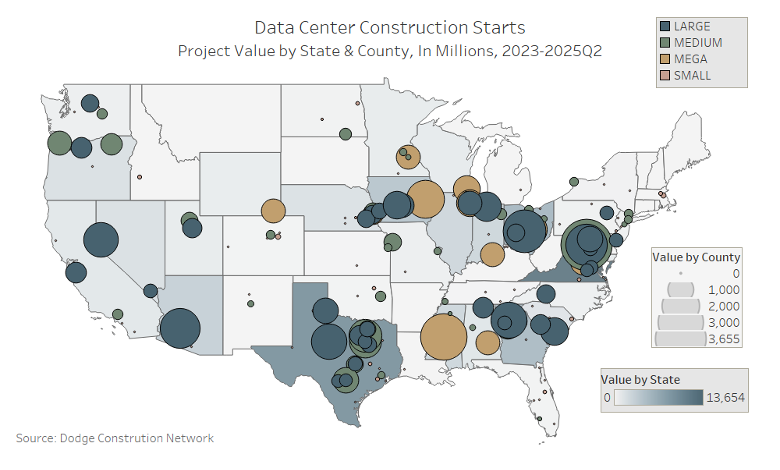
A McKinsey analysis found that almost $7 trillion in capital expenditures will be invested in data center infrastructure by 2030 — more than 40% of which will be invested in the U.S. Since 2022, U.S. construction starts have grown year-over-year, according to data from Dodge Construction Network.
Sales to the data centers segment have been a strong note in Wesco International’s financials. The electrical supplies distributor — No. 1 on MDM’s Top Distributors List for Electrical/Data/Security Supplies and a 2025 MDM Industry Titan — reported about $1.2 billion in data center sales in the third quarter of 2025, setting yet another quarterly company record. Sales in that sector were up 60% year-over-year and represent 19% of total Q3 sales.
MDM Case Study: Wesco (Premium access here)
“We have a unique and very strong set of end-user customers,” explained Wesco Chairman and CEO John Engle in an earnings presentation when asked to look ahead toward 2026. “We’re in dialogue with them. We get good insights into their multi-year investment and deployment plans for data centers. We’re helping them execute globally … We are focused and committed to and confident that we will continue to outperform the market in data centers.”
Electrical Distributors’ Investments Signify Strong Market Demand
Robust wire and cable demand for data centers in the Great Lakes specifically was a major factor in Distributor Wire & Cable’s decision to scale its Columbus, OH-area distribution center up to more than five times its previous size.
Its new 153,000-square-foot warehouse signifies the specialty electrical wire and cable master distributor’s long-term investment to meet the demands being placed on wholesale electrical distribution due to the growing data center market, as well as give a boost to its national distribution capacity for manufacturing, renewable energy and electric vehicle charging.

About two years ago, DWC initiated its plan to replace its Ohio facility with one equipped to keep pace with exceptional growth in several markets. The master distributor has been serving its Rust Belt and upper Midwest customers from this facility since mid-2015, and demands have only grown since. DWC Chief Executive Travis Williams told MDM that the expansion reflects the customer base of the area.
“Data center and manufacturing clients cannot wait weeks. They need product on the ground, ready to go,” Williams tells MDM. “This expansion strengthens our national supply network, accelerates delivery and supports the industries driving the future economy.”
Market Complexity and Scale Drives Strategic Centralized Focus
The data center market is unique in its pace, complexity and expectations, explained Sonepar Americas President Rob Taylor. Sonepar — No. 2 on MDM’s 2025 Top Distributors List for Electrical/Data/Security and a 2025 MDM Industry Titan — serves data center customers with a national reach, which need local- and national-level support for both new construction and long-term MRO needs.

“Projects are large-scale and time-sensitive, and contractors are under pressure to deliver without delays,” Taylor tells us. “At the same time, the supply chain for key components remains tight, so having the right inventory at the right time is critical.”
While Sonepar serves a “significant number” of data center projects through its local operating companies, in November 2025, the distributor signaled a move toward a centralized, national strategy with the creation of a new role — Senior Vice President of Data Center Solutions and Datacom in the U.S., which reports directly to the company’s Chief Operating Officer.

“We felt it was the right time to create a national team that can both assist our local operations and speak on behalf of our entire U.S. business to manufacturers and national, as well as global, customers,” Taylor says.
The centralized team, led by Richard Landry (previously VP of Industrial Business at Sonepar subsidiary Crawford), will align strategic efforts across the entire U.S. and with Sonepar’s global data center organization.
“Centralizing this role will ensure that we share best practices and value-added capabilities, while maintaining the agile local execution that sets us apart,” Taylor says.
Sonepar’s U.S. strategy is to establish data center solutions hubs in key markets throughout the country. Its operating companies have long-supported projects in hotspots such as Northern Virginia and Dallas, but the company is now looking at activity in the Midwest and Southeast.
“These hubs will ensure that no matter where data center construction is happening, we have and will continue to have the inventory needed locally to service data center construction,” Taylor adds.
A centralized team may also increase its visibility for current and potential customers.

In late 2023, electrical and industrial supplies distributor Turtle hired on Teesee Murray as Chief Strategy Officer to spearhead the company’s transition toward continuous innovation. That mindset covered everything from AI and automation to micro-investments. But one of those pillars of focus was on the growth opportunities within the data center market.
Turtle is No. 19 on MDM’s Top Distributors List for Electrical/Data/Security Supplies, and Murray was recognized as one of MDM’s 2025 Women in Distribution.
“Turtle has served the data center market’s utility providers for a century. Data centers didn’t exist when we started, but we’ve always provided components. What we’re doing is creating a holistic strategy to serve the industry from hyperscalers to existing data centers that need to retrofit based on the requirements that are increasingly more sophisticated and have higher power,” Murray tells MDM. She explained that to build data centers, there is a foundational level of energy infrastructure needed to support that infrastructure.
Supporting the Lifecycle of a Data Center
From the time a data center project is announced and funded, it can take between four to seven years to become operational, Wesco’s Executive Vice President and Chief Financial Officer David Schultz said during the company’s 3Q25 earnings presentation.
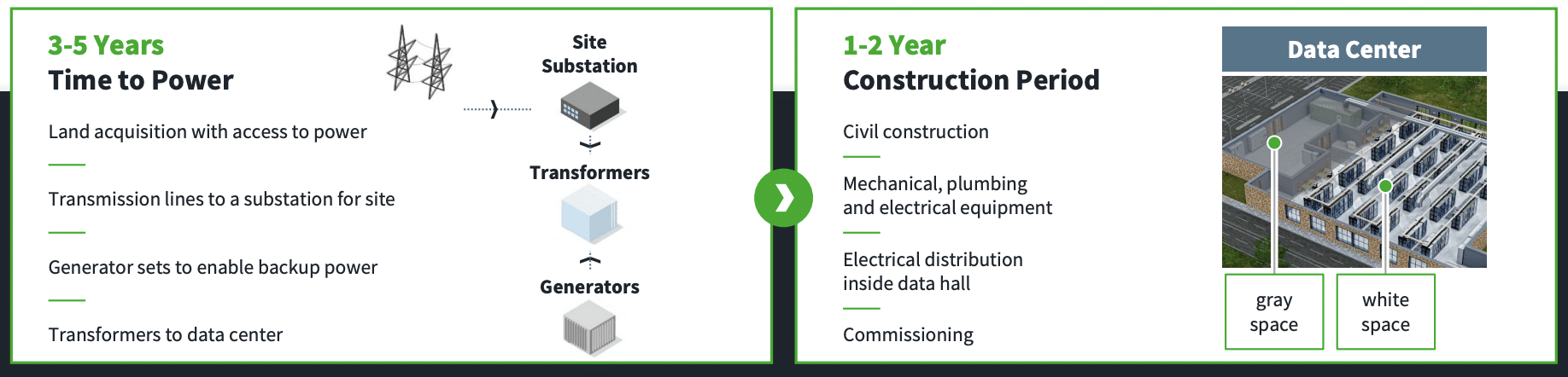
In recent years, Wesco has made several tuck-in acquisitions — first in 2022 with hyperscale solution company Rahi and again in 2024 with data center building intelligence software entroCIM and data center facility servicer Ascent — to serve this market from “cradle to cradle.” It’s built out a network that can support initial construction, on-site services and solutions, ongoing upgrades, retrofits, life cycle upgrades and modernization.
“We are there every step of the way, moving with speed to help our customers quickly adapt and thrive in a rapidly evolving environment,” Schultz said.
Product Demands — Data center product demands span many categories. Below is a (noncomprehensive) list of products supplied by distributors to the data center market:
-
- Electrical Infrastructure Building: Wires, cable trays, medium-voltage cable, switch gear, UPS system
- Mechanical and Cooling: Automated switches and sensors, chillers, Computer Room Air Conditioning (CRAC)
- MRO and Safety: Communication devices, janitorial, lighting, tools and equipment
- Physical Security and Monitoring: Access control, sensors and monitoring, video surveillance
- Communications: Copper and fiber cabling systems, racks and enclosures, high-speed interconnects
These are beside the other building materials/construction supplies needed to actually build data center facilities.
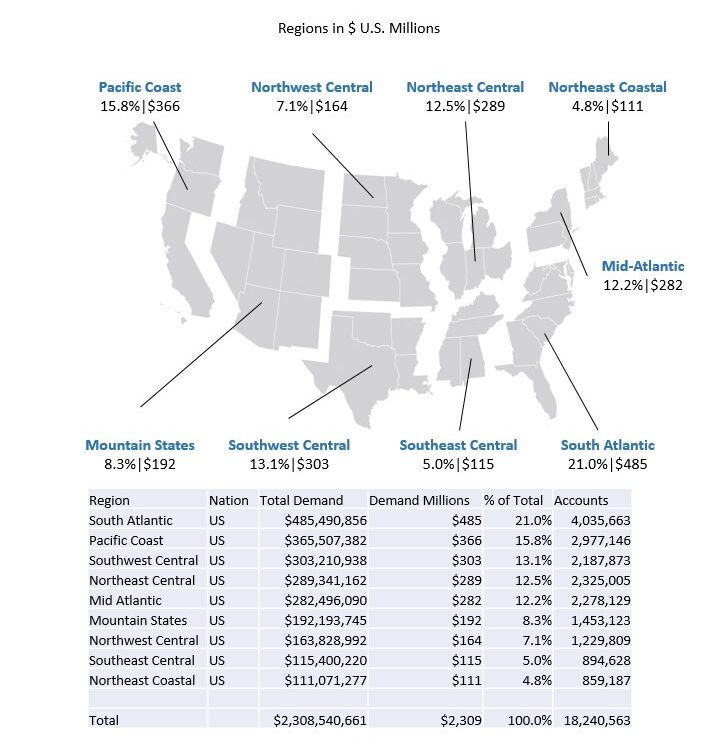
Product Demand Snapshot: Wire Datacomm MRO Demand is $2.3 billion
Between early 2024 and the summer of 2025, DWC grew its investment in medium voltage cable due to the large-scale and time-sensitive nature of demands by data center projects, which is stretching cable manufacturers’ capacity, Williams explains.
While manufacturers may be fulfilling bulk purchases for hyperscale data center projects, for example, there remains a still (and growing) immediate need for product on active jobsites.

Needs also go beyond the physical data centers and into the energy space.
Turtle’s Murphy shares that constraints of the U.S. power grid and the need for power resilience/redundancies have accelerated the use of distributed energy management (DER) systems (think of them as small-scale power generators located close to the load they serve which enhance traditional electric power) with microgrids to bridge the gap.
“We’re shifting from components to an ecosystem,” Murray shares. “The priority has really moved to integrated strategies that align power, cooling, monitoring and operational technologies under one coordinated system. So at Turtle, we operate as a strategic partner with responsibility for engineering, coordination, vendor alignment and full delivery across data center life cycles.”
Rapid Expansion Brings Rising Scrutiny
The boom of construction has received notable pushback from the communities they have cropped up in. Main concerns revolve around the exceptional electricity and water consumption data centers require once up and running to power the computer systems and cool them, which some believe has the potential to stress local grids and therefore broadly increase utility costs for local communities, among other sustainability concerns. For example, a study by the International Energy Agency estimates a 100-megawatt data center consumes roughly the same amount of water as 2,600 households — accounting only for direct water consumption and averaged across the various cooling strategie
In addition, aesthetics and noise impacts are also often cited as concerns.
This pushback has led to some states to propose efforts such as ending tax breaks for data centers (Arizona) and requiring data centers to pay more for grid use (New York). Others are using zoning controls to block or suspend some construction approvals. For now, there are no federal environmental/energy-use limits regulations related to data center construction.
Federal policy has been generally enabled AI infrastructure growth and permitting efficiency. In July 2025, the Trump Administration issued an Executive Order to ease “federal regulatory burdens” and accelerate permitting for data centers, especially on federal owned land.
MDM will continue to monitor the data center market. Have insights to share? Did we miss a key part of the conversation? We welcome feedback. Send your comments to [email protected]