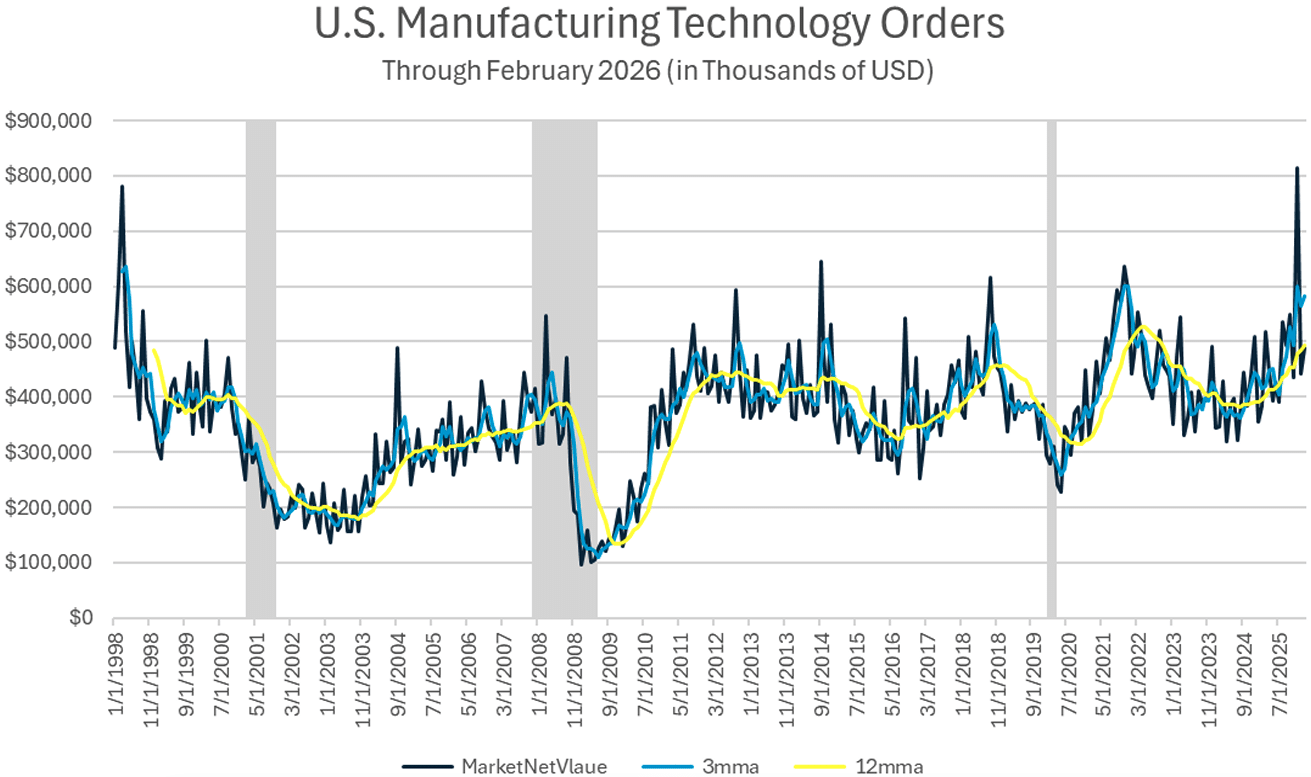
New U.S. orders for metal cutting, forming and fabrication machinery (manufacturing technology) totaled $489 million million in February — a 10.7% increase over January, and a 27.4% increase year-over-year. That’s according to the Association for Manufacturing Technology’s (AMT) latest Manufacturing Technology Orders Report (USMTO).
Through February, year-to-date orders of $930.5 million were up 26% vs. a year earlier.
The report detailed that while the total value of orders showed considerable increases, volume has progressed at a far slower pace with the total number of units orderd roughly flat year-to-date. This bifurcation trend, AMT said, can generally be attributed to an increased demand for automation, shifting customer industries and ongoing market distortion from federal policy and geopolitical disorder. Demand for manufacturing technology entered a period of recovery in 4Q24 after nearly three straight years of decline, and the divergence between value and volume has been prominent since.
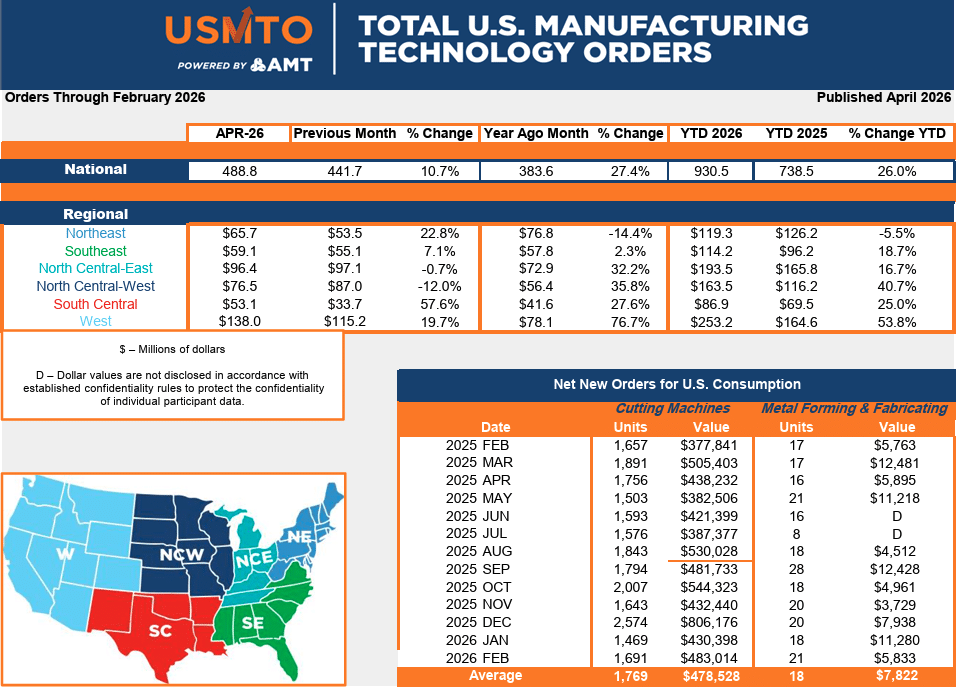
- Contract machine shops — the largest customer of manufacturing technology — increased their value of orders by more than a quarter over the first two months of 2025, while the number of units increased by only a modest single-digit percentage. Job shops typically increase orders in response to demand for additional capacity, and the number of units ordered closely correlates with the value of those orders.
- Conversely, manufacturers of aerospace equipment tend to have outsized order values compared to the number of units ordered because of the highly specialized operations required in their processes. In the first two months of 2026, aerospace orders were 233% above 2025, and units were 125% higher.
“In previous months, as businesses learned to cope with elevated levels of uncertainty and the cost of inaction grew, demand for manufacturing technology increased,” AMT’s report said. “This confident investment in the face of fluctuating policy carried into the first two months of 2026. However, with the outbreak of war in Iran in the last few days of February, whether businesses will continue to invest at this elevated rate remains to be seen. On one hand, additional military spending will funnel into an aerospace and defense sector already grappling with capacity constraints, yet further changes to the tariff environment could stall additional investment.”