The Institute for Supply Management released its monthly manufacturing Purchasing Managers Index (PMI) on Nov. 3, reflecting October U.S. industrial activity, which reverted further into contraction after a modest improvement in September.
The PMI — regarded as a key of U.S. industrial health — slid 0.4 percentage points during October to a reading of 48.7%, negating September’s 0.4-point gain. It marked the eighth straight month that the PMI was in contraction territory (anything below 50.0%) after a brief expansion in January-February preceded by 26 straight months of contraction.
ISM PMI – the Last 12 Months
ISM’s report showed that all four of the October PMI’s demand indicators (new orders, new export orders, backlog of orders and customer inventories) improved month-to-month, but remained in contraction territory. Demand improvement was more than offset by considerable declines in output indexes of production and inventories. Meanwhile, the index for prices fell 3.9 points.
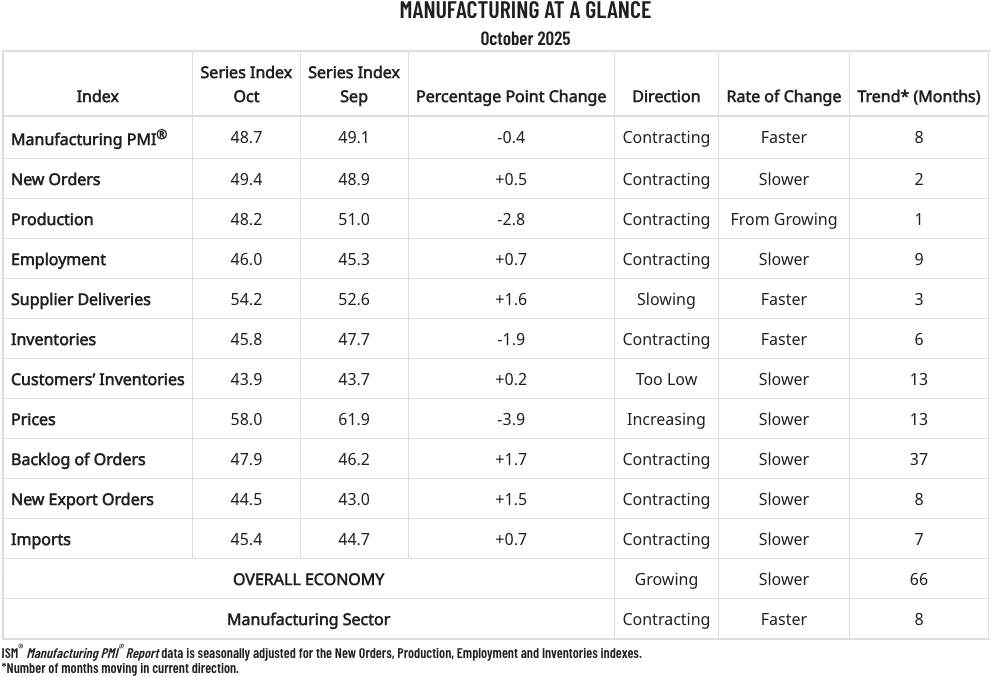
Four manufacturing industries reported new orders growth in October (vs. five in Sept.): primary metals; plastics & rubber; fabricated metal; and transportation equipment, while 11 industries reported a decline (led by apparel, leather & allied products; textile mills; and paper products).
On the production side, four industries reported growth during October: primary metals, transportation equipment; plastics & rubber; and fabricated metal, while 12 industries reported a decline (led by apparel, leather & allied products; textile mills; and wood products).
October PMI Respondent Commentary
- “Business continues to remain difficult, as customers are cancelling and reducing orders due to uncertainty in the global economic environment and regarding the ever-changing tariff landscape.” (Chemical Products)
- “Decrease in domestic demand for finished products has resulted in slower manufacturing and an increase of raw material in inventory.” (Petroleum & Coal Products)
- “In general, business is really strained. Money is sitting tighter, and geopolitical changes add to the uncertainty/risk factor. Even medical fields are feeling the pressure.” (Miscellaneous Manufacturing)
- “Sales continue to underperform in our automotive OEM and industrial divisions. Our aerospace and automotive aftermarket are the only areas performing slightly above budget. This is the third month of lower-than-expected sales, and the remainder of the year outlook is not looking better. Sales are expected to be slightly less than in 2024.” (Fabricated Metal Products)
- “Tariffs continue to be a large impact to our business. The products we import are not readily manufactured in the U.S., so attempts to reshore have been unsuccessful. Overall, prices on all products have gone up, some significantly. We are trying to keep up with the wild fluctuations and pass along what costs we can to our customers.” (Machinery)
- “The commercial vehicle (CV) market remains depressed as customers continue to delay vehicle purchases. Uncertainty in price and transportation demand remains the center of attention. U.S. trade policy and reciprocal actions by China in the form of export controls on rare earths and semiconductors, as well as ocean freight carrier restrictions, have once again caused a lot of stress in supply lines. The CV industry is now bracing for the next round of tariffs focused on commercials vehicles, scheduled to begin on November 1.” (Transportation Equipment)
- “The tariff trade war has negatively impacted agricultural export markets, driving down demand and price. This negatively impacts farmer revenue and the likelihood of farmers investing in new equipment.” (Machinery)
- “The unpredictability of the tariff situation continues to cause havoc and uncertainty on future pricing/cost. But even with the tariffs, the cost to import in many cases is still more attractive than sourcing within the U.S. Challenges with tariffs on production equipment necessary for internal production makes it difficult to justify expansion of capacity.” (Computer & Electronic Products)
- “Volatility in some of our highly exposed commodity markets has tempered a bit, thanks to improved weather conditions and overall downward pressure on pricing. Tariffs continue to remain difficult to quantify, manage and deal with in general, since they continue to impact us day-to-day and our bottom line.” (Food, Beverage & Tobacco Products)
- “Wonder has turned to concern regarding how the tariff threats are affecting our business. Orders are down across most divisions, and we’ve lowered our financial expectations for 2025.” (Chemical Products)
Related Posts
-

A new chair will succeed Timothy Fiore in June 2025 to lead ISM’s Manufacturing Business…
-
September's PMI rose slightly to 49.1% but stayed in contraction territory as some manufacturers report…
-

U.S. manufacturing activity remained in contraction during June for a fourth straight month, but the…