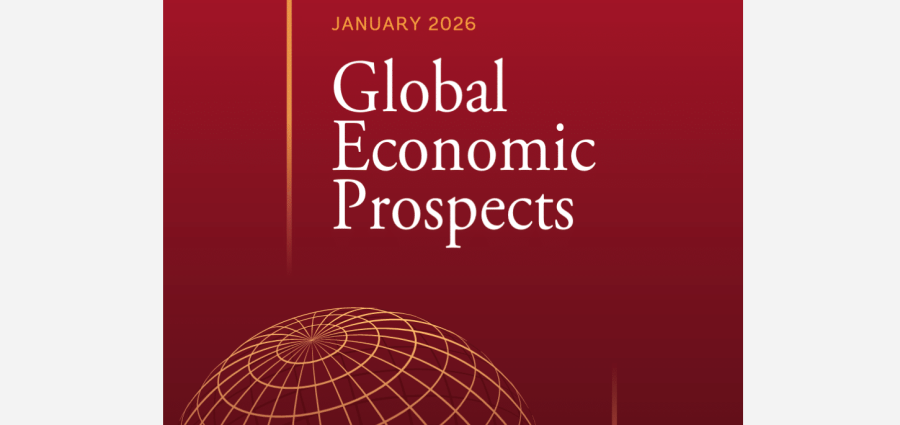
The World Bank upgraded its outlook for both global and U.S. economic growth in its January Global Economic Prospects report, citing stronger-than-expected momentum through 2025, resilient trade activity and a growing contribution from artificial intelligence-related investment.
Global GDP growth is now projected at 2.6% in 2026, reflecting an upward revision from the Bank’s prior outlook as economic activity proved more durable amid elevated trade tensions and policy uncertainty. The bank said the global economy capped a five-year recovery from the 2020 recession at a pace “unmatched in more than six decades,” supported by inventory stockpiling, strong financial market risk appetite and a surge in AI-related capital spending.
The World Bank estimates that the global economy grew by 2.7% in 2025 — up from the 2.3% it expected this past June. For 2026, the forecast is for 2.6% growth, which tops the bank’s previous 2.4% outlook.
The bank said the resilience reflects better-than-expected growth — especially in the United States, which accounts for about two-thirds of the upward revision to the 2026 forecast.
“In 2025, growth was supported by a surge in trade ahead of policy changes and swift readjustments in global supply chains. These boosts are expected to fade in 2026 as trade and domestic demand soften,” the World Bank said in a news release. “However, the easing global financial conditions and fiscal expansion in several large economies should help cushion the slowdown, according to the report.”
Further ahead, the group calls for 2.7% growth in 2027.
The World Bank also upgraded its outlook for the U.S. economy, pointing to stronger domestic demand and productivity tailwinds tied to technology investment. The development bank estimates that the U.S. economy grew by 2.1% in 2025 — far ahead of the 1.4% growth it expected in its mid-year forecast, though still a slowdown from 2024. Meanwhile, the World Bank lifted its 2026 U.S. growth forecast from 1.6% to 2.2%.
According to the report, nearly 90% of advanced economies are now above their pre-2020 per-capita income benchmarks. That divergence remains a defining feature of the outlook: more than one-quarter of emerging market and developing economies (EMDEs) — particularly low-income and conflict-affected countries — have yet to recover lost ground, underscoring uneven global demand conditions heading into 2026.
Looking ahead, the World Bank expects global growth to moderate modestly as several temporary supports fade. Trade growth is projected to cool as firms unwind inventory accumulation and the effects of higher tariffs intensify. Still, the bank noted that both advanced economies and EMDEs demonstrated greater adaptability to trade frictions than previously anticipated, helping stabilize near-term growth expectations.
Risks to the outlook remain tilted to the downside. The bank warned that an escalation in trade restrictions, renewed financial market volatility or inflation surprises could weaken activity. On the upside, broader diffusion of AI-driven investment and continued supply-chain adaptation could extend the current expansion.
The Key Takeaways for Distributors
For wholesalers distributors, the upgraded outlook reinforces expectations for steady — if unspectacular — global demand growth entering 2026, led by advanced economies and technology-intensive sectors. At the same time, uneven recovery across emerging markets suggests continued regional divergence in end-market demand, pricing power and capital spending trends.
The report also emphasized the importance of policy reforms to sustain longer-term growth, particularly in EMDEs, calling for improved trade environments, stronger macroeconomic frameworks and investment in physical, digital and human capital infrastructure.
Overall, the World Bank’s latest assessment signals a more resilient global economy than previously expected — with the U.S. remaining a central growth engine — even as structural and geopolitical headwinds continue to shape the trajectory beyond 2026.
Related Posts
-

The distributor said revenue growth was again driven by the company's largest strategic accounts.
-
The IMF modestly raised its global and U.S. growth forecast for 2025 and 2026, citing…
-

While annual sales expectations tracked down slightly overall from midyear, almost 1 in 3 members…