Editor’s Note: This is one of two articles based on our Feb. 4 MDM Podcast episode and the first in a three-part article series to be packaged into an MDM Case Study. See Part 2 here, and stay tuned for Part 3.
In an era when many distribution platforms pursue scale through cost-center centralization and sweeping operational uniformity, Singer Industrial is charting a different path.
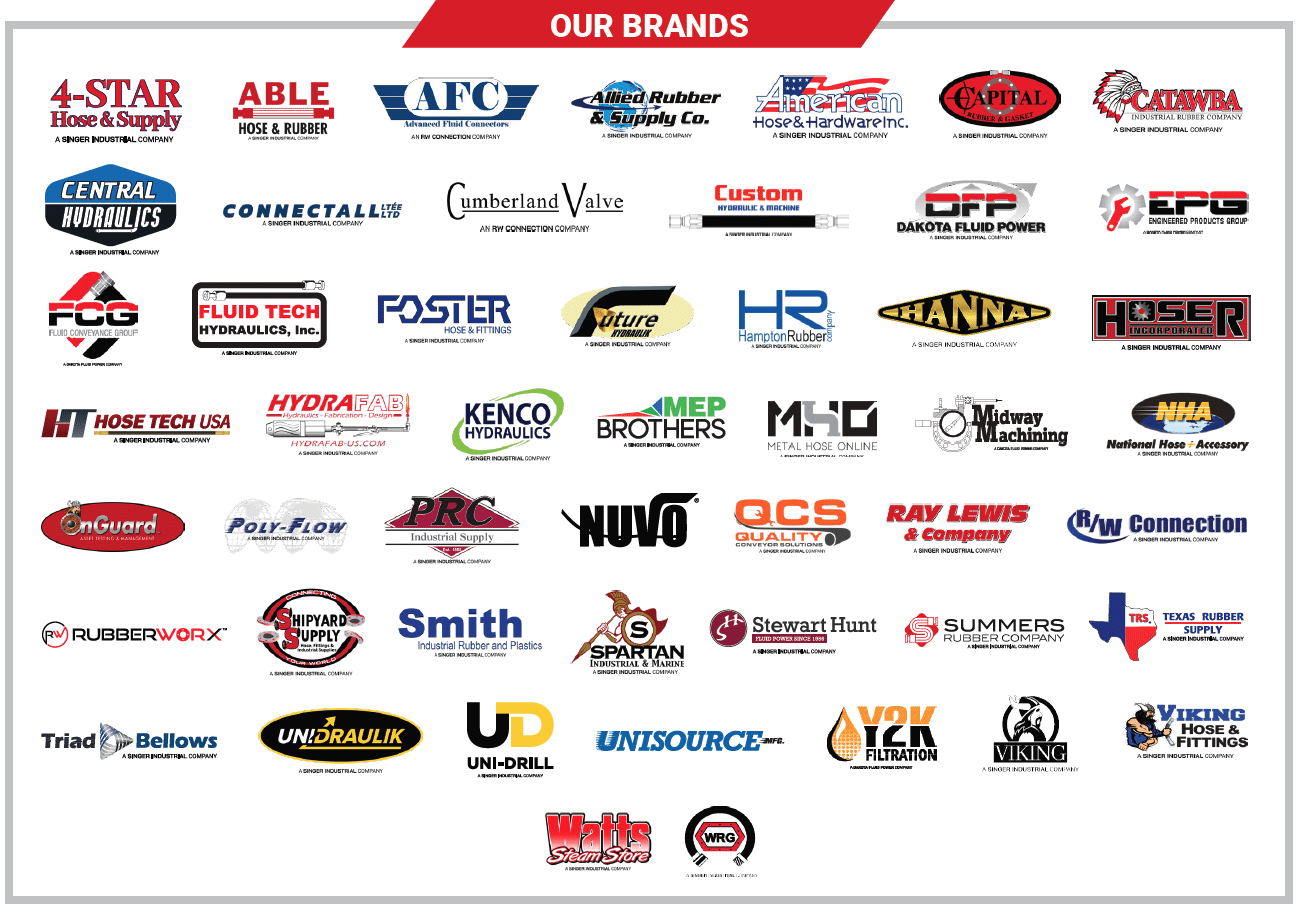
The Dallas-based industrial rubber, fluid power and automation distribution platform has built a growing, diverse portfolio of legacy distributors — now more than 55 operating companies across the U.S. and Canada — by leaning into what President Pete Haberbosch calls “coordinated autonomy.” This philosophy, he argues, unlocks the benefits of scale while preserving the local culture, relationships and decision-making that make longstanding distributors successful.
Singer’s model stands in contrast with the standard roll-up playbook. Instead of imposing uniform systems, centralized staffing or brand homogenization, Singer extends resources where they create value — and lets its partner companies operate with meaningful independence.

“We aren’t in the business of making every business look the same,” Haberbosch says. “We’re in the business of enabling each local team to continue doing what they do best” — backed by shared capabilities and strategic support that enhance, rather than replace, local strength.
Haberbosch has been in the industrial supply channel for more than 30 years and joined Singer in 2014 as Vice President of its Hampton Rubber business unit and managed several field units before his promotion to company president in mid-2024.
A Platform Rooted in Legacy and Local Strength
Singer’s history is one of aggregation without assimilation. The company began in industrial rubber distribution and has expanded through a steady cadence of acquisitions and organic growth, a strategy supported by investment from a continuation fund anchored by AEA Investors’ Small Business Private Equity strategy. In 2023,
The company was founded in 1999 as Singer Equities, which became Singer Bishop Products (SBP) Holdings. In 2023, SBP rebranded as Singer Industrial as private equity owner AEA Investors completed a $384 million continuation fund to hold a majority stake — demonstrating long-term support for Singer’s growth and acquisition strategy. AEA has sponsored Singer since 2011.
Today, Singer’s network spans over 110 locations and employs roughly 1,500 people while offering a wide array of products and services that include hoses, conveyor belts, fluid power components, filtration systems, automation products and more. Many of the partner companies Singer brings into its fold have histories stretching back decades — some more than a century — with deep customer relationships and leadership that have been built over generations.
Here’s just a handful of Singer’s most longstanding companies:
- PRC Industrial Supply (Westbrook, ME) – celebrated 125 years in business in 2025 – acquired in 2018
- Hanna Rubber Company (Kansas City, MO) – celebrated 100 years in business in 2025 – acquired in 2012
- Hampton Rubber Company (Hampton, VA) – celebrated 70 years in business in 2025 – acquired in 1999
- Custom Hydraulic & Machine (Kent, WA) – celebrated 60 years in business in 2025 – acquired 2024
Those deep local roots are exactly what Singer aims to nurture rather than homogenize. “There’s real value in legacy,” Haberbosch says. “Those businesses have earned trust in their markets. You remove that at your peril.” His critique of traditional centralization is practical as well as cultural: “We’ve seen models where the pendulum swings too far toward corporate control and the things that made a business special are lost.”
Besides acquisitive expansion, Singer enhanced its buying power and network capabilities in 2024 when it joined AD’s Bearings and Power Transmission division.
What Coordinated Autonomy Actually Means
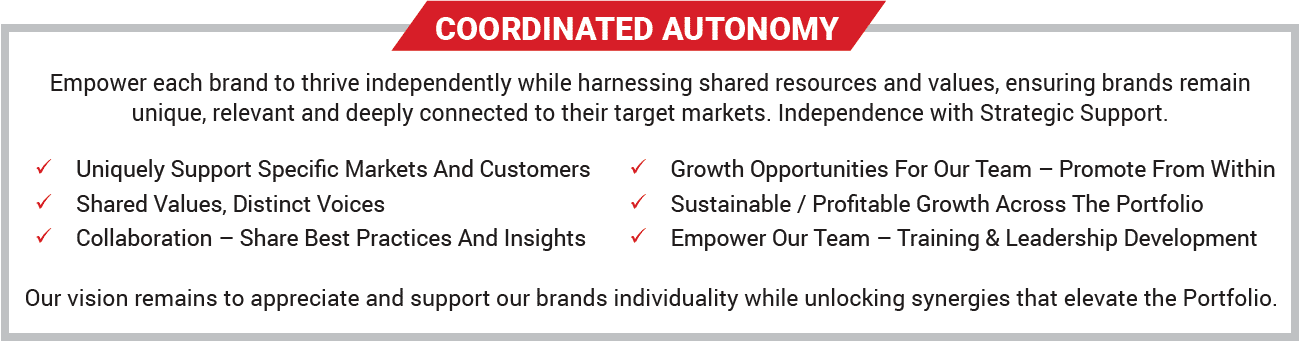
So what does Singer mean by coordinated autonomy? At its core, the model blends shared strategic alignment and functional support from the platform with local decision rights and operational control left in the hands of the acquired company’s leadership.
Haberbosch explains it this way: “Coordination without autonomy is just centralization. Autonomy without coordination is fragmentation. The magic happens when both exist together.” This duality is central to Singer’s view of value creation: local teams are empowered to run their business, but they’re connected to a platform that can amplify purchasing scale, marketing reach, back-office efficiencies and talent development.
Practically speaking, coordinated autonomy translates into several operating principles:
- Local leadership stays in place, typically with existing owners or managers continuing in leadership roles. “We’re not aiming to replace every leader,” Haberbosch says. “We want leadership continuity because they are the ones who know their customers and markets best.”
- Shared services are deployed where it makes sense, such as in IT, human resources, compliance support and strategic procurement, creating cost advantages and reducing administrative burden.
- Best practices are shared across the network, enabling local businesses to learn from each other’s successes without mandating a single way of working.
Haberbosch puts it bluntly: “We’ve seen how centralization can streamline reporting, but if you strip away local culture and decision ability, you often drive away the very people who create customer loyalty.”
The Logic Behind Singer’s Approach
Singer’s coordinated autonomy is not just a cultural choice — it’s strategic. The industrial distribution sectors Singer operates in — including maintenance, repair and overhaul (MRO), fluid power and automation — are highly relationship driven. Sales often stem from trust built over years, and customers value deep technical expertise and responsiveness from their local provider.
“Customers don’t want to feel like they’re just another number,” Haberbosch says. “They want a partner who understands their business and can respond with solutions that fit their specific needs.”
By empowering local teams, Singer aims to preserve exactly that customer experience, while layering on platform advantages that private equity investors and sophisticated acquirers value: buying scale in purchasing, broader service offerings, stronger access to talent and centralized legal, finance and HR infrastructure that smaller distributors typically lack.
This approach also differentiates Singer in the competitive M&A market for distribution businesses, where sellers are increasingly evaluating potential partners not just on price but on cultural fit and the future role of leadership post-transaction. “When someone is considering selling their business, they’re asking, ‘Will I have a voice here? Will my team matter?’ Coordinated autonomy answers that question positively,” Haberbosch says.
Facing Skepticism and Reinforcing Trust
Of course, Singer’s model isn’t without skeptics. Some industry observers question whether decentralized models can deliver the same financial performance as heavily standardized platforms. But Singer’s leadership views that skepticism as rooted in outdated assumptions.
“There was a time when the only path was centralization — ERP first, then everything else,” Haberbosch says. “But we’ve proven you can have disciplined financial and operational control without micromanaging every aspect of every local business.”
For Singer, success isn’t measured by how quickly a newly acquired company loses its identity; it’s measured by how quickly it accelerates growth while retaining its competitive edge. “Our success is when a partner company hits new growth milestones and their customers say, ‘You’re even better than before,’” he says.
A Model for a Fragmented Market
Singer’s coordinated autonomy is especially relevant in highly fragmented industrial distribution sectors where no single platform has dominant share and customer needs vary significantly by region and application. In such environments, maintaining agility and local expertise can be a competitive advantage.
Haberbosch notes that while industry consolidation continues, prospective partners are increasingly sophisticated in what they look for: strategic support, access to capital and back-office capabilities — but not the loss of identity or local decision-making. “Coordinated autonomy isn’t just our philosophy — it’s our value proposition in the M&A marketplace.”
Looking Ahead
As Singer continues its growth through acquisition and organic investment, coordinated autonomy will remain central to how it evaluates opportunities and builds value. For Haberbosch, the key is balancing scale with stewardship — ensuring that legacy distributors retain what made them successful while gaining the benefits of being part of a larger, more capable enterprise.
“We want to be a home for great distributors,” he says. “That means giving them the autonomy they need to thrive, and the coordination they need to compete and grow.”
Singer’s approach highlights a broader shift in distribution platform thinking — one that recognizes that centralization is not the only path to scale, and in some cases, it may not be the most effective one.
Up Next in This Series
In Part 2, we’ll get more granular into Singer’s M&A strategy and criteria when considering targets, and its disciplined approach to integration.