Editor’s Note: This is the first in a three-part series that will later be packaged into MDM’s next Case Study report. Click on images for hi-res version.
Grainger’s High-Touch Solutions business is best understood as an answer to a problem every industrial distributor knows well: MRO is essential, but it is rarely clean.
The products themselves matter, of course. Customers need safety, facility maintenance, material handling, janitorial, metalworking, plumbing, hand tool and countless other MRO items available when work must get done. But the bigger challenge for many customers is not the product category itself. It is the process around the product — how it is selected, approved, bought, stored, replenished, standardized and used across multiple sites.
That is where Grainger has increasingly built separation.
In the Store: MDM’s U.S. MRO Market Trends Report
A Model Built for Complex Customers
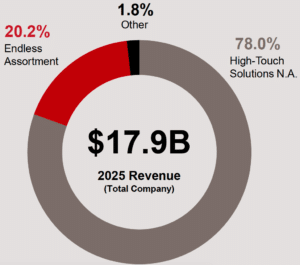
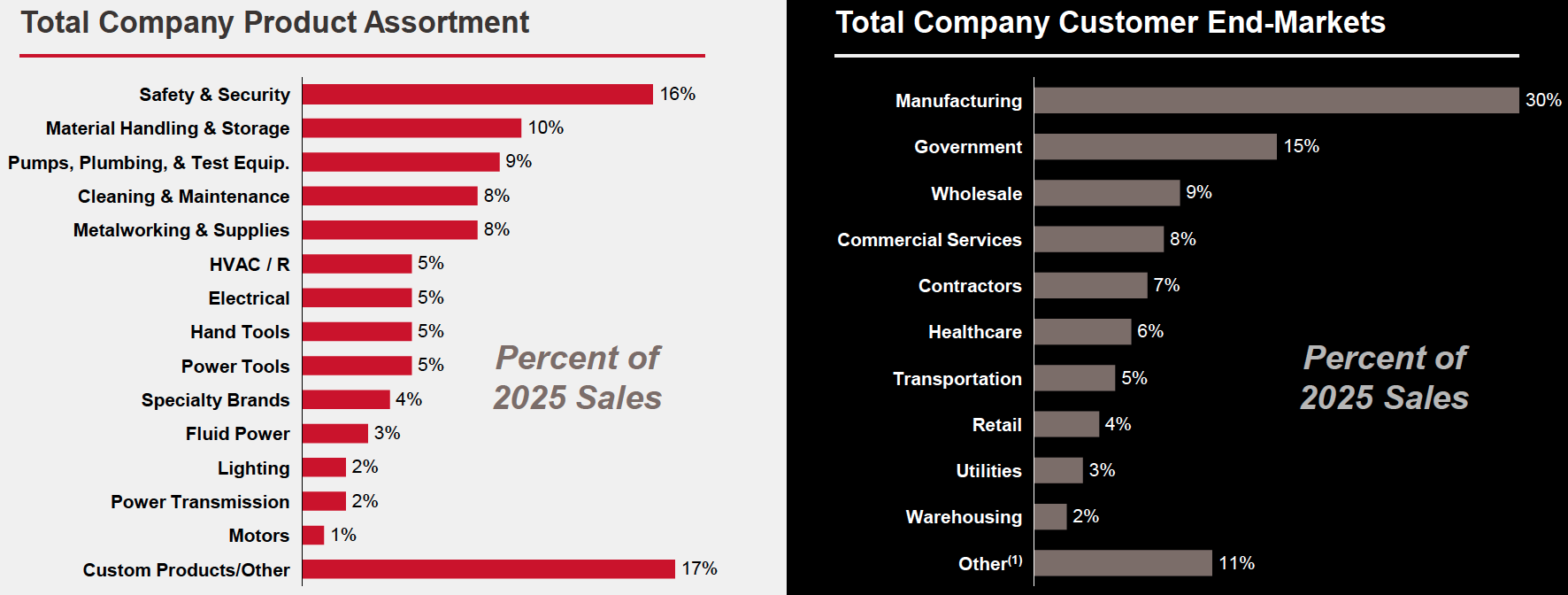
The company’s own segmentation makes the strategy clear. Grainger describes High-Touch Solutions N.A. as a model for large to mid-size customers with complex operations and processes, delivering value-added MRO solutions through specialists and curated digital experiences. That business represented 78% of Grainger’s $17.9 billion in 2025 revenue, while Endless Assortment accounted for 20.2%. And while Grainger touts its status as the largest MRO player — it has long been atop MDM’s Top Distributor List for Industrial MRO — it also notes its ~7% market share in a $200 billion addressable market, illustrating its fragmentation.
This is not a new pivot. In 2022, MDM examined how Grainger’s two-model structure separated High-Touch Solutions from Endless Assortment. High-Touch was already defined by complex buying needs, total cost of ownership, differentiated sales and services, and multiple order-origination points, including website, KeepStock, EDI/ePro, phone and branches.
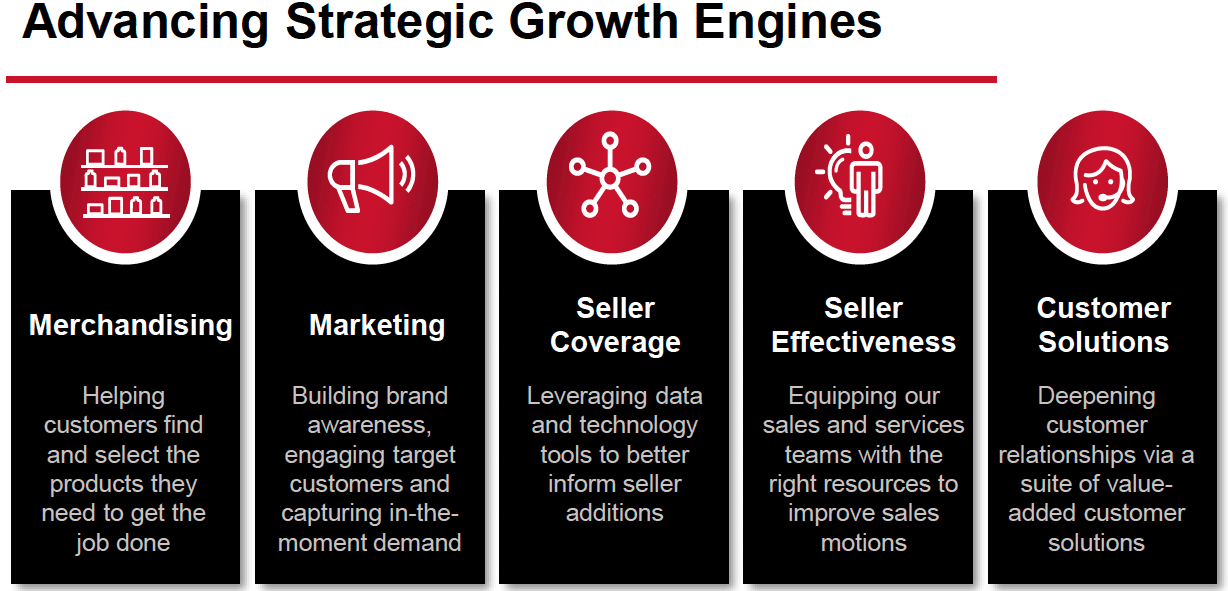
By 2024, the message was even clearer. MDM identified customer solutions as one of Grainger’s key growth engines, alongside merchandising, marketing, seller coverage and seller effectiveness. That article described customer solutions as Grainger’s way of helping customers save time and remove cost from procurement, inventory management, facility safety and maintenance, technical knowledge and supplier processes.
The 2026 version of that story is more mature. Grainger is not merely branding itself as a problem-solver. It has built an operating model around the idea.
“We want you to buy less in total but buy more from Grainger.”
The Cost Is Around the Product
Paige Robbins, Chief Operations and Strategy Officer, put it plainly when speaking to industry media at the company’s biennial Grainger Show in March 2026: “The products are just step one.” Customers, she says, are increasingly looking for value-added solutions because “they don’t want to manage MRO. MRO is messy, it’s hard.”
That is the core of Grainger’s High-Touch advantage. The company wins when it turns MRO from a purchasing burden into a managed operating function.
Sam Johnson, Group Vice President of Customer Solutions, framed the customer challenge as a total-cost problem. Customers want to do more with less, and Grainger’s role is to help them improve productivity, reduce waste and lower total operating cost. His clearest line captures the strategy’s underlying logic: “We want you to buy less in total but buy more from Grainger.”
That may sound counterintuitive for a distributor. But in MRO, total spend and supplier share are different questions. Many customers buy from fragmented supplier bases, carry duplicate inventory, route low-dollar purchases through expensive approval workflows and lack visibility into what sits on shelves across facilities. Reducing total MRO waste can still shift more of the remaining, better-managed spend to Grainger.
Where MRO Spend Leaks
Johnson’s examples show how large the hidden-cost opportunity can be. He describes a procurement process in which seven people and about $100 in process cost were involved in buying a $17 hammer. He also cites two inventory-management problems Grainger commonly sees: up to 30% of products customers buy and place on shelves may never get used, while maintenance workers entering a storeroom walk away without the product they came for about 18% of the time.
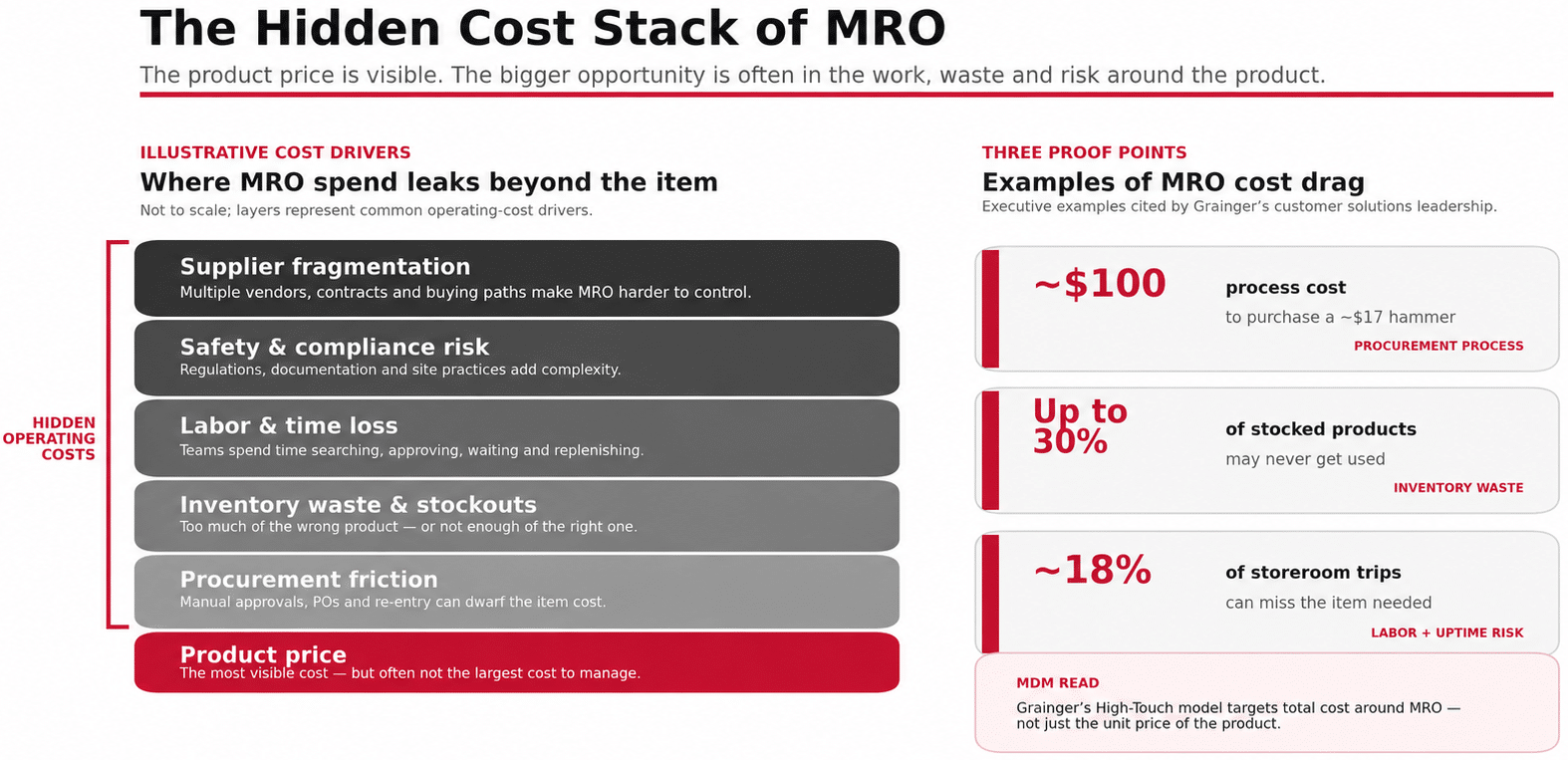
Those are not simply purchasing problems. They are labor, process, visibility and uptime problems.
Grainger’s High-Touch model attacks those problems through several connected capabilities. Procurement specialists help map inefficient purchasing workflows and identify opportunities to digitize the process through Grainger.com, third-party procurement platforms or direct electronic connections. Inventory solutions help customers determine what to stock, where to stock it and how to maintain it. Safety specialists help customers navigate changing regulations, assess risk and identify gaps in compliance. Grainger also manages third-party service-provider relationships in areas such as facility maintenance, where customers may lack the labor or vendor network to complete work efficiently.
The broader services strategy also shows how Grainger turns customer data into operational insight. Customers increasingly want to understand what they buy, how they buy it, how long it takes to buy it, what inventory they carry, what they actually use and where they are inconsistent across sites. The more Grainger can interpret that data, the more it can point customers toward opportunities to reduce cost and improve productivity.
That is an important distinction. Dashboards alone do not create value. Interpretation does.
Consider product standardization. A customer may believe it has a product purchasing problem when the real issue is uncontrolled variation. If 100 sites are buying dozens of types of safety glasses, the solution may not be a better price on each pair. The larger opportunity may be narrowing the approved set, improving compliance, removing rogue spend and placing the right products in controlled inventory locations. Grainger’s ability to see those patterns is part of the value it brings.
The same logic applies to onsite support and vendor-managed inventory. Those programs depend on trust because Grainger is not simply filling orders; it is influencing what sits on shelves, how products are replenished and how customer teams spend their time. The relationship deepens when customers see that the goal is not to overstock or overcomplicate the site, but to make the operation easier to run.
Why High-Touch Keeps Compounding
Grainger’s 2025 annual report reinforces how these pieces fit together. In High-Touch Solutions N.A., customers are typically mid-size and large businesses with complex purchasing operations and processes. Many use sophisticated electronic purchasing platforms that communicate directly with Grainger’s systems through eProcurement technology. Sales and service representatives help customers select the right products and reduce costs by using Grainger as a consistent source of supply, while KeepStock serves customers onsite with insights, tools and inventory-management processes.
The performance proof points remain strong. In the first quarter of 2026, High-Touch Solutions N.A. sales increased 10.5% to $3.75 billion, while operating margin improved 60 basis points to 18.3%. Total company sales increased 10.1% to $4.74 billion, with operating margin up 110 basis points and diluted EPS up 18.2%.
That matters because Grainger’s High-Touch story is not only about being helpful. It is about building a growth model around customer productivity.
The strategic lesson for distributors is clear: Grainger is not defining service as responsiveness alone. It is defining service as the ability to remove work from the customer’s system. That is a higher bar. It requires product breadth, technical expertise, data, digital integration, seller effectiveness, inventory-management capabilities, supply chain reliability and enough customer trust to influence how work actually gets done.
Many distributors can solve one of those problems. Grainger’s advantage is that it can connect them.
That is why its High-Touch model remains central to its market outperformance. Grainger is not simply asking customers to buy more products. It is making the case that customers can run MRO better with Grainger at the center of the process. And in a category as fragmented, under-managed and operationally consequential as MRO, that may be the company’s most powerful growth engine.
Up Next
In part 2 of this series, we’ll detail how Grainger’s competitive advantage in the markets it serves is not just its massive SKU count. It is the company’s ability to curate complexity through merchandising discipline, supplier management, private label, standardization and product data.