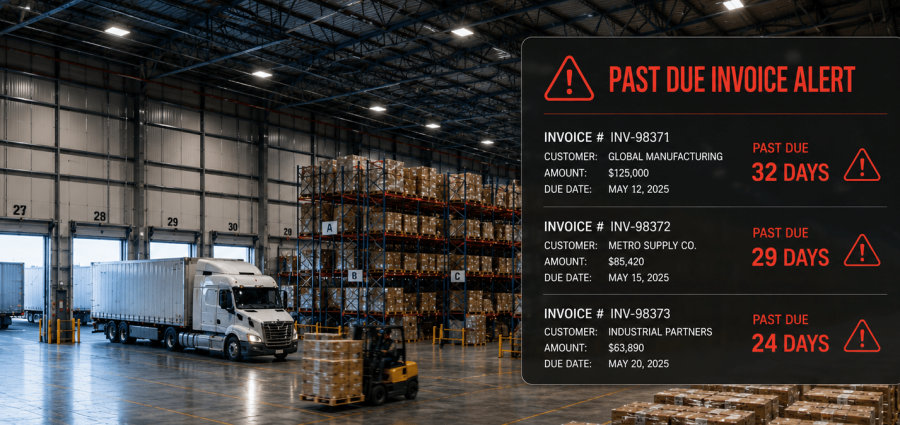
Most distributors consider late payments an unavoidable cost of doing business. They don’t have to be, but fixing them won’t come from traditional approaches.
Distributors’ supply chain is under pressure from every direction. Tariffs are high, retaliatory trade measures are reshaping supplier relationships overnight, and freight costs are volatile. Persistent inflation has compressed already-thin margins, and every customer is stretching their payment cycles while suppliers demand faster settlements.
In this environment, late payments aren’t just an administrative nuisance. They compound every other pressure. But many distributors mistake overdue invoices for a collections problem. In reality, a late payment is the result of misalignment across the revenue lifecycle, including contracts, pricing, billing, and fulfillment.
Distributors that consider the order-to-invoice-to-cash lifecycle as a coordinated system, not a series of handoffs, will find and fix issues before an invoice goes out.
Collections Isn’t the Problem
To understand why cash gets stuck, it’s important to look beyond collections processes to the structural friction points that slow cash conversion and make overdue payments a recurring problem.
- The middleman squeeze
Across the supply chain, distributors are naturally caught in the middle. Customers want to extend payment cycles while upstream suppliers push for faster payment to offset their own elongated cash cycles—often exceeding 70 days. This “middleman squeeze” forces distributors to absorb the gap. Cash goes out faster than it comes in, increasing reliance on credit lines and tightening working capital. Without better coordination across the revenue chain, the imbalance grows. - Fragmented systems
Many distributors still rely on a patchwork of ERP, billing, CRM, and logistics platforms that don’t align. As a result, invoice data is hard to find. Pricing may differ across systems, and order details may not match contract terms. Even small discrepancies can delay a customer’s invoice approval, pushing payments further out. - High volume disputes
A 2026 study of finance leaders found 7% of all invoices contain errors and 54% of all disputes take up to 10 days to resolve. Pricing discrepancies, partial shipments, and unclear contract terms that stem from information gaps and inconsistent processes routinely trigger questions, and resolution cycles can stretch for days or weeks. Over time, a high volume of disputes becomes a serious drag on cash flow. - Landed cost volatility and tariff complexity
Customers may pause payment to validate fluctuating fuel charges and freight costs, especially when tariffs shift quickly or retroactive adjustments are common. Distributors experience a growing gap between what is invoiced and what customers expect to pay without an automated way to reflect these changes.
Consequences Cost More Than a Late Check
The downstream effects of late payments are easy to see. Higher days’ sales outstanding (DSO) leads to tighter working capital. But less visible costs also have an impact.
Efficiency suffers as the finance team must spend more time on reconciling discrepancies and addressing disputes, leaving less time for higher-value, strategic work. Supplier relationships are strained when they expect but don’t receive timely payment. Inconsistent billing and frequent disputes erode customer trust, making future transactions more complex.
Closing Payment Gaps: From Reactive Collections to Proactive Revenue Management
Rather than focusing on collections as the primary way to reduce late payments, think about order-to-invoice-to-cash as a single system. Payment gaps can be closed in these ways:
Work from a unified data foundation: As long as pricing, contracts, orders, and billing live in different systems with different versions of the truth, disputes will continue. One source of truth across revenue operations, including pricing, contracts, orders, and billing, is the foundation for faster cash conversion. When data is consistent from contract to invoice, the error rate drops and customer confidence goes up.
Make billing contract-driven. When billing is derived directly from the contract, the gap between what gets invoiced and what the customer expects to pay shrinks dramatically. Fewer surprises mean fewer disputes and faster payment.
Use AI to replace manual chasing. Traditional collections is largely reactive. Send a reminder, wait, escalate, repeat. AI-powered collections change this model by surfacing past behavior and identifying at-risk accounts. It’s not about nagging more efficiently, but knowing which accounts need attention before they become problems.
Price for the real world. Tariffs shift and freight costs move, so the billing system needs to keep up. The ability to reflect real-time cost changes and communicate them clearly to customers reduces payment delays when landed costs don’t match expectations.
Cash Performance is a Competitive Advantage
Addressing these underlying revenue management issues can do more than accelerate collections, they can create a more predictable, resilient cash flow model that supports growth. In an industry defined by complexity and margin pressure, the ability to convert revenue into cash efficiently is not just an operational improvement, it’s a competitive advantage.
Related Posts
-

The agency plans to overhaul its current sytem that would require about 4.4 million man-hours…
-

Distributors often don’t lack strategy — they lack execution. Drawing from industry research and frontline…