“AI in distribution is like sex in high school: everyone’s talking about it, hardly anyone is doing it, and those who are… aren’t doing it well.”
A room of distribution leaders laughed at a vendor’s opening line, seconds before he launched into yet another pitch on how AI would “revolutionize” the industry.
Accounts payable? There’s AI for that. HR? Machine learning has it covered. Warehouse ops? Automate away. Next up: ChatGPT for office gossip?
In the Store: MDM’s 2025 Economic Outlook Report (Premium access)
No wonder distributors feel overwhelmed. The industry went from zero to ninety overnight, with vendors shouting: act now or be left behind. The problem? With vendors pulling you in a dozen directions, it’s nearly impossible to know where to focus.
We found ourselves asking the same question as distributors — where is the best place to invest in AI?
We are technologists with experience at Google, Stripe, McKinsey and PayPal. As part of our MBA program at Stanford, we led a research project on technology in distribution, interviewing more than 200 executives, software providers, trade associations, buying groups, and industry media.
Through this research, we developed a framework to cut through the noise and focus on where AI can create real, measurable impact. We tested this framework with nearly a dozen distributors and saw their GMROI improve by 20-30%. Now, it’s time to share it with you.
PREMIUM – From Hype to Adoption: Benchmarking 3 Years of AI Progress in Distribution (July)
A Scientific Approach to AI Investment
Where should distributors invest in AI? It’s the question we’ve heard again and again and the one we’ve spent the last two years working to answer.
Our answer is to use the scientific method. It’s a simple but powerful process where you:
- Observe
- Hypothesize
- Test
- Analyze
- Conclude
This is the same method the Wright brothers used to get the first airplane off the ground, NASA used to put a man on the moon, and the Oakland A’s used in Moneyball to outthink richer teams.
Let’s break that process into practical steps and share what we learned working side by side with industry leaders.
MDM’s 2Q25 MarketPulse Report (Premium access)
1) Observe – Brainstorm High-Impact Areas
The first step is to identify where AI could have a transformational impact if it succeeds.
The good news: your employees already know where the pain points are. Ask people at all levels of the organization a simple question:
“If you had a magic wand and could create any tool to make your job easier, what would it be?”
Their answers will surface your biggest opportunities. From there, build a shortlist of three to five areas to carry forward.
Our research:
In each of our 200+ distributor interviews, we started with the magic wand question. The answers were remarkably consistent.
Distributors told us they struggled with demand forecasting and purchasing. They didn’t know what, how much, or when to buy. Sometimes they bought too little and had stock outs. Other times they bought too much and had dead inventory.
Distributors wished they could price dynamically, knowing they were leaving money on the table.
Distributors highlighted the ongoing challenge of hiring and retaining top talent.
These themes surfaced again and again: the “3 Ps.”
- Purchasing
- Pricing
- People
They may also be a strong starting point for your business but don’t take our word for it. Ask your own employees and build a shortlist for yourself.
In the Store: MDM’s U.S. MRO Market Trends Report
2) Hypothesize – Rank Your Ideas
Resources are limited. You can’t chase every idea at once. That’s why we developed a two-dimensional framework using return on investment and strategic leverage to help you prioritize where AI can create the most impact.
A) Return on Investment:
Only pursue ideas where the results can be measured clearly and tied to financial outcomes. If it can’t be quantified, it’s speculative and isn’t worth testing.
That’s why we find most vendor ROI claims misleading. The classic pitch goes: “Our tool cuts time spent on a task by 50%, multiplying the hours saved by salary and – voilà – ROI!”. Unless you’re planning to make layoffs, those “savings” never show up on the P&L. At best, they trickle down over years through natural turnover which is not exactly a game-changer. We also hear that freed up time lets employees do “more strategic work.” Sounds nice, but what strategic work? Are they trained for it? And when time is freed in scattered five-minute chunks, it almost never adds up to real productivity.
On slides, these claims look convincing. In practice, they collapse. Anchor ROI tests to outcomes you can defend in dollars and filter out anything that can’t.
B) Strategic Leverage:
ROI tells you if an AI initiative pays for itself. Strategic leverage shows you something bigger: how success in one area can strengthen your long-term competitiveness, not just short-term efficiency.
To assess this, ask:
- Core relevance: How central is this use case to your business model?
- Downstream impact: Will other functions benefit if this improves?
- Scalability: Can it extend across products, regions, or customer segments?
- Resilience: Will it help you absorb supply chain shocks?
Put simply: when you succeed in AI in the right function, the rewards compound. Improvements cascade through the business, creating durable advantages rather than isolated wins.
Our research:
When we applied this framework with distributors, one area consistently rose to the top: demand forecasting and purchasing.
- A) Return on Investment: If you know what your demand is going to be, you can buy exactly the right things, at the right times, in the right quantities. This improves sales with higher fill rates and fewer stockouts. This lowers costs because you can purchase fewer items and hold less safety stock. And this optimizes working capital by reducing dead inventory and freeing up cash flow.
- B) Strategic Leverage: When purchasing improves, the uplift touches every corner of the business. Fewer stockouts lead to happier customers. Less excess stock reduces carrying cost and improves cash flow that can be used to grow your business (e.g., acquisition, category expansion). Fewer purchase orders lighten the load for back-office teams and warehouses. It’s no surprise purchasing scored highest: it sits at the heart of distribution, and improvements here ripple through every part of the operation.
3) Test – Pilot an AI Use Case with Clear Metrics
To test your hypothesis, you need to design a focused experiment. Start by asking three questions:
- Metrics: What are the main metrics that you care about related to the idea you chose?
- Sample: Where can you run a controlled test: a product line, geography, or customer segment?
- Success: What specific uplift would justify scaling?
With those answers in hand, bring in a vendor for a proof of concept. Have them sign an NDA, share a representative data sample plus any business context they’ll need, and challenge them to show exactly how their solution performs on your business.
Proof of concept cuts through hype: no glossy claims, no inflated case studies, just data-driven results for your company. Define success together, measure it clearly, and use that evidence to decide whether to expand.
Our research:
To put this framework into practice, we partnered with 10 distributors and played the role of vendor, testing how AI-driven demand forecasting could improve their businesses.
- Metrics: We chose inventory turns, GMROI, and total inventory dollars held
- Sample: We ran the pilot on three product groups
- Success threshold: A 5% improvement across these metrics would justify scaling
Each company provided three years of purchasing, inventory, and sales data in a one-time transfer, designed to keep the workload light. We then worked with Jay Shitole, a former leader in Walmart’s Applied AI Lab for demand forecasting, to build and train a machine learning model on 2.5 years of the data provided. The model was kept blind to the final six months and tasked with predicting demand and simulating purchasing decisions for that period.
To ensure an apples-to-apples comparison, the simulation incorporated all the real-world constraints distributors face: lead times, minimum order quantities, free-freight thresholds, rebates, and so on. We compared what the model predicted with what the 10 distributors actually purchased over the six month period.
4) Analyze – Focus on the Numbers
Once the pilot is complete, don’t settle for a glossy summary. Sit down with your vendor and dig into the details. High-level metrics are useful but the real insight comes from comparing the results directly against your own data.
Expect gaps. No model will capture every nuance of your business on the first try. That’s not a flaw, it’s the point of the exercise. Your role is to fill in the missing context, refine the assumptions, and send the vendor back for another run. Each iteration brings the results closer to the reality of your operations.
Our research:
Across 10 distributors, our model’s predictions improved inventory turns, GMROI, and average inventory levels by 20-30% while maintaining service levels. In some cases, sales even grew as the model flagged hidden demand in previously out-of-stock items.
To make the impact tangible, we built a dashboard where partners could drill down to specific SKUs. They could see how the model spotted demand shifts earlier than they did and how that translated into smarter, more accurate purchasing decisions.
5) Conclude – Double Down or Pivot
Once you have results, ask the simplest question: did the (hopeful) uplift clear your threshold for success?
- If yes: make a plan to scale to new product groups, regions, or vendor/customer sets
- If no: don’t treat it as failure. Go back to your shortlist, pick the next-best idea, and run the process again
The point isn’t to get it right on the first try. The point is to run disciplined, low-risk experiments until you find where AI creates real, repeatable impact. Each cycle sharpens your understanding and increases your odds of a breakthrough.
Taken together, these small bets add up. Keep iterating, and you’ll discover the use cases that truly transform your business with AI.
Our research:
The results of applying AI to demand forecasting were clear: every distributor we worked with is now prioritizing AI to purchase more accurately and strengthen working capital.
And this is just the beginning. Once purchasing is optimized, these companies plan to use the same framework to identify the next high-impact areas for AI investment.
We’re proud to have supported them on this journey and are excited to see how the industry continues to build on these wins.
The lesson: start with high-impact areas, test rigorously, and scale what works. That’s how AI stops being a buzzword and starts driving growth.
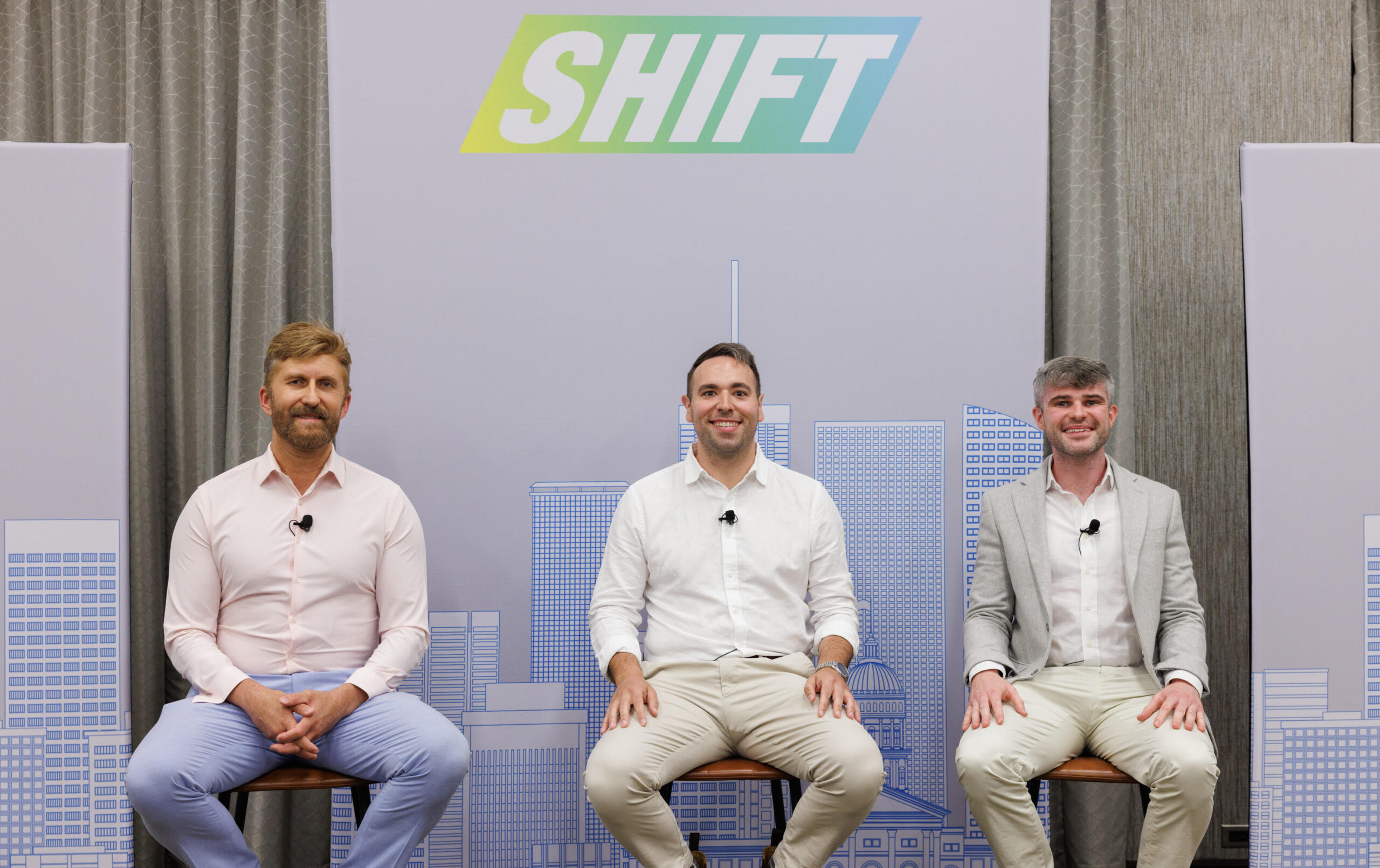
What’s next for Conor and Matt?
Through our research, we fell in love with distribution. The people reminded us of our own communities in Ireland and Long Island, where hard work, loyalty and integrity are core values.
The generosity we encountered left a lasting impression on us. We were invited to visit branches and distribution centers all over the country within minutes of meeting people. It became an easy decision for us that distribution is where we want to build our careers. We’re grateful for the welcome we’ve received and are excited to contribute to the industry’s future.
We’d love to keep the conversation going. If you have questions about this framework, want to talk through AI in distribution, or simply share ideas, you can reach us at [email protected].
Consider us your free AI consultants. We’re here to help distributors cut through the noise and find where AI truly delivers.
Related Posts
-

PHP Distribution promotes a new president and unveils a refreshed logo as it continues to…
-

Univar taps a new chemical distribution unit CEO, citing multi-channel sales expertise as key to…
-

The wire and cable redistributor appointed a new SVP of Distribution and Operations to lead…