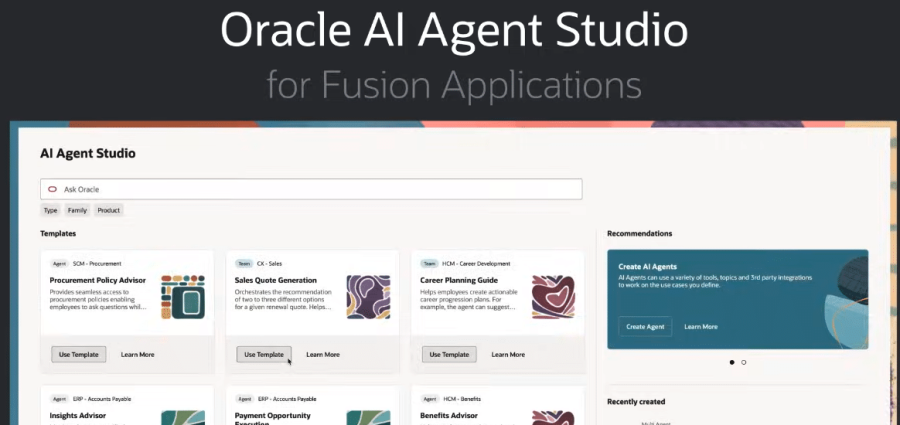
On March 24, Oracle announced a new suite of “Fusion Agentic Applications,” positioning them as a new class of enterprise software embedded within its Fusion Cloud Applications platform.
Unveiled at Oracle AI World in London, the applications are powered by coordinated teams of specialized AI agents designed to be outcome-driven, proactive and capable of reasoning-based decision-making.
Unlike traditional AI copilots or add-ons, Oracle said these applications are native to its transactional systems, enabling them to operate in real time with full access to enterprise data, workflows, policies and approval structures. This architecture allows the agents to both make and execute decisions directly within business processes at enterprise scale and under existing governance frameworks.
Oracle described the applications as teams of AI agents with defined roles, expertise and decision authority. These agents coordinate with one another to determine how and when work should be completed to achieve specific business objectives, continuously advancing outcomes through reasoning and execution.
The company emphasized that the applications move enterprise software beyond “systems of record” toward what it calls “systems of outcomes,” shifting the focus from managing processes to achieving results. Oracle executive vice president Steve Miranda said the goal is to help organizations “reason, decide, and act” within their operations while freeing employees to focus on higher-value activities.
Fusion Agentic Applications are built to operate within Oracle’s existing security and permissions framework, allowing them to autonomously carry out routine actions while surfacing exceptions or decisions that require human judgment.
At launch, Oracle introduced multiple agentic applications spanning functions such as finance, human resources, supply chain and customer experience. These applications are designed to address a range of operational use cases, including automating workflows, improving decision-making and accelerating execution across business processes.
Oracle said the new applications are part of a broader push to embed AI more deeply across its cloud application suite, enabling organizations to unlock additional capacity, improve productivity and achieve outcomes that were previously difficult to reach with traditional enterprise software.
Related Posts
-

Coming in late 2026, Oracle's NetSuite Next ERP includes embedded conversational intelligence, agentic workflows and…
-
Wesco has launched a new managed services suite aimed at helping integrators and end users…
-

Proton.ai launched an AI-powered “industry cloud” platform that unifies CRM, PIM, eCommerce and order automation…