
U.S. manufacturing activity held largely steady in September, according to the latest Purchasing Managers Index from the Institute for Supply Management, published Oct. 1.
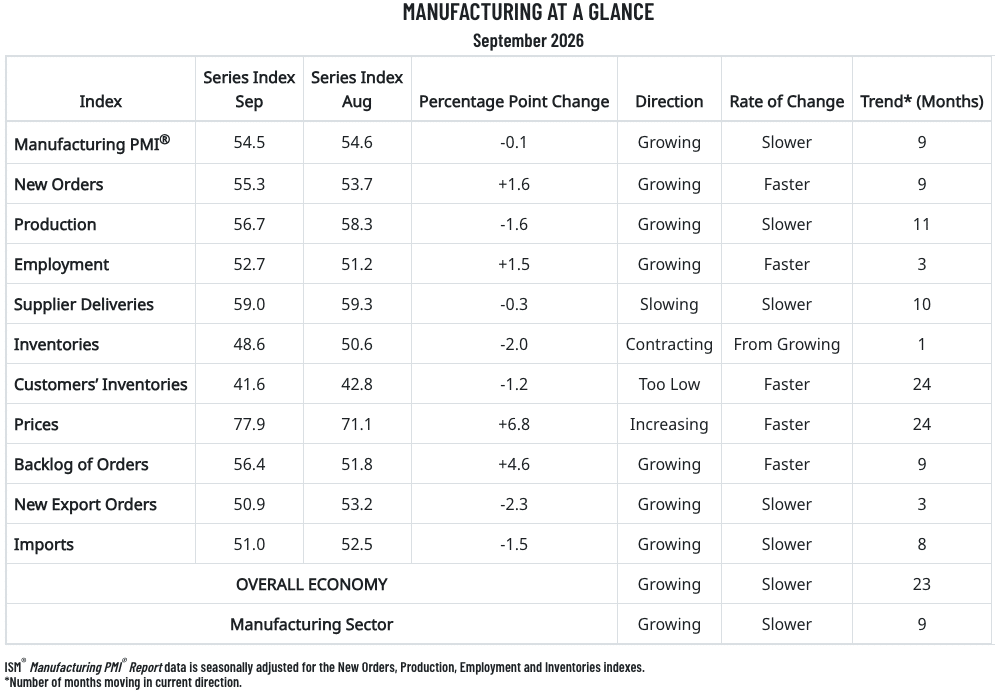
Seen as a reliable barometer for the industrial sector, the PMI registered 54.5% in September — one-tenth of a percentage point from August and trailing market expectations of an increase to 55.0%.
Two of the five core subindexes that comprise the PMI contracted in September (four in August), with Inventories down 2.0 points (-0.6 in August) to 48.6% into contraction territory and Production down 1.6 (-0.2) to 56.7%. Meanwhile, the index for New Orders improved 1.6 points to 55.3% after a 3-point slide in August; Employment improved by 1.5 (-1.6) and Supplier Deliveries ticked down 0.3.
Within the other five subindexes, Prices jumped 6.8 points after holding steady in August and declining by 1.9 and 9.1 points in July and June.
ISM shared that 2% of the manufacturing sector’s GDP contracted in August, compared to 22% in August, and 2% of GDP was in strong contraction (composite PMI of 45% or lower), — level with August.
Five of the six largest manufacturing industries expanded in September (same as August), in the order of Computer & Electronic Products; Food, Beverage & Tobacco; Transportation Equipment; Machinery; and Chemical Products.
ISM PMI September Survey Respondent Commentary
In the September survey commentary collected by the ISM, 40% of comments were positive and 60% negative — moving slightly negative from 42%/58% in August. Among negative comments, pricing volatility was mentioned in 46%; tariffs 34%; the Iran war 30%; and increasing lead times 21%; while most negative comments mentioned multiple factors.
Here is a sampling of commentary provided by ISM in its September manufacturing PMI report:
- “Better performance was driven primarily by temporary market effects, including (1) geopolitical uncertainties, (2) customers bringing forward purchases, (3) delayed raw material price increases and (4) reduced competitor capacity. However, these factors do not signal sustained recovery: Structural challenges facing the chemical industry remain, including overcapacity, persistent pricing pressures and protectionist trade policies.” [Chemical Products]
- “Supply chain performance has improved compared to prior years, with lead times largely normalized. Cost pressures persist in select raw materials, transportation and labor categories, requiring continued focus on supplier management and cost control. We remain cautiously optimistic about business conditions over the next several quarters.” [Chemical Products]
- “The U.S. tariff schedule is providing challenges. Finding alternate sources of supply outside of China, local pushback on data centers in the U.S. and continuing material/component shortages are affecting business.” [Computer & Electronic Products]
- “Manufacturing activity remains stable, with a continued focus on cost optimization, supplier negotiations and supply base consolidation. We are actively evaluating alternative sources in several categories to improve supply resilience and reduce costs. While material availability has generally improved compared to prior periods, qualification requirements and supplier capacity constraints continue to influence sourcing decisions for certain critical materials and components. Capital and operational spending remain focused on productivity, efficiency and transformation initiatives.” [Computer & Electronic Products]
- “Orders have doubled yet again, and delivery times have also doubled, in the semiconductor, electronics and government sectors, with remaining sectors flat to down. Coupled with supply chain lead times and pricing pressures, the factory backlog has nearly doubled. Canada tariffs have impacted cross-border costs and left our supply chain team scrambling — those supply chains took years to develop and nurture — hurting the very lead times government buyers are concerned about.” [Machinery]
- “Order levels remain strong and elevated; we have orders through year-end at above forecast levels. Our biggest challenge continues to be a severe shortage of workers, limiting our production output to meet demand. The second challenge is general availability of steel; the market is getting worse, and more production delays are expected as we gap out of needed material.” [Fabricated Metal Products]
- “Raw metals continue to be challenging, especially with the uncertain nature of tariffs being on and off again. New tariffs against Canada have drastically increased costs for capital expenses as well as assemblies.” [Electrical Equipment, Appliances & Components]
- “Fuel costs are still affecting transportation costs and the overall cost of goods. Beef costs remain high, with no relief in sight.” [Food, Beverage & Tobacco Products]
- “Higher interest rates slow down the growth of new construction projects; we also have to face up to the higher cost of components from overseas due to tariffs and freight rates. Due to booming demand of AI and data centers, domestic steel capacity has been stretched and pushed. Higher steel costs each month increase our raw-material and finished-goods costs.” [Machinery]
- “Every month, we are faced with new headwinds created by this administration. This month, it is the trade war with Canada, which every day is getting worse — causing prices to go up and uncertainty that creates massive disruption. Buying continues to get pushed out indefinitely as customers don’t want to spend on capital expenditures until there is more certainty of costs and demand. The only thing that is predictable is the chaos that is created by these trade policies.” [Transportation Equipment]