Innovation in wholesale distribution is often framed as a race to adopt new technology — from eCommerce platforms to AI tools. But Ludwig Meister’s transformation tells a different story. Its success wasn’t driven by tools. It was driven by sequencing, discipline and execution.
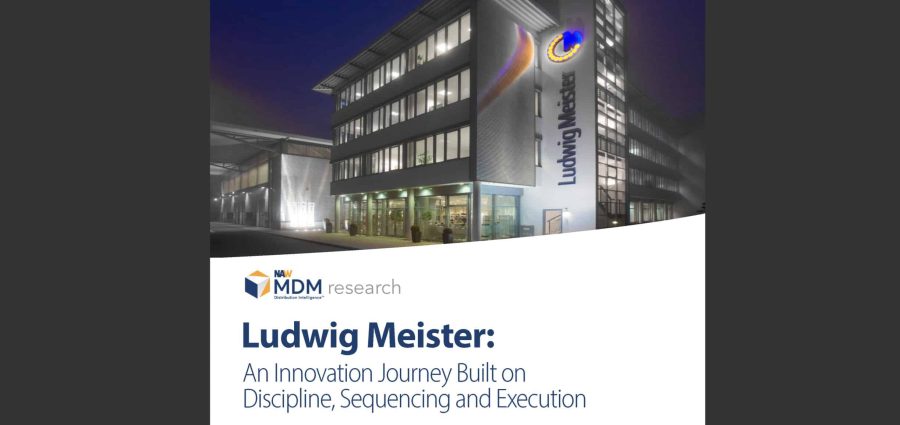
MDM’s latest case study report explores how the Germany-based power transmission and motion control distributor built a modern, data-driven business by doing something most companies struggle to sustain: executing strategy in the right order.
Premium members can view it right here as part of their subscription, and it’s available here in the MDM Store.
The report packages our three-part Premium article series that published during March along with additional reporting. It’s the seventh case study we’ve published since 2024. See the others, in order, below:
Ludwig Meister’s SHIFT Tie-In

The release of this new case study syncs with our fifth annual SHIFT Conference, coming May 12-14 in Denver. SHIFT is all about turning concepts into processes, which Ludwig Meister excels at. That’s why we’re happy to have Ludwig Meister Co-CEO Max Meister as one of the featured speakers at SHIFT to break down the change management frameworks guiding their transformation, sharing repeatable innovation strategies for complex organizations.
Read on below for a synopsis of what’s included in our Ludwig Meister Case Study.

Founded in 1967 and still family-owned, Ludwig Meister recognized early that the role of distribution was shifting — from relationship-driven to increasingly defined by efficiency, integration and digital capability. But instead of reacting with a wave of customer-facing digital tools, leadership made a deliberate choice: start inside the business.
That decision became the foundation of a decade-long transformation.
Rather than launching a web shop or digital sales platform first, Ludwig Meister focused on internal process discipline — standardizing workflows, improving logistics reliability and investing heavily in data quality. As outlined in the case study, leadership believed that without these foundations, any front-end innovation would simply “scale chaos.”
This inside-out sequencing is what ultimately enabled the company to move faster later.
Over time, Ludwig Meister built a unified data architecture, integrating ERP, product, customer and operational data into a single source of truth. That groundwork — largely invisible to customers — created the conditions for advanced analytics and, eventually, AI.
Importantly, AI was not treated as a standalone strategy. It emerged naturally as the next layer of capability.
Because data and processes were already structured and reliable, AI could be applied where it delivered measurable value — from improving product search and substitution logic to automating repetitive workflows and enhancing warehouse operations. The result wasn’t experimentation for its own sake, but cumulative, operational impact.
Equally critical was how the company managed execution.
Ludwig Meister embedded innovation into its operating model through objectives and key results (OKRs), ensuring every initiative was tied to clear priorities and measurable outcomes. Projects were expected to deliver results — or be stopped. That discipline prevented initiative overload and reinforced organizational focus.
But the transformation didn’t stop at systems and processes.
The final — and most difficult — phase was aligning people, culture and sales around this new operating model. Ludwig Meister deliberately delayed sales transformation until the organization was ready. By the time it reengineered its sales approach, data was reliable, processes were stable and employees were accustomed to change.
That sequencing turned what is often a disruptive initiative into an enabling one.
The broader takeaway for distributors is clear: innovation is not about adopting the latest tools faster than competitors. It’s about building capabilities in the right order — and sustaining the discipline to execute over time.
As this case study shows, the companies that win are not those that move first. They are the ones that build foundations that allow them to move with purpose.
Related Posts
-

This comprehensive MDM 1Q26 Forecast Report is a guide to the U.S. wholesale distribution economy,…
-

Our latest MarketPulse Report shares a wealth of data and analysis from the 4Q25 Baird-MDM…
-
See our breakdown of M&A activity by product category, the latest EBITDA trading multiples for…