With B2B buyer expectations shifting as quickly as the AI technology that supports them, wholesale distributors can no longer rely on outdated sales playbooks to protect margins and drive growth. Modern buyers demand seamless digital options for routine reordering, forcing traditional field representatives to evolve from manual order-takers into high-value consultative partners.
Transforming your distribution sales model doesn’t mean abandoning your human sales force. Instead, you must equip them with the team structure, real-time data and aligned incentives to thrive in an omnichannel market. In this guide, we’ll explore five steps you can take to help your sales team work smarter, not harder:
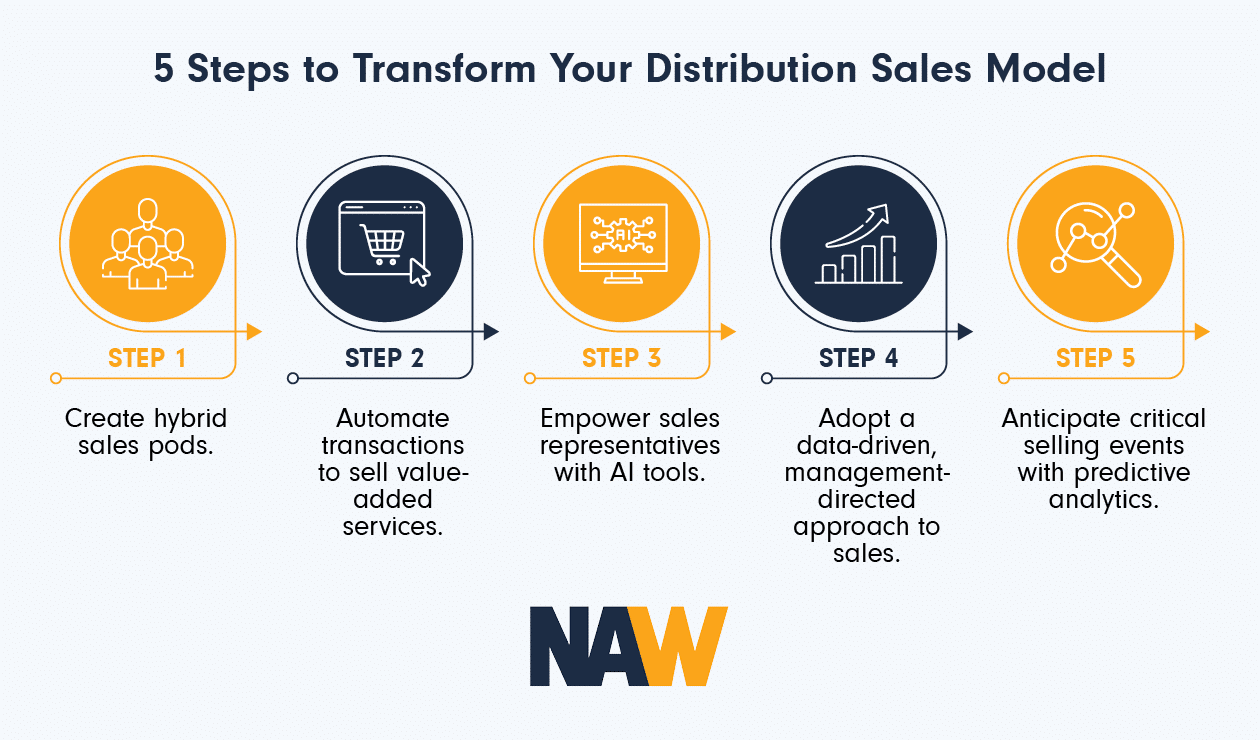
5 Steps to Transform Your Distribution Sales Model
1. Create hybrid sales pods.
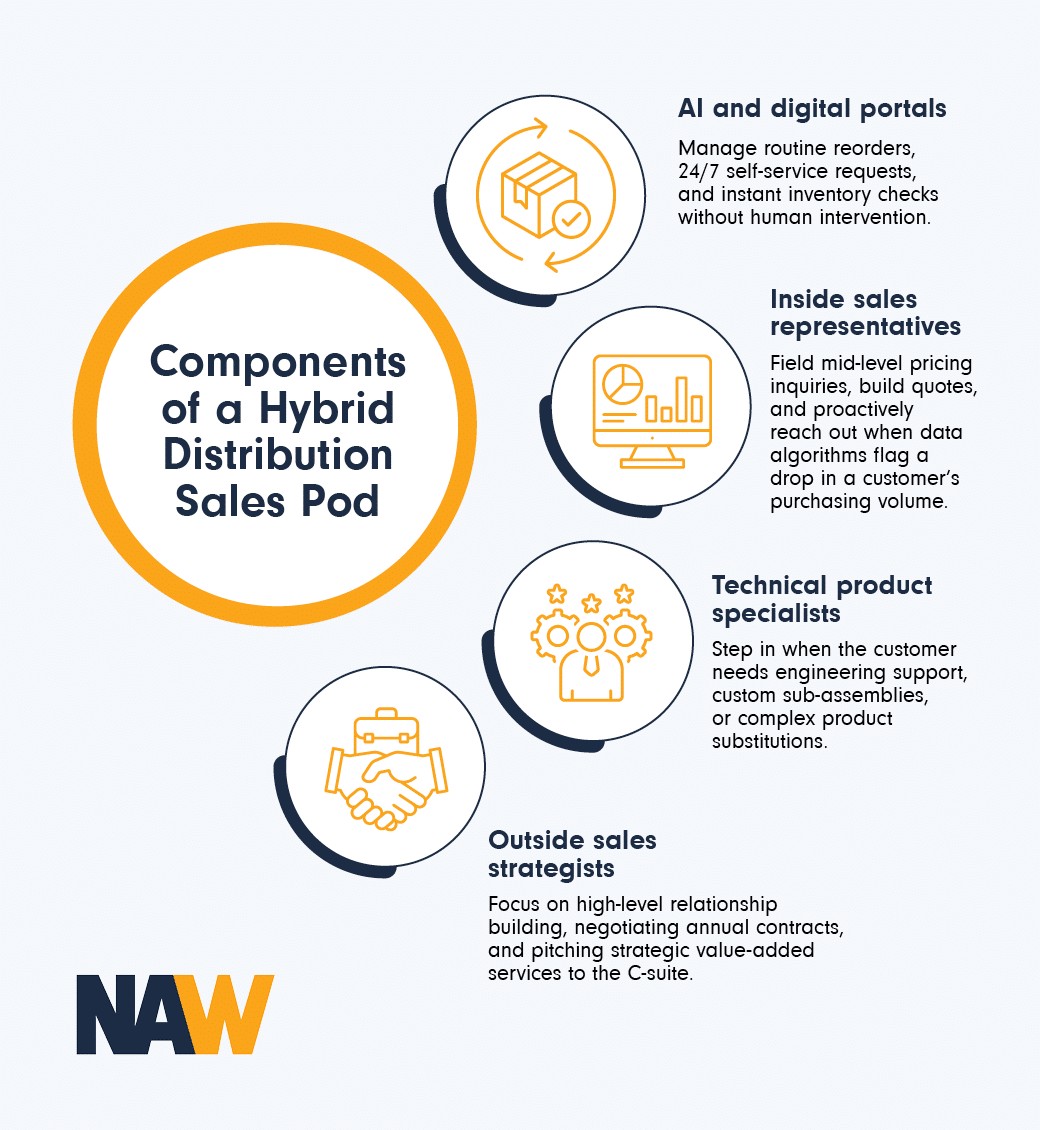
The era of the lone wolf field representative managing every aspect of an account in isolation is over. Distributors who are capturing market share today have evolved past basic omnichannel tools and are structuring their teams into cross-functional sales pods. In this model, the customer is surrounded by a dedicated team: an outside sales strategist, an inside sales representative, a technical product specialist and an AI-driven self-service portal.
Rather than competing with one another, the members of a sales pod work in tandem to manage the entire customer lifecycle. Here is how the workflow operates in practice:
AI and digital portals capture the baseline workload, seamlessly managing routine reorders, 24/7 self-service requests, and instant inventory checks without human intervention.
Inside sales representatives serve as the day-to-day command center, fielding mid-level pricing inquiries, building quotes and proactively reaching out when data algorithms flag a drop in a customer’s purchasing volume.
Technical product specialists act as on-demand subject-matter experts, stepping in virtually or in person when the customer needs engineering support, custom sub-assemblies or complex product substitutions.
Outside sales strategists leverage the time saved by the rest of the pod to focus entirely on building relationships, negotiating annual contracts and pitching strategic value-added services to the C-suite.
As seen in recent industry shifts — such as Southern Glazer’s Wine & Spirits transitioning segments of independent accounts to a hybrid model backed by dedicated customer solution teams — this approach radically improves service speeds while freeing field representatives to focus on high-impact account expansion.
2. Automate transactions to sell value-added services.
Your outside sales team is one of your most valuable assets, and you probably pay them accordingly. Paying field representatives high commissions to answer phone calls, manually log orders or verify shipping dates drains profitability. By integrating intelligent self-service tools and autonomous processing with your ERP, routine purchasing becomes completely seamless.
Once you free your sales team from administrative order-taking, you must retrain them on what to sell. In an era where digital marketplaces like Amazon Business can deliver basic SKUs rapidly, distributors cannot win on product availability alone. Field representatives must pivot toward selling complex value-added services (VAS) that embed your company directly into the customer’s supply chain. These may include:
Vendor managed inventory (VMI)
Job-site staging
Kitting
Custom sub-assemblies
When your sales force transitions to selling these capabilities, the conversation with the buyer fundamentally shifts from product price to total supply chain efficiency. Monetizing these services not only protects your margins against digital disruptors but also transforms your business from a commodity vendor into an indispensable operational partner.
3. Empower sales representatives with AI tools.
Technology in the wholesale distribution space can now go far beyond sending automated reorder reminders. It should act as an assistant to your sales force. Equipping your sales representatives with targeted AI enablement tools helps defend margins and elevates their consultative capabilities at every touchpoint by enabling processes like:
Dynamic pricing: Instead of relying on static floor prices or unearned discounts to close deals, representatives can use AI copilots that analyze customer size, purchasing history and real-time market data to offer dynamic, tiered pricing guardrails during negotiations.
Smart product substitutions: During inventory stockouts, AI engines feed representatives instant, in-stock product alternatives and complementary items, allowing inside and field representatives to protect order volume without deep technical knowledge of every SKU.
Automated account briefings: AI tools synthesize CRM data, past order trends and market news to generate instant pre-meeting briefs, giving representatives immediate insight before walking into a client meeting.
In a highly competitive market, intuition alone is no longer enough. By arming your sales force with these data-driven copilots, you empower them to make faster, more profitable decisions at the point of sale, ensuring you never leave margin on the table or lose an order to a competitor with better technology.
4. Adopt a data-driven, management-directed approach to sales.
Historically, outside sales representatives operated like independent business owners, visiting accounts based on personal relationships, habit or gut feel. In a modern distribution sales model, leadership uses data analytics to direct sales efforts where they yield the highest net return.
Leading distributors use AI and cost-to-serve analytics to strip emotion from account coverage. By measuring true profitability — factoring in return rates, delivery frequency and service time — management can stratify accounts into clear tiers:
High-margin accounts: Assigned to dedicated field strategists and hybrid pods.
High-maintenance accounts: Gently routed toward inside sales and digital self-service portals.
Alongside this shift, leadership must adapt compensation structures. Structuring commissions so that representatives receive credit for digital reorders within their territory ensures that field teams view self-service technology as an income multiplier rather than a threat to their livelihoods.
5. Anticipate critical selling events with predictive analytics.
Our research shows that most customers will continue doing business with their existing supplier as long as everything goes smoothly. But when there is a quality issue, a delivery problem or another glitch that disrupts business, that customer may look for a new supplier. These disruptions are critical selling events (CSEs) and represent the best opportunity to capture market share from competitors.
Field representatives shouldn’t wait for a prospect to reach out with a problem. Instead, distributors should use predictive market intelligence to spot CSEs in advance. By tracking competitor supply chain disruptions, regional M&A activity or executive leadership changes at target accounts, sales pods can identify vulnerable prospects early. When your representative initiates contact, they arrive armed with customized, data-backed proposals that demonstrate exactly how your distribution network will improve reliability and protect the prospect’s bottom line.
Frequently Asked Questions About Distribution Sales Models
What is a distribution sales model?
A distribution sales model is the structural framework a wholesale distributor uses to organize its sales force and interact with B2B buyers. It defines how a distributor allocates its human capital and technology to drive revenue, manage customer relationships and deliver value-added services. A modern distribution sales model moves away from relying solely on traditional, isolated field representatives and instead blends outside sales strategists, inside support teams, AI tool, and digital eCommerce platforms into a cohesive, omnichannel engine designed to maximize profitability.
Will AI replace the outside sales representative in B2B distribution?
No, but it will fundamentally change the role. In a modern distribution sales model, AI acts as an administrative assistant and negotiation copilot. It handles low-margin, time-consuming tasks such as inventory checks, routine reordering and basic quoting. This allows human sales representatives to transition from order-takers to strategic consultants focused on solving complex supply chain problems and delivering value-added services.
What is a hybrid sales pod in wholesale distribution?
A hybrid sales pod replaces the traditional field representative model. It is a cross-functional team designed to surround the customer with specialized support. A typical pod includes an outside sales strategist, an inside sales representative, a technical product specialist and integrated AI tools. This team-based approach ensures buyers get immediate answers without waiting for a field representative.
How do distributors decide which customers get a dedicated field sales rep?
Distributors should use cost-to-serve analytics and customer stratification to determine sales routing. High-margin, complex accounts that require a consultative strategy should be assigned to dedicated field representatives and hybrid pods. Conversely, highly transactional, low-margin customers should be migrated to lower-cost service channels, such as inside sales teams and digital self-service portals.
Conclusion: Mastering the Cultural Shift
Implementing hybrid pods, predictive analytics and AI copilots is ultimately a straightforward technological process. The true challenge for distribution executives is managing the cultural shift that follows. Asking veteran field representatives to suddenly trust an algorithmic pricing tool or hand over transactional accounts to an inside sales pod may create friction. To earn their buy-in, leadership must clearly demonstrate that these changes are designed to protect their livelihoods, not automate them away.
When you successfully align compensation with this new technology, proving that AI handles the administrative grunt work so representatives can close larger, higher-margin deals, the resistance will fade. Transforming your distribution sales model is no longer optional; it is a baseline requirement to remain competitive today. You have the strategic blueprint to modernize your operations. Now is the time to lead your people through the transition.
As NAW's Chief Communications and Marketing Officer, Meghan Cieslak is a seasoned communications and marketing professional with two decades of experience crafting impactful messaging across public affairs, marketing, communications, and digital strategy. She spearheads NAW's strategic communications and marketing campaigns to ensure the vital contributions of wholesale distribution are heard loud and clear by policymakers, consumers and the media.
To continue reading, you must be an MDM Premium subscriber.
Join other distribution executives who use MDM Premium to optimize their business. Our insights and analysis help you enter the right new markets, turbocharge your sales and marketing efforts, identify business partners that help you scale, and stay ahead of your competitors.
By providing your email, you agree to receive announcements from us and our partners for our newsletter, events, surveys, and partner resources per MDM Terms & Conditions. You can withdraw consent at any time.