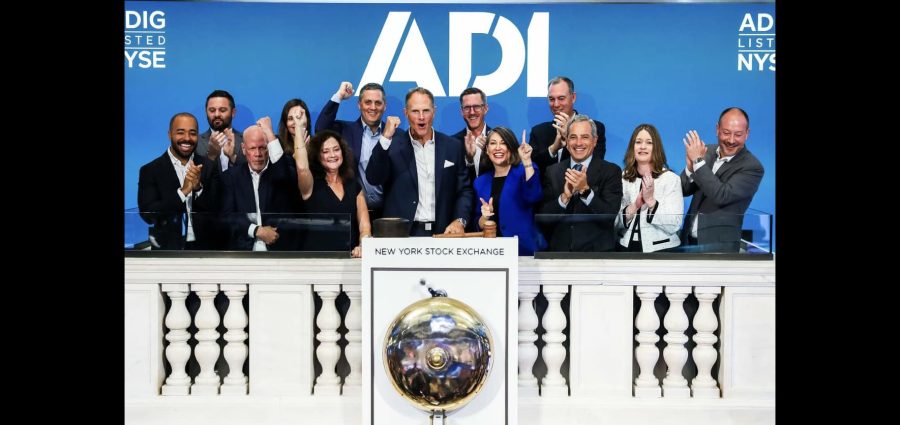
Lead photo: ADI Global Distribution President & CEO Rob Aernes (center) and ADI executives ring the New York Stock Exchange opening bell on Aug. 3. (NYSE photo)
Wholesale distribution has predominantly operated behind the scenes and in relative silence since the 1850s despite its $8.7 trillion U.S. economic impact, but now and then this industry presents something well worth bragging about to the greater business world.
Two market-driving distributors — both longtime members of the National Association of Wholesaler-Distributors — provided that here in early August.
ADI Global Distribution’s opening-bell ceremony at the New York Stock Exchange on Aug. 4 marked the formal beginning of its life as an independent public company. But the moment belonged to more than ADI.
For wholesale distribution, the debut represented something the industry does not get often enough: a prominent stage, a recognizable ticker and a new publicly traded company whose core identity is distribution.
MDM photos from the NYSE event below:


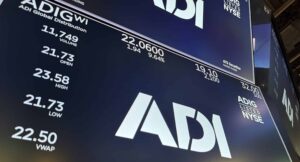


ADI completed its spin-off from Resideo Technologies after the close of trading Aug. 3 and began regular-way trading the next morning under the ticker ADIG. The separation established ADI as a standalone specialty distributor of low-voltage products across security, audio/visual, fire and life safety and data communications. ADI also joined the S&P SmallCap 600 effective Aug. 4.
I was happy to be invited and attend ADI’s event alongside NAW CEO Eric Hoplin, and the excitement was palpable on the trading floor. When I stated to ADI President and CEO Rob Aarnes that the NYSE debut was arguably the biggest event in company history, he was quick to politely correct me that it isn’t arguable. He and his team recognized how special the occasion was, and his staff echoed the sentiment during an evening reception Aug. 3 on the trading floor and the Aug. 4 bell ringing ceremony to open trading markets.
Speaking in the NYSE Board Room shortly before the opening bell, President and CEO Rob Aarnes reflected on seeing the ADI logo displayed across the trading floor and the pride he felt in the company’s more than 4,000 employees.
Aarnes emphasized the culture behind the logo — a workforce that wakes up every day looking for ways “not just to compete, but to win” for customers and suppliers. He said his conviction in what ADI has already accomplished is surpassed only by what he believes it can achieve as a standalone public company.
“Last night on that (trading) floor, taking a moment to pause, look up and see our ADI logo all over that place — you gotta admit that was pretty freaking cool, right?” Aarnes beamed to ADI staff, key customers and guests who attended the event. “There’s something behind the ADI logo that is pretty emotional to me, and that is the people we have in this organization. I ran the gamut of emotions last night and this morning while seeing that manner go up, from euphoria to being overly excited to just being fired up, ready to take on the challenge of this next chapter. The one that really continued to ring true for me was pride and how proud I am of this team for everything that you have accomplished.”
ADI enters that chapter with substantial scale. The company generated $4.8 billion in 2025 standalone revenue and serves approximately 100,000 customers through a global workforce of more than 4,100. Its standalone strategy centers on category leadership, an omnichannel platform, exclusive brands, expansion in professional AV and data communications, value-added services and execution-driven margin improvement.
Those priorities will now play out with a new level of visibility. Public ownership brings greater scrutiny, reporting demands and investor expectations. It also gives ADI an opportunity to explain the value of distribution to a broader audience — one that may understand the products and end markets ADI serves without fully appreciating the distributor connecting manufacturers, integrators and end users.
That matters because distribution remains one of the economy’s largest and most important sectors while often operating outside the public spotlight. The industry’s effectiveness is partly why it can be overlooked: products arrive, projects advance and customers receive technical support without most of the economy seeing the intricate networks making it possible.
“You wake up every day — the people in this room, the 4,000 other team members we have across the globe — trying to find new ways to not just to compete, but to win, to go above and beyond for our customers, our suppliers. That is truly special,” Aarnes continued. “I have a ton of conviction for what we’ve been able to accomplish, which will only be surpassed by what we’ll accomplish going forward as a new publicly traded company under the ADI Global Distribution banner. I could not be more proud of everybody in this company, and I’m sure you are feeling the exact same way.”
Depending on one’s definition of a company operating primarily as a distributor, North America is home to 45-50 distributors that are publicly traded or are a subsidiary of a parent company that is. And given that distribution has been an established industry since the mid-1850s, that figure range shows that a new company joining the NYSE is a rare occurrence.

“Distributors have stolen the spotlight in the financial sector this week, with ADI listing on NYSE and Ferguson joining the S&P 500. It was a privilege to join Rob Aarnes and his team at ADI on the floor of NYSE for the opening bell. That’s a once-in-a-lifetime experience, but more importantly, the dual listing is a strong signal about the health of the growing distribution industry,” Hoplin said. “Moments like this make me incredibly proud to represent such a growing and essential industry. Wholesale distribution is filled with innovative companies and outstanding leaders who are shaping the future of our economy and America’s supply chain. Congratulations to everyone at ADI on this exciting new chapter. I look forward to seeing what comes next!”
Ferguson Joins S&P 500
ADI’s listing puts another distributor squarely in view.
The timing made the week even more notable. S&P Dow Jones Indices announced July 31 that Ferguson Enterprises will join the S&P 500 before the opening of trading Aug. 5. Ferguson called the addition the final step in its five-year transition from a London-listed FTSE 100 company to a solely NYSE-listed, North American-headquartered business.
Ferguson’s elevation places one of distribution’s largest companies inside the most widely recognized benchmark of the U.S. equities market. The distributor generated $31.3 billion in calendar 2025 sales and has approximately 35,000 associates across more than 1,700 locations.
The S&P 500 is widely recognized as one of the premier benchmarks of the U.S. equities market. The index includes 500 leading companies across various important industries of the United States. Companies included in the index are selected using criteria that include market capitalization, liquidity and financial viability.
“Joining the S&P 500 is a significant milestone made possible by our 35,000 expert associates and their commitment to the specialized professionals who build and maintain North America,” Ferguson CEO Kevin Murphy said in a statement. “This recognition is a testament to the dedication of our associates, the strength of our business model and the leading positions we hold in the market.”
What These Milestones Represent
These key events for ADI and Ferguson are different, but connected in meaning. ADI is beginning a new life as an independent public distributor while Ferguson is entering the highest-profile tier of U.S. public companies. Together, they provide a rare visibility boost for a sector that is vast, fragmented and still dominated by privately held independent businesses.
Most distributors will never ring the NYSE opening bell or join a major stock index — nor do they need to. Their local expertise, customer intimacy and entrepreneurial agility remain the industry’s foundation. But market leaders such as ADI and Ferguson help represent that broader ecosystem to investors, policymakers, prospective employees and the public.
That representation carries value. Each milestone gives the industry another opportunity to show that distribution is not merely an intermediary layer. It is an engine of product availability, technical expertise, supply chain resilience and economic activity.
For ADI and Ferguson, this week was one of a major new chapter. For distribution, it was also a moment to step into the spotlight — and celebrate.
Related Posts
-
It results in a combined industrial packaging, JanSan and foodservice distributor with $28 billion in…
-
Hills Distribution now includes Plimpton & Hills, Coastal Supply Group, RJ Murray Company and Bender…
-
The facility features an expanded footprint and improved layout to enable greater throughput.