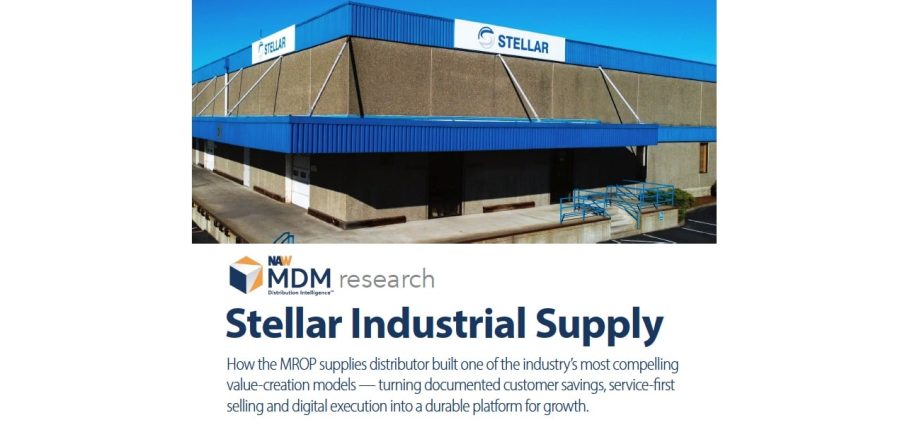
How did Stellar Industrial Supply turn documented customer savings into one of distribution’s most compelling value-creation models? This MDM Case Study explores how the MROP supplies distributor built a differentiated platform around measurable customer impact, service-first selling and digital execution.
Industrial distribution has no shortage of companies that talk about customer value. What makes Stellar Industrial Supply different is how it proves it.
MDM’s latest case study report — authored by Executive Editor Mike Hockett — explores how the Tacoma, WA-based MROP supplies distributor built one of the industry’s most compelling models for turning measurable customer savings into growth, loyalty and operational discipline.
Premium members can view it right here as part of their subscription, and it’s available here in the MDM Store.
The report packages our three-part Premium article series that published earlier this year, along with additional reporting and a forward by former MDM Owner, CEO and Editor Tom Gale, who joined Stellar’s Board of Directors in 2025. It’s the ninth case study we’ve published since the start of 2024. See the others, in order, below:
Read on below for a synopsis of what’s included in our Stellar Industrial Supply Case Study.
Since launching its Documented Customer Savings program in 2010, Stellar has quantified more than $252 million in customer-approved savings, including nearly $34 million in 2025 alone. But this report is not simply about a cost-savings program. It is about how Stellar turned documented value creation into a commercial philosophy, operating system and cultural identity.
The case study examines how Stellar’s DCS program helps the company shift customer conversations away from piece price and toward measurable financial impact. It also explores why the model is difficult to replicate, including Stellar’s discipline around documenting outcomes, reporting them transparently and using those results to deepen customer relationships.
The report also looks at Stellar’s service-first sales culture, including why the company is willing to walk away from misaligned opportunities and how its commercial structure supports both customer acquisition and existing-account expansion. That approach reflects a broader philosophy: Stellar is not trying to sell more products for the sake of volume — it is trying to earn more business by helping customers perform better.
Finally, the case study explores Stellar’s digital, data and customer experience investments, including its pragmatic blend of third-party platforms and in-house development. From automation and reporting to its buy-vs.-build strategy, Stellar’s technology investments are tightly connected to the same value-creation mission that drives its DCS program.
Drawing on interviews with Stellar President and CEO John Wiborg, SVP of Customer Experience Molly Langdon and Director of Software Engineering Brett Parkhurst, the report explores:
- How Stellar’s Documented Customer Savings program works and why it has become a defining part of the company’s identity
- Why the company’s sales philosophy prioritizes service, alignment and long-term value over transactional selling
- How Stellar documents customer outcomes and uses those results to build trust and earn more business
- Why culture, process and leadership are central to the company’s operating model
- How digital tools, automation and internal development are helping Stellar scale while improving customer experience
Whether you lead an independent distributor, a multi-branch organization or a company working to sharpen its value proposition, Stellar Industrial Supply’s story offers a compelling look at how documented performance, customer alignment and disciplined execution can create sustainable differentiation.