Most U.S. companies expecting tariff refunds plan to hold onto at least some of the money, according to new Federal Reserve Bank of Atlanta research examining how businesses are deploying the sizable one-time payments.
The Atlanta Fed surveyed 1,156 C-suite executives Aug. 10-21 through its Survey of Business Uncertainty, asking about companies’ eligibility for tariff refunds, how they are navigating the refund process and what they intend to do with the proceeds.
The survey comes after the U.S. Supreme Court invalidated a series of import tariffs in February and the U.S. Court of International Trade ordered refunds of affected duties. The Atlanta Fed said nearly $170 billion is involved, with roughly $100 billion refunded by late July.
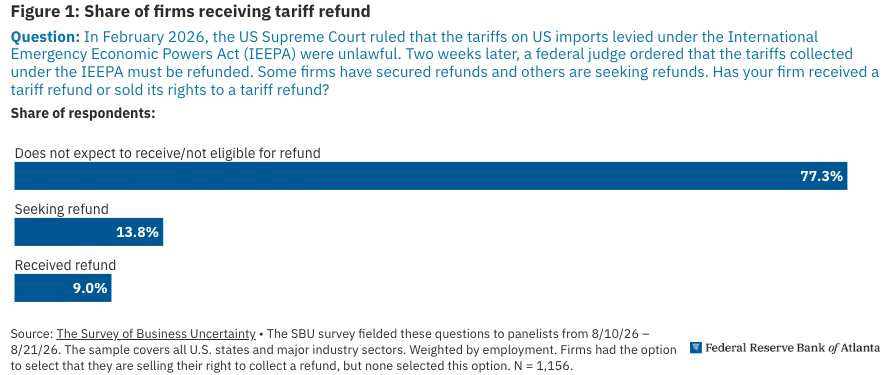
Nearly one-quarter of surveyed executives said their companies are eligible for a refund. Among those firms, about 40% had already received one, representing approximately 9% of the overall survey sample when weighted by employment. Refunds averaged 1.7% of annual company revenue.
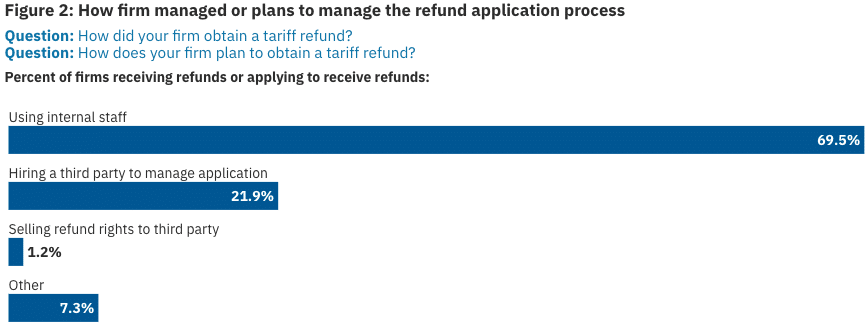
Larger companies were somewhat more likely to have received or be pursuing refunds, while publicly traded companies were more than twice as likely to have already received one. About two-thirds of firms have either used internal staff to manage the refund process or sold their refund rights to third parties, according to the Fed.
The most common planned use is strengthening companies’ cash positions: 75.2% of eligible firms said they expect to retain at least some of their refunds as cash or cash equivalents.
That doesn’t necessarily mean those businesses will leave all of the refunded money untouched. Respondents could select multiple uses, and more than half said they expect to devote at least some funds to research and development or new capital investment projects.
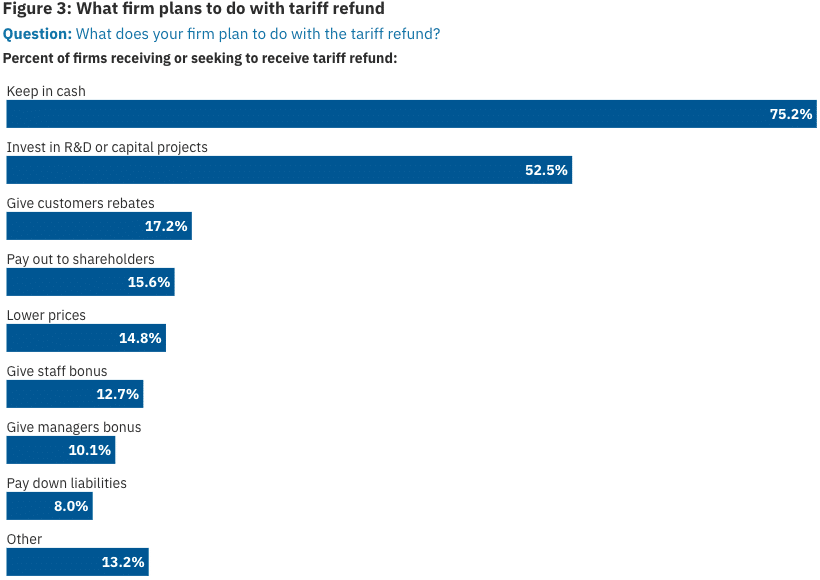
Other uses were considerably less common. The survey found that:
- 17.2% expect to provide customer rebates;
- 14.8% plan to temporarily lower prices;
- 12.7% expect to pay bonuses to employees; and
- 10.1% plan bonuses for managers.
The results largely align with earlier Atlanta Fed research published in July, which estimated that 34% of approximately $166 billion in expected refunds would flow to the most financially constrained firms — companies the researchers said are more likely to use the money for investment, hiring or pricing adjustments. Firms with greater access to capital were considered more likely to save refunds, repay debt or distribute funds to shareholders.
MDM Analysis
For distributors, the 75% figure reinforces that tariff refunds are primarily a balance-sheet and capital-allocation event rather than an automatic trigger for lower prices. Many recipients appear to be rebuilding liquidity after absorbing tariff costs while selectively reinvesting the proceeds. With more than half also considering R&D or capital projects, distributors receiving meaningful refunds have an opportunity to weigh working capital, debt reduction and strategic investment alongside any customer-facing price or rebate decisions.
Related Posts
-
The Federal Reserve raised its benchmark interest rate by a quarter point, marking its first…
-
The Federal Reserve maintained its benchmark interest rate again, extending a pause that began in…
-
The Fed held rates steady again in its June meeting, maintaining its benchmark range at…