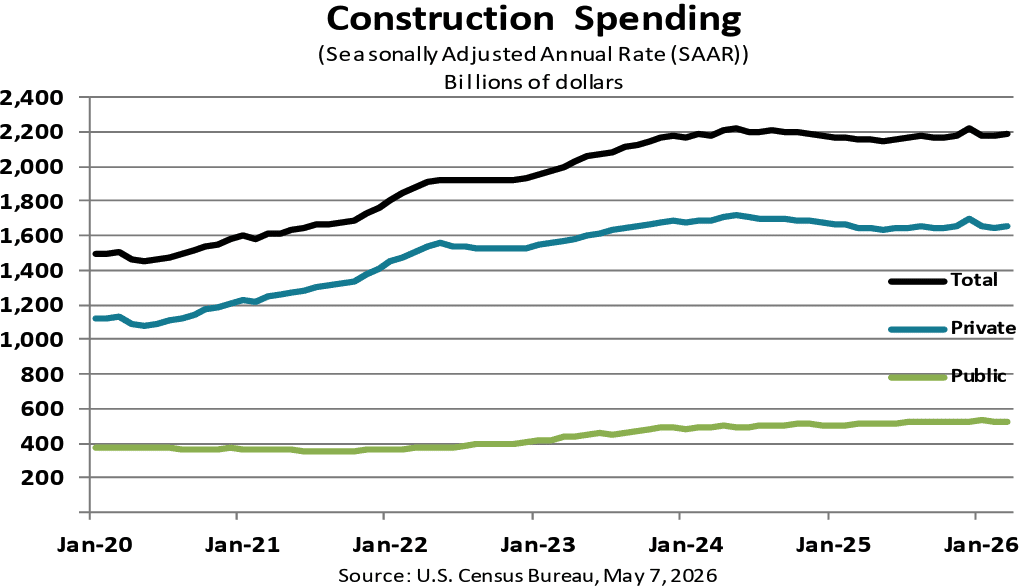
The U.S. Census Bureau released its monthly construction spending report on May 7, covering data for both March and February.
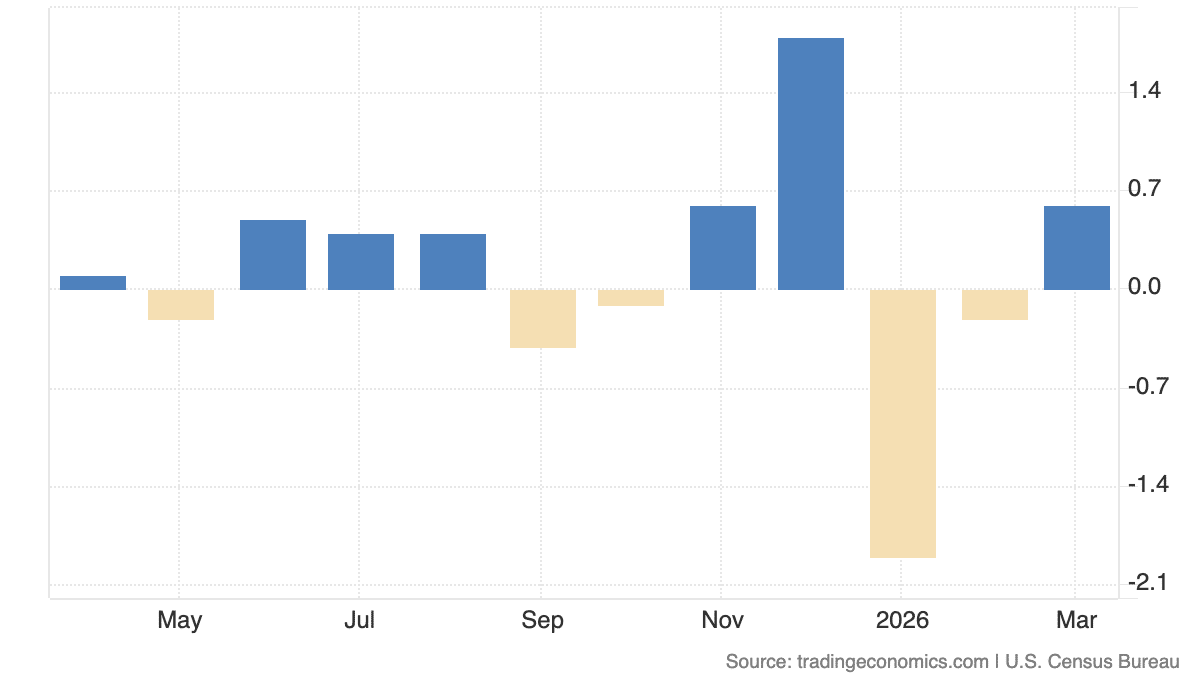
The Bureau’s report shared that March total construction spending was estimated at an adjusted annual rate of $2.186 trillion, 0.6% above February’s revised estimate and up 1.6% year-over-year. It rebounded from February’s 0.2% monthly decline and was well ahead of market expectations of a 0.2% increase.
March private construction spending of $1.659 trillion was up 0.8% from February’s revised total and up 1.0% year-over-year, while public construction spending of $526 billion was down 0.2% month-over-month and up 3.6% year-over-year.
Total U.S. Construction Spending: MoM % Change
Total residential spending of $942 billion was up 1.6% month-over-month and up 3.5% year-over-year, while total nonresidential spending of $1.244 trillion was down 0.2 month-over-month and up 0.2% year-over-year.
March nonres spending was down month-to-month in 9 of the Bureau’s 16 subcategories.
Private Construction — Residential vs. NonRes
Within March private construction spending, residential was up 1.7% month-to-month and nonresidential was down 0.2% — with the latter being its sixth straight decline. Within private nonres, spending was down in 5 of its 11 subcategories. Private nonres spending has been in decline for nine consecutive quarters despite the influx of demand from data center construction.
“While a large portion of the ongoing decline is due to steadily falling manufacturing-related construction activity, weakness is becoming more widespread,” Associated Builders & Contractors Chief Economist Anirban Basu said in the firm’s analysis of the Bureau data. “Both public and private sector activity fell in March, and the latter is now down more than 2% on a year-over-year basis. With the exception of the ongoing boom in data center construction (+34.3% year over year), there are few sources of momentum. Despite this ongoing weakness, however, contractors remain optimistic about the outlook.”
Public Construction
Within public nonres construction, spending decreased in seven of its subcategories.