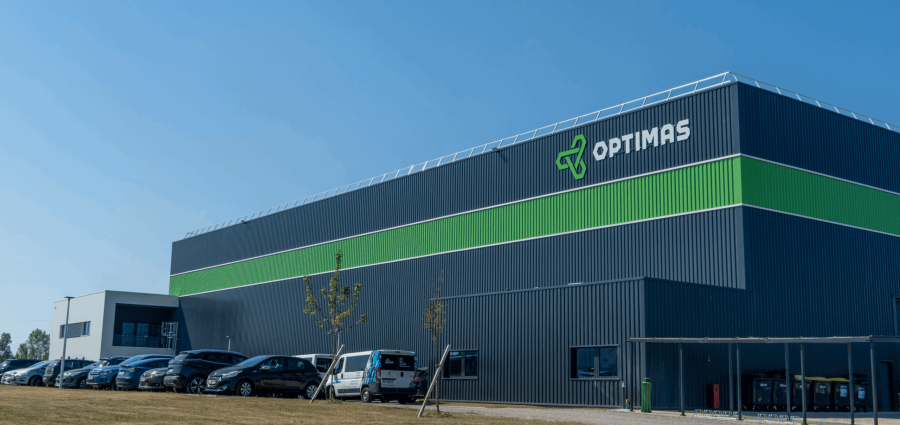
After three-plus years of transformation, fasteners distributor and manufacturer Optimas Solutions is entering what its Chief Operating Officer Mark Korba calls a “value creation stage.” During September, Korba emphasized that the company is now in growth mode, backed by a three-year roadmap focused on organic expansion, operational efficiency and diversification into emerging markets.
The 2025 International Fastener Expo — held Sept. 15-17 in Las Vegas — was a fitting event for Optimas to voice its intentions and priorities going forward. While Optimas hosted an evening reception there, Korba emphasized the company’s vision, and I followed up with him on that in an interview at the company’s expo booth.
“We’ve exited our transformation stage. We’re ready to go. We’ve poured the concrete, and the foundation is solid. Let’s start building some more value.” – Mark Korba, COO of Optimas Solutions
With a background in logistics, Korba joined Optimas in mid-2021 as Vice President of Supply Chain & Business Intelligence, became Chief of Staff in April 2023 and was promoted to COO this past August.
MDM’s Free Virtual M&A Summit Coming Dec. 3. Register here!
From Repositioning to Acceleration
Optimas’ recent history has been defined by a comprehensive transformation aimed at modernizing its operations. Over the past several years, the company invested heavily in technology upgrades, process improvements and talent acquisition. This groundwork was essential for scaling without inflating costs — a critical priority as Optimas pursues accelerated growth.

“We launched this year a pretty aggressive three-year growth plan,” Korba told me. “It includes everything from new customer growth, existing share-of-wallet growth, tapping into different industries and verticals and upgrading talent in our sales group.”
On MDM’s 2025 Top Distributors Lists, Optimas was No. 32 for Industrial Supplies and No. 8 for Fasteners on the strength of $635 million in 2024 revenue. The company had about 1,400 employees serving more than 5,000 customers globally.
Optimas’ strategy is rooted in efficiency: leveraging process improvements to ensure expansion doesn’t come with disproportionate overhead so the company can grow without scaling the costs. That’s where all the efficiencies the company has been working on lately come into play.
MDM Case Study: LINC Systems (Premium access)
A Hybrid Advantage
Unlike most fastener distributors, Optimas operates not-quite equally as both a manufacturer and distributor — a dual role that Korba views as a competitive advantage.
“Manufacturing is definitely a differentiator for us,” he said, comparing to other major fastener distributors. “It gives us flexibility, especially when you look at geopolitical stances, on-shoring opportunities, tariff avoidance and risk mitigation.”
This hybrid model allows Optimas to offer rapid supply capabilities and maintain tighter customer relationships. The company also took advantage of IFE to announce its new QuickShip program that alleviates inventory shortages and stockouts for OEMs and distributors by slashing lead times from a traditional 8 to 16 weeks to just 1 to 4 weeks.
That hybrid model also positions the company to respond more nimbly to supply chain volatility, a lesson reinforced by the new normal of constant disruption.
Optimas manufactures more than one billion parts annually and has a network of approximately 4,000 local, regional and global suppliers.
Optimas at a Glance
-
-
- Headquarters: Wood Dale, IL
- Core Business: Global distributor and manufacturer of fasteners and supply chain solutions
- Differentiator: Hybrid model combining manufacturing and distribution for greater flexibility and customer integration
- Recent Investments:
- ERP and data integrity initiatives to enable AI and automation
- Manufacturing plant upgrades for capacity and efficiency
- Sustainability programs, including EcoVadis certification
- Strategic Focus: Organic growth, diversification into EV, renewable energy and semiconductor markets
-

Agility in a Volatile World
Korba stressed that Optimas’ sourcing strategies and supplier partnerships have been designed for adaptability, setting a foundation for that through all of the company’s sourcing strategies.
One of Optimas’ recent internal improvements was the addition of multi-sourcing functionality within the company’s SO99+ ToolsGroup Platform, which involved consolidating supplier data through automation and AI to streamline the supply network. Testing ensured the solution met performance, accuracy and reliability standards, and ultimately integrated risk mitigation strategies into Optimas’ operations.
Those enhanced dual-source options and supplier management mean that if something becomes too expensive, Optimas can pivot quickly.
Nearshoring and onshoring remain central to Optimas’ approach, particularly amid tariff uncertainty and shifting global trade dynamics.
“It comes down to having Optimas set up to be agile and efficient,” Korba noted. “We’re to ebb and flow with the tide instead of going into panic mode.”
Digital Transformation: Data First
While AI is a buzzword across industries, Korba emphasized that Optimas’ focus has been on data integrity — often a prerequisite for leveraging advanced technologies like machine learning and robotic process automation.
“For any AI tool to be effective, you have to make sure your data is solid,” he said. “We’ve spent the last several years cleaning up and honing our database to put us in a position where we can take advantage of emerging technologies.”
This digital foundation also supports smarter demand forecasting and inventory management, helping Optimas optimize capital-intensive operations.
MDM Case Study: MSC Industrial Supply (Premium access)

Sustainability and Customer Expectations
Sustainability is increasingly shaping customer requirements, particularly in Europe, where ESG questionnaires and traceability demands are common. Optimas maintains an EcoVadis rating and employs a global sustainability lead to drive initiatives such as renewable energy adoption.
During December 2024, Optimas announced that it had already achieved the emission reduction goals it had initially set during 2023 to accomplish by the end of 2025.
“We put a lot of focus on sustainability as a corporation,” Korba said. “It’s about having the processes and foundation so you can adapt as regulations and expectations change.”
Growth Opportunities: EV, Renewable Energy and Semiconductors
Looking ahead, Optimas sees significant potential in sectors aligned with macro trends: electric vehicles, renewable energy and semiconductors. These markets represent a strategic diversification beyond the company’s heavy-duty truck stronghold — a segment that has seen cyclical downturns.
“We’ve been exploring a lot with EV,” Korba said. “Renewable energy is still untapped, and the semiconductor market is ready to take off in North America. Those are major areas we’re focusing on.”
Roadmap: Prioritize Organic Growth
While mergers and acquisitions remain a possibility, Optimas’ near-term focus is on organic growth. This includes deepening relationships with existing customers, expanding into new verticals, and optimizing inventory strategies to improve turns and reduce capital exposure.
“We’ve put a lot of work and capital investment into technology and facilities and to get our manufacturing plant ready for additional growth. Now it’s about executing.” – Mark Korba, Optimas COO
The Final Word
Optimas’ evolution underscores a broader trend in the fastener industry: the shift from transactional distribution to strategic, technology-enabled partnerships. As Korba put it, “We’re excited about what’s ahead. The foundation is set, and now it’s time to build.”