Wholesale websites are generating new accounts and bringing inactive customers back, but sales representatives still handle substantially larger orders, according to new research from WizCommerce.
The wholesale sales technology provider released its 2026 B2B E-Commerce Benchmark Report Oct. 1, examining eight measures spanning online purchasing, customer acquisition, sales technology adoption and product content.
 The report draws on anonymized platform data from more than 250 WizCommerce wholesalers between January 2025 and July 2026. An August survey of more than 100 wholesale brands includes WizCommerce customers and companies using other systems, across gift and toys, home décor, furniture, lighting and seasonal categories. Three-quarters of respondents were owners, CEOs or heads of sales. Eligible company counts vary by benchmark.
“These benchmarks give every team a reference point: where they are strong, and where the next opportunity sits,” WizCommerce CEO and Co-Founder Div Makkar said.
Websites’ Expanding Role
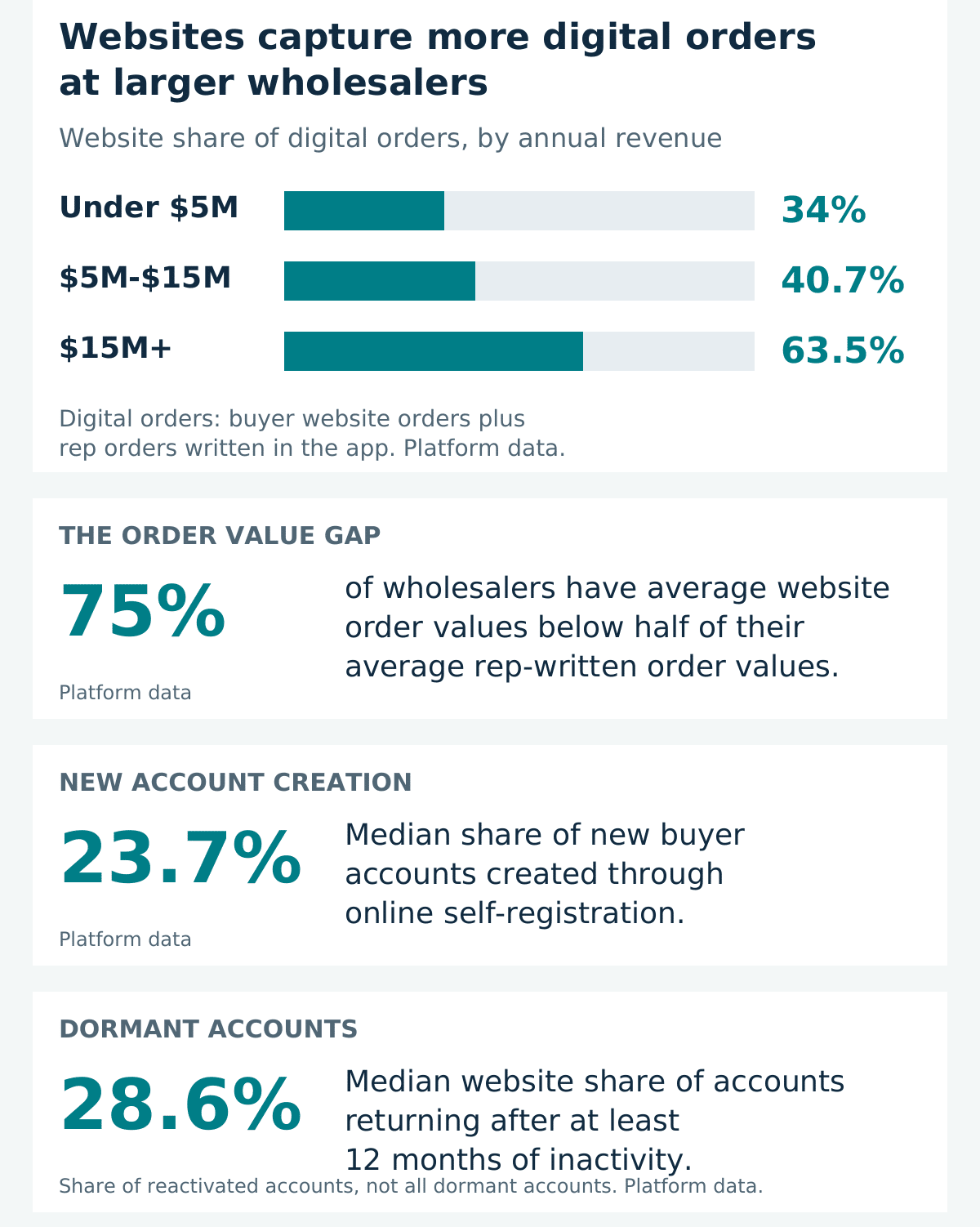
Website orders represented 34% of digitally captured orders at wholesalers with annual revenue below $5 million, rising to 40.7% at $5 million-$15 million and 63.5% at $15 million-plus. Those figures compare buyer-submitted website orders with orders representatives write in an app; they do not measure eCommerce’s share of total company sales.
Other findings include:
- New accounts: At the median wholesaler, 23.7% of new buyer accounts came through online self-registration. The report’s best-in-class group reached 62.45%. This measures account creation, rather than completed purchases.
- Online-only buyers: About 40% of buyers at wholesalers in the two larger revenue bands had ordered exclusively through the website, compared with 25.5% at companies below $5 million.
- Order values: For 75% of wholesalers, average website order value was less than half the average rep-written order value. Just 14.29% had a gap below 20%.
- Returning customers: At the median wholesaler, websites accounted for 28.6% of reactivated accounts that had been inactive for at least 12 months. The best-in-class figure was 50.4%. These percentages describe returning accounts, rather than the entire dormant account base.
The survey also found that 38% of brands were using AI to support representatives, while 30% were actively exploring it. Meanwhile, 44.1% reported initial pushback followed by acceptance when introducing new sales technology; 20.6% reported substantial resistance.
MDM Analysis
For distribution executives, the useful takeaway is a broader eCommerce scorecard: track account creation, first purchases, reactivation, repeat buying and profitability alongside online revenue.
The order-value gap deserves investigation, but smaller baskets can still be attractive if self-service lowers handling costs and encourages more frequent purchases. Compare margins, order frequency and cost-to-serve before treating parity with rep-written orders as the goal. Customer-specific pricing, inventory visibility and easy reordering are practical areas to examine.
Use these figures as directional references. The platform sample comprises WizCommerce customers, and the survey’s category mix differs from industrial distribution. Company size, product mix and account coverage can affect results. A purchase completed online also does not establish that sales or marketing played no role. The strongest test is whether digital investment produces incremental, profitable business and frees representatives for higher-value work.
Related Posts
-

This category can only be viewed by members. To view this category, sign up by…
-

Foster Electric is an independent electrical supply distributor that has served Central Virginia for nearly…
-

It's the master wholesaler's seventh facility overall and its largest facility investment since its 2008…