Amazon is taking a decisive step to commercialize one of its biggest competitive advantages — its logistics network.
On May 4, the company announced it is opening its end-to-end supply chain capabilities to all businesses, not just those that sell on Amazon’s marketplace. The move significantly expands Amazon’s “Supply Chain by Amazon” offering into a standalone, full-service logistics platform that can support inventory movement from manufacturers to end customers across channels.
Called Amazon Supply Chain Services (ASCS), the service bundle includes ocean freight, ground transportation, warehousing, fulfillment and last-mile delivery, along with integrated technology for inventory placement and demand forecasting. In effect, Amazon is positioning itself as a one-stop logistics provider — competing more directly with third-party logistics firms, parcel carriers and freight forwarders.
“Amazon is bringing the infrastructure, intelligence and scale of its supply chain services — proven over decades — to businesses everywhere, much like Amazon Web Services did for cloud computing,” ASCS Vice President Peter Larsen said in a news release. “Supply chain wasn’t just a function at Amazon — it was core to providing an exceptional shopping experience. Our differentiator. The reason we could offer fast, dependable delivery that nobody else could. And with the launch of ASCS, we’re confident we can give any other business access to the same cost efficiency, reliability, and speed that we’ve built for Amazon customers.”
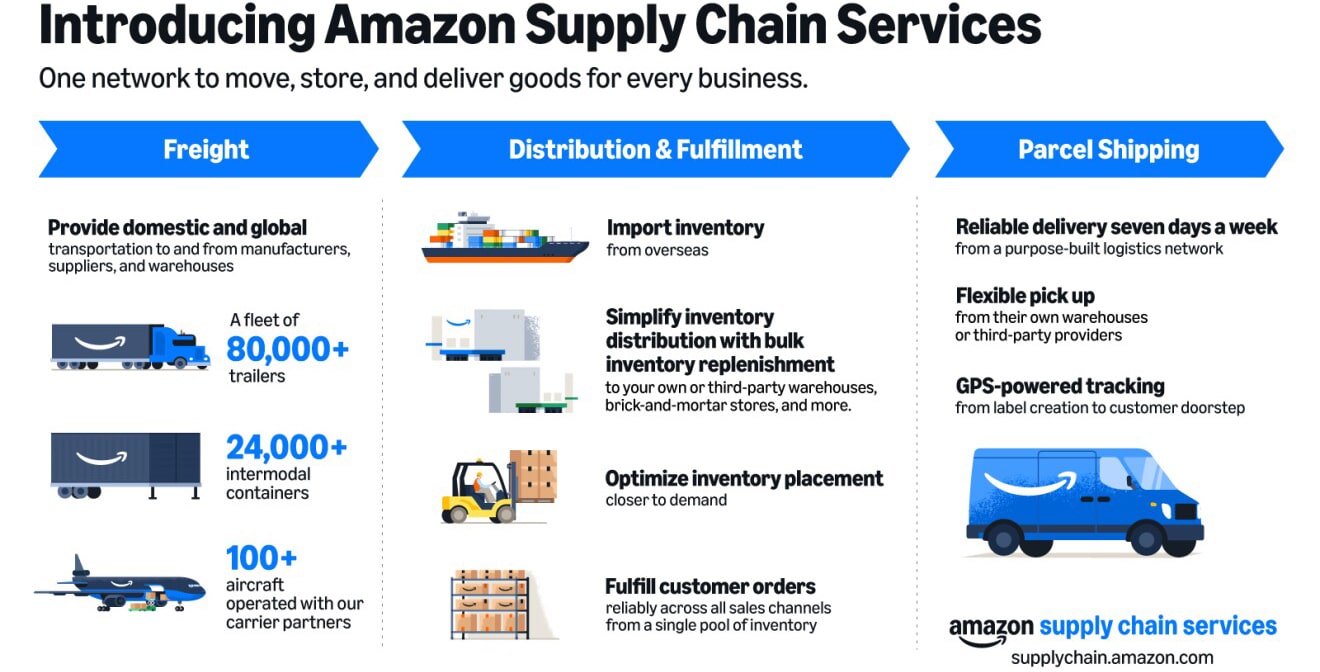
Previously, many of these capabilities were primarily available to sellers within Amazon’s marketplace ecosystem, particularly through Fulfillment by Amazon (FBA). With this expansion, companies can use Amazon’s logistics infrastructure even if they sell through their own websites, physical locations or other marketplaces.
Amazon says the offering is designed to simplify fragmented supply chains, reduce handoffs and improve delivery speed and reliability. Businesses can tap into Amazon’s scale — which includes hundreds of fulfillment centers, sortation facilities and delivery stations — while leveraging its data and automation capabilities to optimize inventory positioning closer to demand.
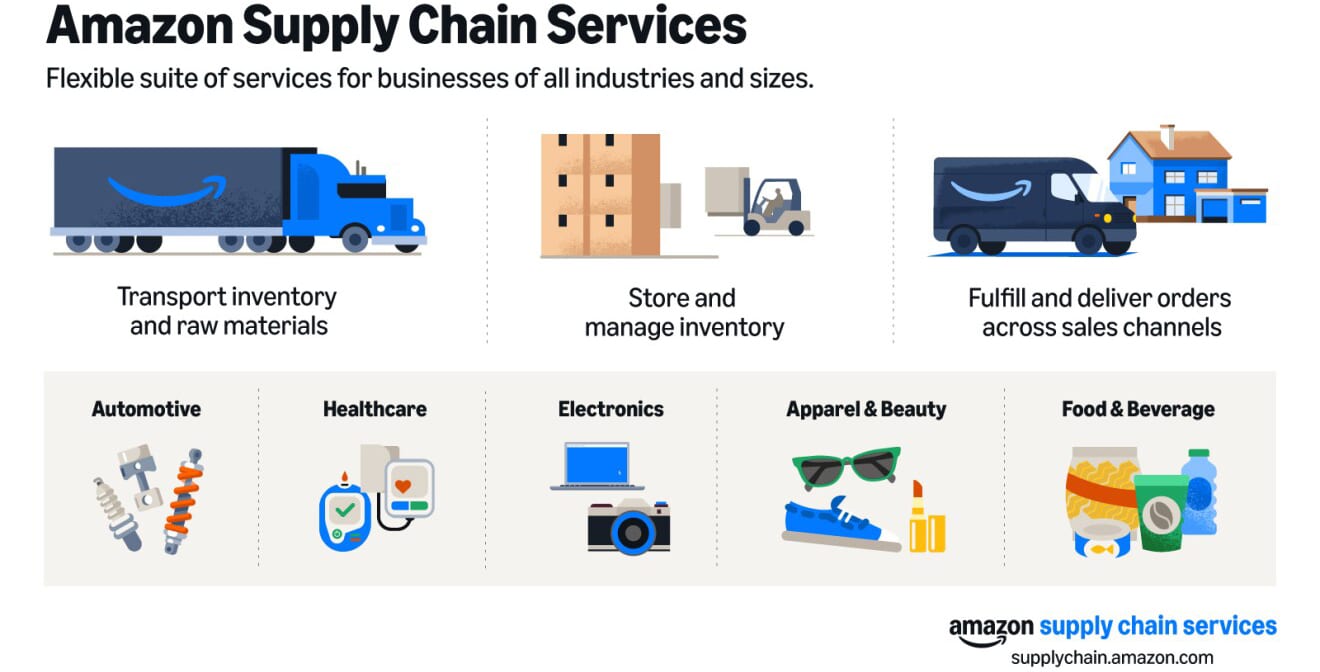
The move reflects Amazon’s broader effort to monetize its logistics buildout after years of heavy investment. That network — built to support its own retail dominance — now rivals or exceeds the reach of traditional carriers in many markets. Opening it up externally creates a new revenue stream while potentially improving asset utilization.
Amazon has been gradually testing elements of this model, including “Buy with Prime” and multi-channel fulfillment services, but this marks its most comprehensive push yet into serving non-marketplace businesses at scale.
While Amazon is emphasizing flexibility — allowing companies to use individual services or the full stack — the underlying value proposition is clear: fewer intermediaries, faster delivery and tighter integration between supply chain execution and demand signals.
What This Means for Distributors
For distributors, Amazon’s expanded logistics offering is less about a single new service and more about the continued blurring of industry boundaries.
At a baseline level, this increases competitive pressure on third-party logistics providers and could reshape customer expectations around speed, visibility and cost. Distributors that operate their own fleets or warehouse networks may find customers benchmarking their performance against Amazon’s capabilities — particularly for parcel and last-mile delivery.
But the implications go deeper.
Amazon is effectively unbundling logistics from its marketplace and offering it as infrastructure. That creates a scenario where manufacturers, brands or even competing distributors could rely on Amazon for fulfillment while maintaining control of their sales channels. In turn, logistics — long a source of differentiation for distributors — risks becoming more commoditized.
Distribution and fullfilment are one of the bundled services ASCS offers, with the company’s description of it covering much of the core functionality that wholesale distributors provide every day:
“Distribution and Fulfillment: Amazon enables businesses to import, store, and position inventory closer to demand — and fulfill customer orders across their sales channels, all within a single network. By using a unified inventory pool and advanced forecasting capabilities, businesses can improve delivery speed and accuracy across their own website, eCommerce marketplaces, social media channels and physical stores.”
At the same time, this could introduce new strategic options.
Some distributors may view Amazon’s network as a supplemental capacity layer — particularly for overflow, hard-to-serve geographies or direct-to-consumer fulfillment. Others may explore hybrid models, using Amazon for certain nodes while maintaining control over core customer-facing logistics.
The bigger question is how distributors respond to rising expectations around integrated, data-driven supply chains. Amazon’s advantage is not just physical infrastructure — it’s the tight coupling of logistics with demand forecasting, inventory optimization and digital ordering experiences.
Distributors that continue investing in those capabilities — whether through internal development, partnerships or selective outsourcing — will be better positioned to compete. Those that rely primarily on legacy network advantages may find that edge eroding.
In that sense, Amazon’s move is less a disruption event and more an acceleration of an existing trend — one where logistics scale, technology integration and customer experience are increasingly inseparable.
Related Posts
-

Amazon estimates the new benefits aimed to support financial management, cybersecurity and HR could amount…
-

Boosted by NEFCO's acquisition of Big D Tool Center, the cooperative strengthens its Texas footprint.
-

It results in a combined industrial packaging, JanSan and foodservice distributor with $28 billion in…