Editor’s Note: Welcome to “The Hidden Majority” — a new column series from MDM authored by one of our top contributing writers, Nelson Valderrama. This series is all about providing thought leadership and industry analysis geared for small- to mid-sized distributors — which comprise the vast majority of the wholesale distribution landscape. Leveraging the quarterly Baird-MDM survey data and other MDM research data, Nelson dives into the numbers and commentary to identify trends and takeaways that apply to SMBs in the industry.
You’ve heard the pitch: “AI is transforming distribution.” You’ve seen the case studies. They feature billion-dollar companies with dedicated data science teams and implementation timelines measured in years. Industry conference meetings showcase dashboards you’ll never build and results that assume resources you don’t have.
If you run a $30 million or $60 million distribution operation, you’ve probably asked yourself, “Does any of this actually apply to my business?”
That question finally has an answer — and it comes from data, not vendor promises.
Where This Data Comes From
Two major research efforts recently focused on how distributors are actually using AI:
- The Baird-MDM Industrial Distribution Survey, a quarterly study, has tracked distributor sentiment and behavior for 14+ years. Each survey includes a set of four rotating questions, and in 2025, more than 200 distributors responded to each quarter’s survey questions about AI adoption, succession planning, and technology investment with both quantitative and qualitative feedback. When you isolate the sub-$100M segment (distributors with annual revenue under $100 million), patterns emerge that aren’t visible in the published aggregated results.
- NAW and MDM’s “In Pursuit of Value” research, released in April 2026, surveyed 426 distribution leaders, 80% at VP level or higher, specifically about AI priorities, investments, and outcomes. It asked the questions that matter: Where are distributors putting their AI bets? What results are they actually seeing?
Together, these studies reveal a clear picture. And for sub-$100M distributors, that picture is both surprising and actionable.
The Gap Between Expectations and Results
Let’s start with the uncomfortable finding from the NAW/MDM research.
Pricing emerged as the top-ranked AI priority. 27% of distributors ranked pricing and margin optimization as their #1 AI investment area — higher than inventory, customer service, sales or logistics. Nearly three-quarters (74%) said pricing AI is on their roadmap.
The expected returns are significant: 73% of distributors expect pricing AI to deliver margin improvement of 2% or more.
But here’s what’s actually happening: only 16% have achieved those results. Sixty-five percent report no measurable improvement yet.
If you’ve been skeptical about AI promises, you were paying attention. Most distributors who’ve invested haven’t seen the payoff. But the problem isn’t that AI doesn’t work. The problem is where it’s being applied.
What Distributors Your Size Are Actually Doing
Here’s the number that reframes the conversation: 64% of sub-$100M distributors already use AI in some form. That’s nearly two-thirds. So, you see, the data does not support the “small distributors are behind.”
But look at what they’re using AI for.
When the MDM/Baird Q2 2025 survey (conducted July 2025) asked sub-$100M distributors to describe their AI initiatives, here’s what they said:
- “Two of us just recently opted for a Copilot license to assist with Excel documents.” — $10-$25M distributor
- “We have found it useful to replace some legal replies to various customers, vendors and employees.” — $26-$50M distributor
- “It’s all on the marketing side of things. We are using some AI to help our marketing team with their creative endeavors.” — $51-$100M distributor
- “Utilizing AI Chatbot on a website to answer customer inquiries.” — $10-$25M distributor
Excel assistance. Legal replies. Marketing content. Chatbots. Website code. These aren’t inappropriate uses. But they’re not where the margin lies.
Out of 62 sub-$100M distributors who described their AI initiatives in the July 2025 survey, only one mentioned pricing. One.
Meanwhile, the NAW/MDM research shows that 46% of all distributors are already exploring dynamic pricing, the highest adoption of any specific pricing use case. The industry knows where the opportunity is. Sub-$100M distributors just aren’t going there.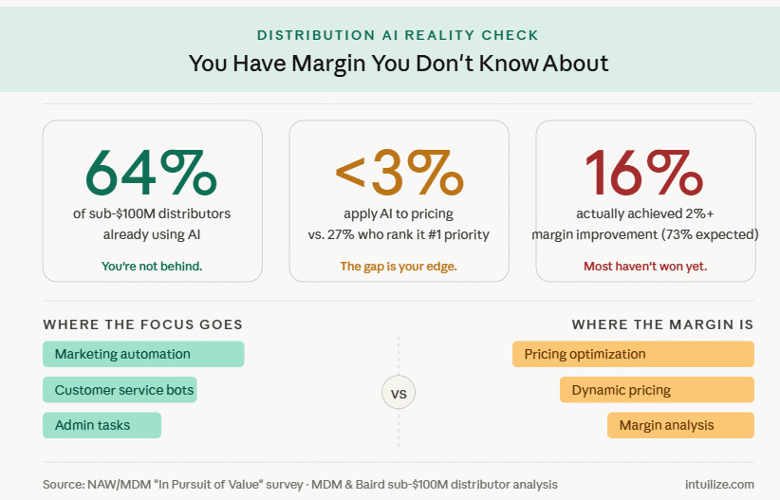
What’s Holding Them Back
The distributors who haven’t started yet are clear about what’s holding them back:
- “Still trying to get a clear picture as to how it can help the business.” — $10-$25M distributor
- “Trying to determine the area that would provide the highest ROI.” — $51-$100M distributor
- “We use it for marketing content creation. We are waiting for function-specific agents’ or solutions (like inventory management) to hit the market as we do not have the resources to create them ourselves.” — $10-$25M distributor
These aren’t resistance statements. They’re resource constraints. Limited bandwidth to evaluate options. No clear signal on what delivers ROI. A sense that the tools built for billion-dollar enterprises don’t fit a $40M operation.
The NAW/MDM research directly addresses this perception: “A $20 million distributor today can access the same AI-powered pricing tools, demand forecasting algorithms, and customer service agents as a billion-dollar enterprise.”
The technology gap has closed. The application gap hasn’t.
Here’s The Investment Hesitation Pattern
The MDM/Baird data reveals another pattern: sub-$100M distributors plan to invest, but at lower rates than larger peers.
When asked about 2026 IT investment plans in the Q4 2025 survey (conducted January 2026):
- 5% of sub-$100M distributors planned to increase IT investment.
- 5% of over-$100M distributors planned to increase.
That 17-point gap compounds over time. And it appears even among distributors who say they’re growth-oriented.
In fact, the Q3 2025 data (collected October 2025) showed a paradox: While small distributors ($25-100M) had the highest share of net growth-oriented respondents (40.4%), they also had the highest share who decreased capital expenditures (34.8%). They want to grow, but they’re not investing to do it.
One distributor captured the tension saying,
“Periods of economic weakness present a great opportunity to prepare for growth during a potential rebound.”
The awareness is there. The action just doesn’t match.
Why Pricing Is Different
The NAW/MDM research makes the case directly: “Pricing is one of the fastest ways to impact the bottom line. AI-driven dynamic pricing, smarter discounting, and contract leakage prevention directly improve margin without increasing volume.”
Logistics optimization or demand forecasting require complex data infrastructure and long validation cycles. However, pricing connects directly to what you control. You have pricing data.
You make pricing decisions every day. The question is whether those decisions are systematically optimized or left to intuition and spreadsheets.
Among distributors pursuing pricing AI, approximately 60% expect to achieve scale within 12 months. That’s a faster timeline than any other AI category. It reflects the maturity of available solutions and the direct visibility that pricing improvements provide.
The 16% who have achieved 2%+ margin improvement aren’t the ones with the largest IT budgets. They’re the ones who focus.
What Larger Distributors Are Doing (And Not Doing)
Here’s what surprised me in the data: distributors over $100M aren’t talking about pricing AI either.
When 30 larger distributors described their AI initiatives in the July 2025 survey:
- “We use AI for marketing (images and text), content and communication creation and review, data parsing and revisions, research of industry trends and competitor activity…” — $101-$250M distributor
- “The biggest use so far has been taking meeting notes (Copilot) and helping with marketing materials.” — $101-$250M distributor
- “Focused on internal operations, mostly pilots. Being very cautious about data governance and privacy concerns.” — $3B+ distributor
Not a single one of these 30 mentioned pricing.
The application gap isn’t a small-distributor problem. It’s an industry-wide blind spot. The difference is that smaller distributors can move faster to fill it.
Your Constraint Is Your Advantage
Your larger competitors have more resources, but they also have more complexity. Look at what they’re saying:
- “We struggle with adoption but see the benefits and will need to drive deeper in the organization to realize benefits.” — $101-$250M distributor
- “We want to, I would say it’s somewhere between a lack of a really good use case and a lack of education of our employees to ‘find’ those use cases.” — $101-$250M distributor
They’re running parallel initiatives across multiple business units with competing priorities. A $400M distributor spreading AI investment across six initiatives will move slower than a $40M distributor who commits to one.
The constraint you think is holding you back—limited bandwidth, no dedicated IT team, pressure to show results quickly — drives focus. And in AI, focus beats resources.
The Opportunity Is Still Open
The 73%/16% gap isn’t a problem for you. It’s a window.
Most distributors who’ve invested in AI haven’t captured the value yet. The market hasn’t been picked clean. The distributors who focus on pricing now, while their competitors still experiment with chatbots and marketing content, will capture the margin that’s sitting untouched.
The NAW/MDM research found that 41% of distributors who have invested $0 in AI are still actively exploring or piloting in at least one category. They haven’t committed. They’re looking for a signal.
For the sub-$100M distributor, the AI conversation is finally including you. The question is whether you’ll use that opening for Excel assistance or for the margin that’s been sitting in your data all along.
Data sources: MDM/Baird Industrial Distribution Survey Q1-Q4 2025 (n=577 across four quarters); NAW/MDM “In Pursuit of Value: Where 400+ Distributors Are Investing in AI” (April 2026, n=426).
Related Posts
-

This category can only be viewed by members. To view this category, sign up by…
-

The MRO supplies distributor's gross margin narrowly dipped year-over-year, though profits saw double-digit growth.
-
Sales and margin growth well-exceeded the market's expectations and that of Grainger itself, with the…