When the automated teller machine arrived in the 1970s, many predicted it would wipe out bank tellers. The machine now handled what people thought was the teller’s main job: counting out cash. Instead, the opposite happened. The cost of running a branch dropped, banks opened far more branches, and the number of tellers in the United States kept climbing for another 30 years. What changed was the work. Tellers stopped counting bills and started opening accounts, solving problems and selling. The machine did not replace the person. It freed the person to do the part of the job that made money, and the banks that understood that early came out ahead.
Distribution has been running the same experiment for decades, on one front after another. Warehouse automation took over picking and packing that used to take a building full of people. ERP systems absorbed the paperwork that once buried the back office. ECommerce lets customers place routine orders at midnight without a person on the phone. Now AI is reaching the work that stayed manual because it took judgment: reading a messy request, matching it to the catalog, drafting the quote, answering the question the counter used to dig for. Tasks that once consumed hours can happen in minutes.
Every one of these waves gets sold the same way, as labor savings. And every time, the savings turn out to be the least interesting part. Each wave changes where people create value. Automation creates capacity, and that’s all it creates. Whether the capacity turns into growth is a management decision, and it’s the one most automation projects never get around to making. Give a busy person free time and no direction, and it fills with whatever is nearest.
You can see the fork in the waves we’ve already lived through. The same eCommerce investment that freed one distributor’s counter team to work the phones left others standing at a quieter counter. The technology was identical. The decision about the hours was not.
Take the example I hear most often, because it starts with a question I put to distributors all the time: is your inside sales team proactive or reactive? The answer often comes back with a wince. “They’re a customer service team. They react.” Nobody says it with pride. They built that team to grow accounts, and they watch it spend the day keeping up instead.
That’s not a hiring failure. You hired people who can sell, and when put in front of a customer with a reason to call, they do it well. The problem is that the day fills up before anyone gets to the call that would grow the account. A request comes in, and turning it into a quote or an order is tedious work: read the email or take the call, find each item in the catalog, match what the customer called it to what sits on your shelves, check price and availability, key it into the ERP. Run 50 of those in a day and nothing is left for selling. Reactive work wins, because it has a customer waiting on the line.
A reactive team books every order that comes in and feels busy doing it. What slips past is the reorder a customer forgot to place, the item they buy from a competitor because no one offered it, the account that fades one quiet quarter at a time. A buyer orders the same coolant every three weeks for two years, then tapers off, and the only sign is an absence nobody is watching for. None of it lands as a lost sale, because it was never a sale. Spread across a book of accounts, it’s the difference between a flat year and a good one.
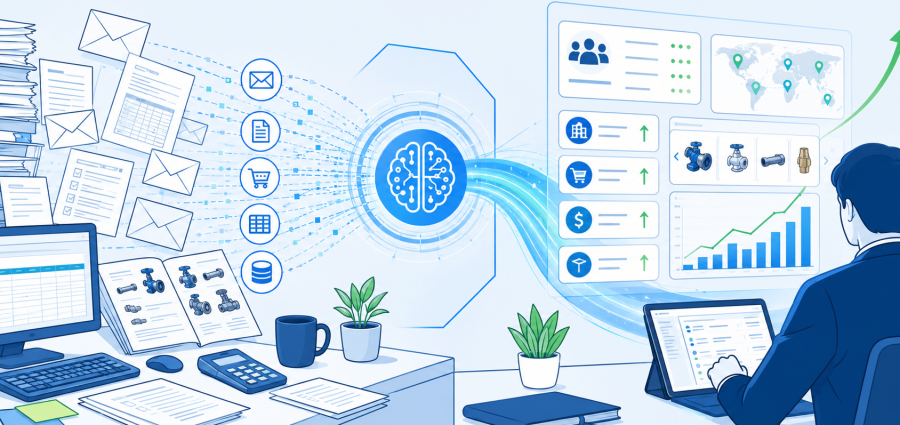
Advances in AI are now making that clerical layer dramatically more automated. For instance, quote and order entry that consumed a rep’s morning can happen in minutes, and the same is happening to the work around it, the catalog content, the status checks, the paperwork that trails every shipment. The hours are coming back. That part is no longer in question.
What fills those hours is not automatic. I’ve seen distributors that can process quotes and orders faster than they ever have, and their team still isn’t making proactive calls. The reps still don’t know which of their hundred accounts to dial, what to sell those accounts, or what to follow up on for the highest revenue impact. The capacity got created and never got pointed anywhere, so it leaked back into the inbox.
The direction has to come from management, and the raw material for it already exists: the order history, the buying patterns, the gap between what a customer buys from you and what similar customers buy. The distributors getting this right treat a freed hour the way they treat inventory, as an asset that isn’t allowed to sit. The rep starts the morning with a short list of accounts worth calling and a reason for each: a reorder gone overdue, a product the account should be carrying, a price worth revisiting before the contract renews. The reactive order-taker becomes a proactive order-maker.
This is the bet the biggest players are making. Amazon’s edge was never a fast checkout. It was the engine that knew what to put in front of you next to increase your order value. That capability used to take a data-science team and a multi-year build, which is why only the giants had it. AI has democratized it and put it within reach of a regional distributor.
Automation of every kind is coming to distribution either way, and before long none of it will set anyone apart. Capacity will be the one thing every operation has more of. The advantage goes to the leaders who decide, ahead of time and on purpose, where those hours land: which accounts, which products, which conversations. The distributors who get that right won’t pay skilled people to react all day. They’ll give them the time, and the direction, to go after the order that was never going to call on its own.
Related Posts
-

Proton.ai’s new agentic system converts customer emails, spreadsheets, PDFs and spoken requests into draft quotes…
-

This category can only be viewed by members. To view this category, sign up by…
-

Proton.ai launched an AI-powered “industry cloud” platform that unifies CRM, PIM, eCommerce and order automation…