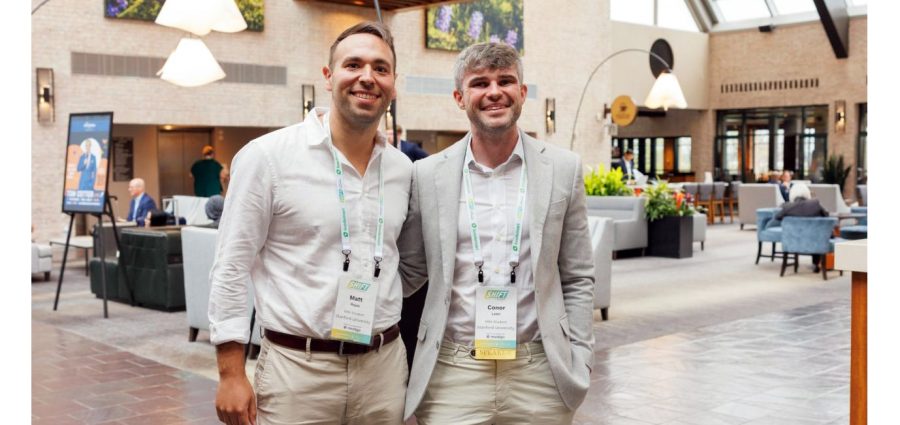
Lead photo: Stanford MBA candidates Matt Rojas (left) and Conor Leen (right) seen at MDM’s 2025 SHIFT Conference, held May 13-15 in Denver, CO.
When Stanford MBA candidates Conor Leen and Matt Rojas set out to choose a research focus for their two-year graduate program, they deliberately looked beyond Silicon Valley’s typical obsession with software startups and consumer tech. Instead, they turned their attention to wholesale distribution — a sprawling, often underappreciated sector that sits at the heart of the global economy.
“We knew this was a massive industry that was fundamental to the way the world works,” recalled Rojas. “But when we looked around the room at Stanford, everybody was excited about the big-name tech companies in the news. Nobody really understood industries like distribution in the way that we thought they should.”
In the Store: MDM’s 2025 Economic Outlook Report (Premium access)
What followed was an ambitious research project that would span two years, involve more than 200 interviews with distribution executives, technology vendors, trade associations and industry media, culminating in original experimentation with AI applications such as demand forecasting. Their findings, summarized in this September MDM article, challenge assumptions about distributors’ appetite for innovation and highlight the sector’s readiness for AI adoption.
For Leen and Rojas — both Knight-Hennessy Scholars with backgrounds in consulting and technology at firms such as McKinsey, Google, PayPal and Accenture — the project became both an academic pursuit and a career-defining experience.
Why Distribution?
The pair’s decision to study distribution was rooted in both personal and professional motivations. Rojas’ father made a career in construction and building materials. Leen had grown up in Ireland surrounded by family connections to small businesses. Together, they saw distribution as a natural intersection between their backgrounds and their belief in the importance of “massive fundamental industries.”
Reflecting on the completed project, the duo told MDM that their biggest surprise from the experience was how open the industry’s business leaders were to being part of the study.

“What drew us in was both the impact and the openness of the industry,” Leen explained. “We had classmates doing research on finance and consulting who struggled to get anyone to talk to them. Meanwhile, our problem was finding enough hours in the week to keep up with all the executives who were willing to engage with us.”
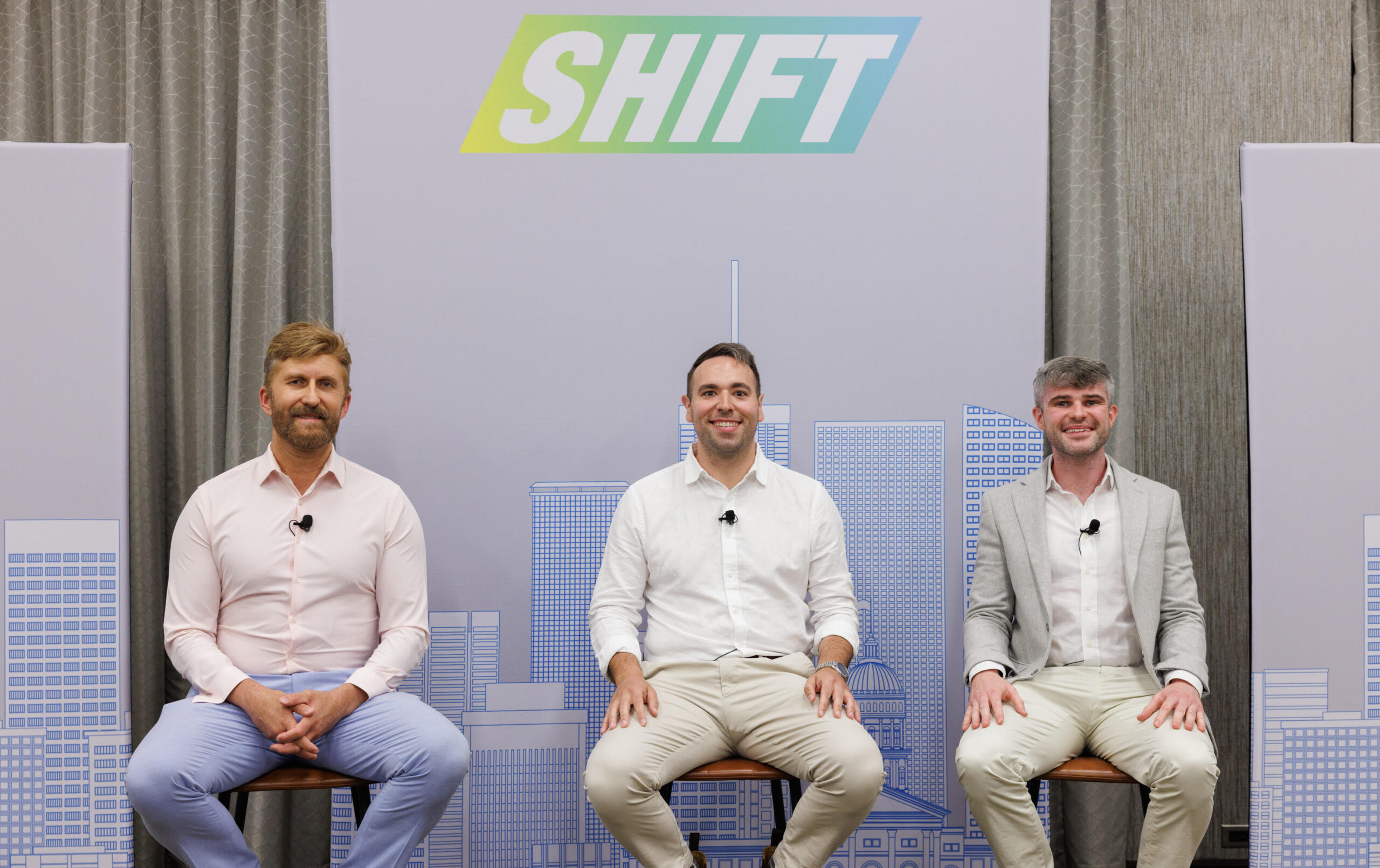
That generosity, they realized, wasn’t just a pleasant surprise — it was a defining feature of the industry’s collaborative culture. At events such as MDM’s 2024 and 2025 SHIFT conferences in Denver and NAW’s Innovators Summits, distributors routinely introduced Leen and Rojas to peers, redirected them to subject matter experts and asked probing questions about their AI experiments.
“The sense of curiosity really impressed us,” Leen said. “People wanted to know what classes we were taking at Stanford, what tools we used at PayPal or Google, how data analysis really works. It completely shattered the stereotype of distribution as a ‘legacy’ industry.”
Other Surprises Along the Way
Leen and Rojas admit they began their research with a few assumptions — many of which turned out to be wrong.

One early belief was that distributors would be hesitant to adopt technology. “We sort of had this image of someone saying, ‘I’ve always done it this way, so why change?’” Rojas said. “Instead, we found the opposite. Almost every distributor we spoke with was forward-thinking, excited about the future and eager to use technology to do an even better job for their customers.”
Another surprise was around data quality. The conventional wisdom is that AI requires vast amounts of clean, structured data — something many outsiders assume distributors lack. But when Leen and Rojas ran actual experiments with purchasing and sales datasets, they discovered the situation was far better than most executives realized.
“Executives would tell us, ‘Our data is a mess,’” Rojas noted. “But when we analyzed it, it was essentially fine. We were able to show them that they could start on AI initiatives today — they didn’t need to wait for some massive data lake project.”
Leen added that the diversity across distribution verticals was another key learning. “Going in, we thought of distribution as one industry. But an HVAC distributor facing the A2L refrigerant transition operates in a very different reality than, say, an electrical or plumbing distributor. A one-size-fits-all software solution simply doesn’t work.”
Running the Numbers
The duo’s most tangible contribution came through their hands-on application of machine learning models to real distributor data. Working with partners in their second year, they built demand forecasting models that compared algorithmic predictions against actual purchasing decisions.
“The results were amazing,” Leen said. “We were able to reduce inventory by 30 to 40% while maintaining, and in some cases increasing, service levels.”
That outcome aligns with recommendations from industry leaders. At NAW’s 2025 Innovators Summit, held Sept. 15-17 in Austin, TX, UPS CEO Carol Tomé identified demand forecasting as one of the most transformational areas for distributors to invest in. For Leen and Rojas, it confirmed that their applied research could move beyond theory and deliver measurable ROI.
Other areas they identified as ripe for AI include pricing optimization and route planning — both of which combine readily available operational data with advanced analytics to create competitive advantage.
People First, Technology Second
Despite their enthusiasm for AI, both scholars emphasized that distribution will remain a human-first industry.
“There’s a narrative in other sectors about technology replacing people, reducing headcount, automating away entire roles,” Leen said. “We’ve never once heard that in distribution. Instead, the conversation is about how technology can take away repetitive tasks and free people to focus on strategic work.”
That balance — between leveraging technology and empowering people — is where they see the greatest potential for transformation. Distributors, they argue, don’t want AI just to feel like they’re innovative or from a fear of missing out while watching what others are doing; they want tools that help sales teams deepen relationships, purchasing managers anticipate shifts in demand and executives make smarter strategic bets.
A New Generation Enters Distribution
To a large extent, distribution has been a career path inherited through family ties. Many of today’s industry leaders are Baby Boomers who entered the field because their parents worked in it. But Leen and Rojas represent a new wave of talent entering from outside the traditional pipeline.
“Connor and I just want to work on things that matter,” Rojas said. “Distribution was at the top of the list. It’s the lifeblood of the economy. Everything we have is because of distribution. If you’re young, hungry and want to make a difference, distribution is the place for you.”
Their unconventional entry also underscores how the industry can attract bright minds who might otherwise default to careers in finance, consulting or consumer tech. For them, the warm welcome from executives and associations reinforced that distribution is not only critical, but also accessible.
Looking Ahead
Now, as their MBA program concludes, Leen and Rojas are deciding how to translate their research into long-term impact while determining how to add as much value as possible to the industry.
“We want to match our skills with the areas where distributors need the most help,” Leen said. “That could be demand forecasting, pricing, or route optimization. But at a high level, it will definitely be technology, AI and machine learning.”
In the short term, they’ve positioned themselves as open resources. “While we figure out what’s next, we’d love to offer ourselves as AI consultants to distributors,” Leen said. “If anyone has questions about what we’ve researched, we’re happy to be that resource. The curiosity we’ve seen from the industry has been inspiring.”
For Rojas, the motivation remains simple: impact. “You only have one life, and time is precious,” he reflected. “Distribution matters so much, and there’s so much opportunity to make a difference here.”
The Executive Takeaway
For distribution leaders, the research project offers two powerful lessons. First, the industry is far more ready for AI than many assume. Data quality, executive openness and cultural curiosity create fertile ground for experimentation. Second, AI should be framed not as a replacement for people, but as a partner that can help distributors meet rising complexity and customer expectations.
As black-swan events continue to disrupt supply chains at an alarming pace, the ability to forecast, adapt and optimize becomes a competitive necessity. And as Leen and Rojas’ work demonstrates, distributors don’t need to wait years for transformation — they can start today, leveraging the data and tools already at their fingertips.
The journey of these two Stanford MBAs highlights something bigger as well: the potential to attract new generations of talent to a sector that rarely makes business school headlines, but underpins every sector of the economy.
“Distribution reminds us of our families back home,” Leen said. “It’s inspiring to play a part in such a fundamental industry to this country’s economy.”
For executives charting the future of their companies, that passion and perspective may be as valuable as the algorithms themselves.
Related Posts
-

The new facility will allow White Cap to simplify its operations and place its broad…
-

First Supply's new distribution center marks a milestone in the company’s ongoing investment in technology,…
-

Industrial supply distributor Turner Supply will purchase assets of Benchmark Industrial Supply in boost to…