Information technology is constantly evolving. The way we employ technology is a response to operating in a competitive landscape. Companies that are faster to adopt new technology can gain an advantage before others in the industry can close that gap. But by jumping ahead to the next generation, laggards can also easily become leaders. Knowing when and how far to jump falls on the shoulders of leadership teams.
Artificial intelligence, the newest tool in the IT world, is enabling the latest technological evolutions. Adopting AI in isolation provides little competitive advantage, but using AI strategically to power your next generation of business processes could put you ahead of your competition.
Software providers targeting the supply chain are now integrating AI into their latest product offerings. There are also examples of startups looking to disrupt the status quo with new AI-first solutions. Navigating this fast-changing environment requires discipline and a focus on what matters to your customers.
There are many stages in supply chain management that can benefit from new technologies. Every process must add value in distribution, and the correct application of AI provides that value.
From Hype to Adoption: Benchmarking 3 Years of AI Progress in Distribution – July 16
Using AI to Improve Distribution
Electronic component distribution encompasses a range of logistical activities, including sourcing, transportation, verification of parts, provision of technical support to customers, supply chain management and delivery. There are many other aspects to a successful distribution business, including (and most importantly) supplier partner relationships. All facets of the business embody tasks where AI can have a positive impact.
Inspecting parts as they arrive at a distribution center provides the first quality assurance measure. Visual inspection of containers and individual packaging is common. Operatives look for damage or signs of tampering. Using AI, those inspections happen faster and, subsequently, can be applied more comprehensively. Expert systems can be employed to examine individual components as needed. This level of inspection requires specialist equipment and highly trained operatives, making it difficult to scale. AI provides the scalability needed.
Technical support is often the first touch a customer has with a distribution partner. This may be as simple as navigating a website for a data sheet or reaching out for more detailed information. Design assistance is a crucial part of demand creation for specialist distributors.
Using AI as a design assistant is gaining traction in the electronics industry. Technologies like retrieval augmented generation (RAG) can be used to examine hundreds of data sheets in seconds. Finding and presenting the right information faster enables engineers to support more customers with more targeted results.
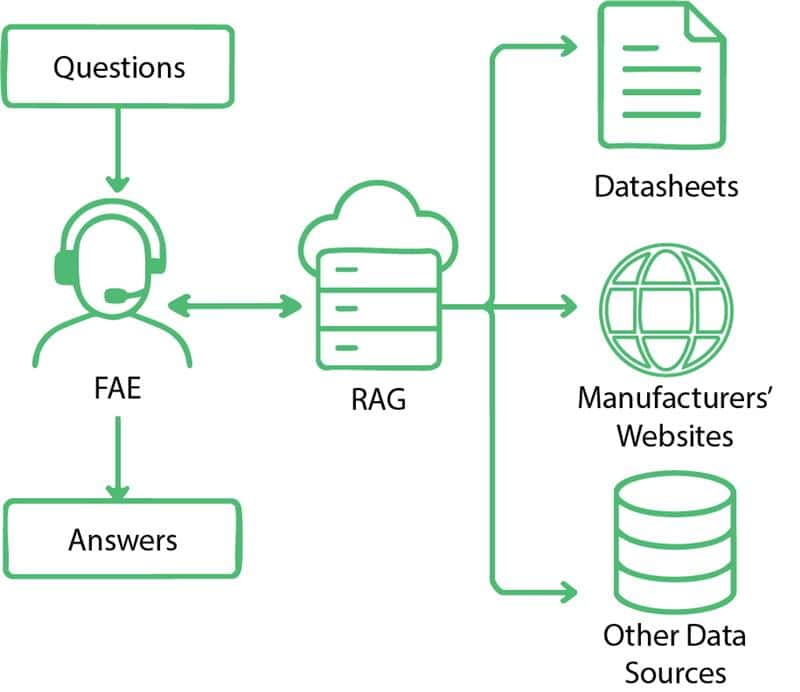
A key enabler here is that RAG can consult more than one type of document with the same query. Contextually, AI can provide advice from a technical perspective on the latest design data while consulting regulatory requirements at the same time. The query could even trigger a system to find errata for the device of interest and provide known workarounds.
Census Data: AI, Robotics Haven’t Taken Away Jobs – Sept. 18
AI in the Supply Chain
At a high level, there are three key stages in the supply chain: planning, inventory management and fulfilment. AI is being used across all these stages. Let’s take a closer look at planning.
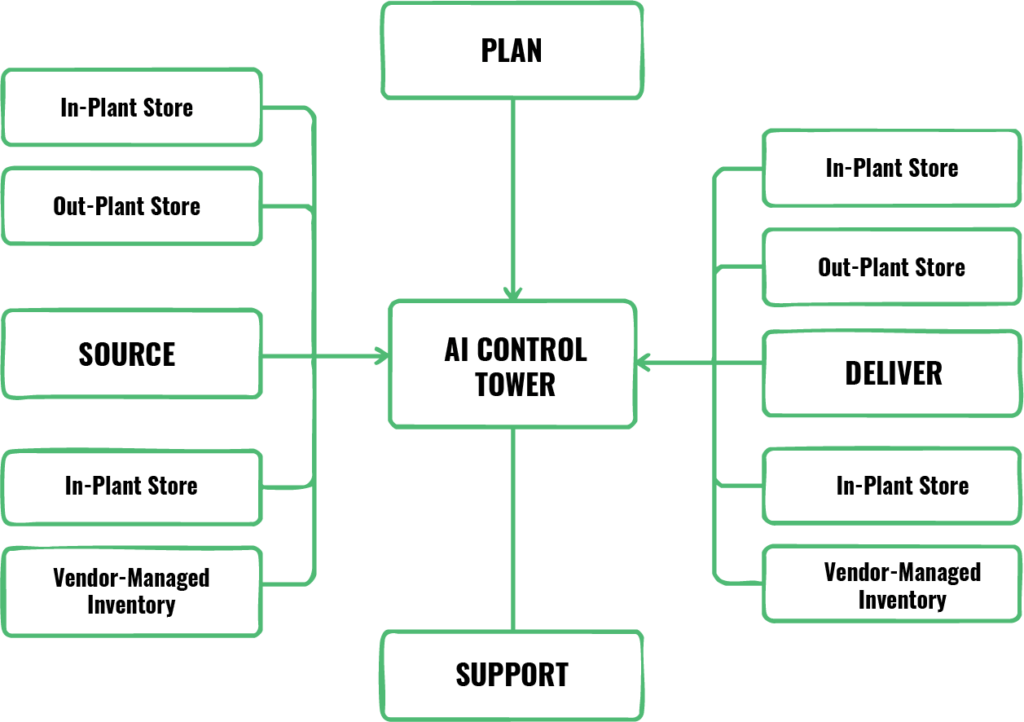
Avnet, for example, follows the SCOR (supply chain operations reference) model. This can be broken down further into plan, source, transform (make), order and fulfil (deliver), return and orchestrate. Planning involves assessing demand and supply on a per-customer basis, taking into account the overall business context. These are constantly changing landscapes that have complex interdependencies. Using AI here enables faster and more efficient assessments to be made.
The source management process is closely associated with planning. Sourcing involves the procurement of raw goods to fulfil customer demand. Again, operating in a global market with multiple suppliers makes this a complex and data-heavy process. This is another example of where AI can be used to augment workers dealing with many moving parts.
The order and fulfil processes (previously referred to as Deliver before SCOR Digital Standard) relate to inventory management. Avnet provides flexible services, including in-plant stores, out-plant stores and vendor-managed inventory. What is common throughout these is the need to understand where and when inventory is consumed. AI provides deeper insights into these processes. Coupling them with other processes, such as planning, offers the ability to improve inventory management, ensuring that production lines never stall.
Integrating AI into the Flow
Supply chain management is already complex, and Avnet has spent over 100 years becoming a recognized authority in its field. The potential for AI to disrupt the supply chain is extremely real. Providing supply chain services in the post-AI future needs to embrace that change while applying decades of experience and the expertise of its people.
The business continuum has a double-edged sword. Maintaining business systems that ‘work’ is risk-averse but can set the pace of change in an organization. That pace may not match what’s going on in the wider industry.
Introducing new technologies (like AI) can have a massively positive impact. They can change the competitive nature of a business by displacing inefficiency. Knowing what systems to change is the role of management.
Avnet has developed an AI governance framework that will see the phased and responsible integration of AI across the organization. That process is underway and its people are at the heart of the transformation.
Related Posts
-

The MRO supplies distributor promoted from within for its supply chain VP and northeast customer…
-

Epicor launched its new AI-driven tools to help businesses boost performance and quicken decision making…
-

Essendant partnered with UPS company Roadie to expand last-mile delivery through local driver networks.